Correct Option
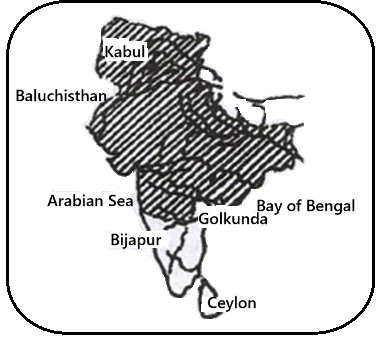
The shaded area on the map illustrates the Mughal Empire at a significant point of territorial consolidation and administrative reach, which is characteristic of the reign of Shahjahan (1628-1658).
- Under Shahjahan, the empire extended from Kabul and Baluchistan in the northwest to Bengal in the east, and substantially into the Deccan.
- Key expansions and consolidations during his rule include the annexation of Baglana and Bundelkhand, which strengthened Mughal authority over Rajput territories.
- His Deccan campaigns led to the annexation of Ahmadnagar and the establishment of tributary relations with Bijapur and Golconda, bringing a large portion of the Deccan under Mughal influence or direct control.
- This period is widely recognized for the empire's stability, economic prosperity, and architectural achievements, reflecting a vast and well-administered territorial domain. The map accurately represents this extent, prior to the further, but often contested, expansions into the extreme south under Aurangzeb.
Incorrect Options
- Alauddin Khalji (1296-1316): His empire, part of the Delhi Sultanate, was primarily centered in North India. While his military expeditions reached the Deccan, these campaigns typically resulted in the establishment of tributary states rather than the direct and consolidated annexation of the scale depicted on the map.
- Mohammad Tughlaq (1325-1351): Although he attempted to extend the Delhi Sultanate's influence into the Deccan and briefly shifted his capital to Daulatabad, his reign was marked by ambitious but often problematic administrative policies and widespread revolts. His territorial control, particularly in distant regions, was frequently unstable and temporary, not representing the consolidated empire shown.
- Aurangzeb (1658-1707): Aurangzeb expanded the Mughal Empire to its largest geographical extent, especially through prolonged campaigns in the Deccan and further into South India. However, this extensive expansion was often characterized by continuous warfare, administrative strain, and the emergence of significant resistance, which contributed to the empire's eventual decline. The map depicts a more consolidated and stable empire, which aligns better with Shahjahan's reign before the later, more contested, and expansive phase under Aurangzeb.