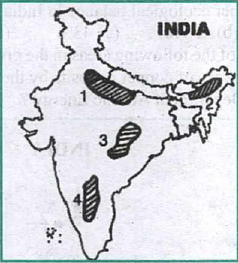
Correct Option (c)
Region 3 on the map represents parts of central India, encompassing areas of Madhya Pradesh, Chhattisgarh, and Jharkhand. This region is characterized by the dominance of Sal (Shorea robusta) forests. In 1997, these Sal forests experienced a significant epidemic caused by leaf-eating insects, primarily from the Lepidoptera order. This infestation led to extensive defoliation, resulting in the drying and destruction of large forest patches, causing ecological stress and impacting local forest-dependent communities.
Incorrect Options:
- Option (a) Teak forests of 3 and 4: Teak (Tectona grandis) is predominantly found in region 4, which corresponds to the Western Ghats, rather than region 3. There were no widespread reports of a serious epidemic affecting teak forests in either region during 1997.
- Option (b) Oak forests of 1 and Sal forests of 2: Oak forests are characteristic of the Himalayan region (represented by 1). While Sal forests are present in parts of India, region 2 is generally associated with moist deciduous forest types. No significant epidemic affecting oak forests in region 1 or Sal forests in region 2 was reported in 1997.
- Option (d) Sandalwood forests of 4: Sandalwood (Santalum album) is native to southern India, particularly Karnataka and Tamil Nadu, which aligns with parts of region 4. However, no specific widespread epidemic threatening sandalwood forests was reported in 1997.