Correct Option
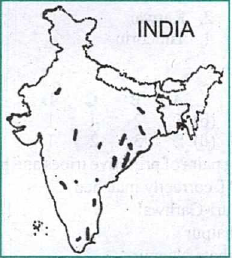
The black marks on the map indicate the distribution of mica, a non-metallic mineral. Mica is valued for its insulating properties, heat resistance, and transparency, making it crucial in the electrical and electronic industries, as well as in paints and cosmetics.
Major mica-producing regions in India, aligning with the map's markings, include:
- Jharkhand (e.g., Koderma, Giridih)
- Bihar (e.g., Gaya, Nawada)
- Rajasthan (e.g., Ajmer, Bhilwara, Udaipur)
- Andhra Pradesh (e.g., Nellore district)
- Telangana (e.g., Warangal belt)
These regions collectively form the principal mica belts of India.
Incorrect Options
(a) Asbestos: While found in parts of Rajasthan and Andhra Pradesh, its distribution is not as extensive or clustered in the specific pattern depicted on the map.
(b) Gypsum: The primary deposits of gypsum in India are concentrated in Rajasthan (e.g., Bikaner, Barmer, Jaisalmer), which does not match the broader distribution shown across multiple states on the map.
(c) Limestone: Limestone deposits are widespread across various states in India. However, the specific clusters marked on the map do not correspond to the predominant limestone mining regions or its general distribution pattern, which differs from the distinct mica belts.