Statistics & Applications PYQ — Page 6
CUET UG Mathematics — Statistics & Applications previous year questions with solutions.
All Statistics & Applications Questions (254)
Ram invested Rs.20,000 in a mutual fund in the year 2012. The value of the mutual fund increased to Rs.32,000 in the year 2017, then the compound annual growth rate of his investment is (Given that $(1.6)^{\frac{1}{5}} = 1.098$)
Ram wishes to purchase a house for ₹ 15,00,000 and made a down payment of ₹ 5,00,000. If he can amortize the balance at 9% per annum compounded monthly for 25 years, then his EMI is: [Given $(1.0075)^{300} ≈ 9.41$]
For predicting the straight line trend in the sales of cars (in thousands) on the basis of 5 consecutive years' data, the company makes use of a 3-year moving averages method. If the sales of the cars for respective years are 15, 24, 18, 33 and 42 respectively, then which of the following averages will not be computed?
A machine costing ₹ 36000 has an effective life of 5 years with scrap value of ₹ 5000 following a linear method of depreciation. Which of the following statements are **correct**? (A) The value of the machine after 1 year is ₹ 31000 (B) The value of the machine after 2 years is ₹ 23600 (C) The value of the machine after 3 years is ₹ 18400 (D) The value of the machine after 4 years is ₹ 11200 Choose the **correct** answer from the options given below:
A company is shut down due to unavailability of electricity due to non payment of electricity Bill because of some unavoidable circumstances. Under which component of time series does this situation fall?
Which of the following are the components of a time series? (A) Cyclic component (B) Regular component (C) Seasonal component (D) Economic component Choose the **correct** answer from the options given below:
Which of the following are correct about the Sinking Fund? (A) It is a fixed term account. (B) It is a set-up for a particular upcoming expense. (C) A fixed amount at regular intervals is deposited in the Sinking Fund. (D) It can be used in any emergency. Choose the correct answer from the options given below:
In a survey question for a sample of 250 individuals, 120 persons gave response 'yes', 80 persons gave response 'no' and 50 gave 'no response'. The point estimate of the proportion in the population who responded 'yes' is:
Data available for profit (₹ Thousands) of a company as | Year | 2004 | 2005 | 2006 | 2007 | 2008 | 2009 | 2010 | |---|---|---|---|---|---|---|---| | Profit(₹ 000) | 114 | 130 | 126 | 144 | 138 | 156 | 164 | Based on the above data using least square method the trend value for the year '2007' is
The amount should be deposited at the end of every 6 months to accumulate Rs.50,000 in 8 years if money is worth 6% p.a. compounded semiannually, is: [Given $(1.03)^{16} = 1.6047$]
A charity organization has a fund of Rs.2,00000 to provide annual grants to students. The grant amount each year is Rs.15,000. The fund earns an interest rate of r% per annum. If the interest earned is used entirely to provide the grants, then the annual interest rate r is:
The fund created to accumulate money over the years to discharge a future obligation is known as:
The following data shows the percentage of urban Indian households who have a high speed 5G internet connection: | Year (x) | 2020 | 2021 | 2022 | 2023 | 2024 | |---|---|---|---|---|---| | Urban house hold (y) | 9% | 18% | 21% | 29% | 38% | If a straight line trend by the method of least square for the above data is $y = 23 + 6.9(x - 2022)$, then the forecast for the year 2025 is:
Mr. X wishes to purchase a flat for Rs. 44,65,000 with a down payment of Rs. 10,00,000 and balance in equated monthly installments (EMI) for 25 years. If the bank charges 6 % per annum compounded monthly, the EMI is: [Given: $(1.005)^{300} =4.4650$]
If $x_1, x_2, x_3, ..., x_n$ are n observations in a sample then which of following is/are TRUE? (A) The mean $\bar{x}$ has n degree of freedom (B) The mean $\bar{x}$ has (n-1) degree of freedom (C) The standard deviation of the sample has (n-1) degree of freedom (D) The standard deviation of the sample has n degree of freedom Choose the correct answer from the options given below:
An annuity in which the periodic payment begin on a fixed date and continue forever is called
The cost of a property appreciates by 10% of the previous month every month. If in end march 2024 it was ₹ 13.31 lakh, when was it ₹ 10 lakh?
Assuming the same rate of change continues for the following data: | Year (x) | 2019 | 2020 | 2021 | 2022 | 2023 | |---|---|---|---|---|---| | Profit(in Percentage) (y) | 38 | 40 | 65 | 72 | 69 | The equation of the straight line trend using the least square method is:
A company has been producing steel tubes of mean inner diameter of 2 cm. A sample of 10 tubes gives an inner diameter of 2.01 cm and a variance of 0.0004 cm². The value of test statistic is :
As per the graph given below: 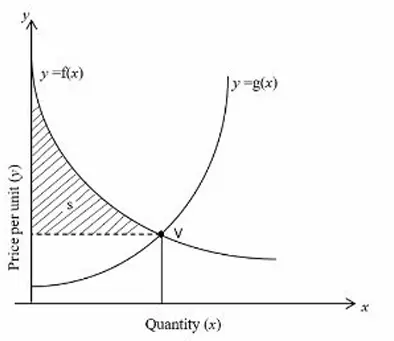 Match List-I with List-II | List-I | List-II | |---|---| | (Function/Area/point) | (Representation) | | (A) Consumers Surplus | (I) y=g(x) | | (B) Supply function | (II) v | | (C) Demand function | (III) s | | (D) Equilibrium point | (IV) y=f(x) | Choose the correct answer from the options given below:
If we reject the null hypothesis when it is true, we might be making
At what rate of interest will the present value of a perpetuity of Rs. 1000 payable at the end of every six months be Rs. 20000?
In the below mentioned demand supply curve , identify the equilibrium point 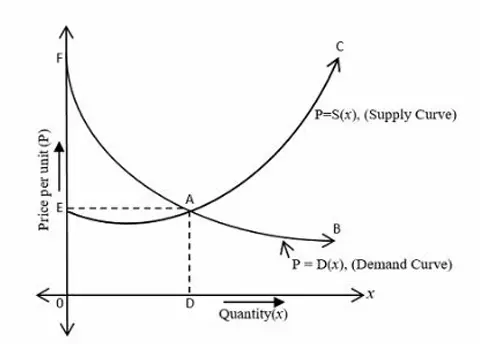
A sofa set costing ₹ 36000 has a useful life of 10 years. If the annual depreciation is ₹ 3000, then the scrap value by linear method is: