CUET UG 2025 — Statistics & Applications
Mathematics Statistics & Applications questions from CUET UG 2025.
Other Years
247 Statistics & Applications Questions from 2025
The effective rate equivalent to a nominal rate of 12% compounded quarterly is: (Given $(1.03)^4=1.1256$)
The rise in prices before Diwali is an example of
Mr. X purchased a house from a company for ₹ 7,00,000 and made a down payment of ₹ 1,50,000. He repays the balance in 25 years by equal monthly installments at 9 % per annum compounded monthly. The equated monthly installment (EMI) is: [Given that : (1.0075)⁻³⁰⁰ = 0.106]
Consider the following hypothesis $H_0: \mu = 315$ and $H_a: \mu \neq 315$ A sample of 60 provided a sample mean of 324.6. The standard deviation ($\sigma$) is 14 and level of significance $\alpha = 0.05$. Then the confidence interval is: [Given: $Z_{a/2}{\frac{14}{\sqrt60}} = 3.54$]
With reference to sampling, which of the following are correct? (A) Simple random sampling is probability sampling (B) Snow-ball sampling is non-probability sampling (C) Stratified sampling is probability sampling (D) Cluster sampling is non-probability sampling Choose the correct answer from the options given below:
Let us suppose that two independent random samples of sizes $n_1$ and $n_2$ has been drawn from the same normal population then degree of freedom of statistic t-distribution is:
Let $y = 138.86 + 7.64(x - 2021)$ be a straight line of best fit by using least square method to the following data: | Year(x) | 2018 | 2019 | 2020 | 2021 | 2022 | 2023 | 2024 | |---|---|---|---|---|---|---|---| | Profit(y) (in Rs. '000) | 114 | 130 | 126 | 144 | 138 | 156 | 164 | Then the trend value for the year 2024 is:
Which of the following is not correct about the Compound Annual Growth Rate (CAGR)?
Ram had invested Rs. 15,000 in a mutual fund and the value of the investment at the time of redemption was Rs. 25,000. If the compound annual growth rate (CAGR) is 8.88%, then the number of years for which Ram has invested the amount is: [Given: $\log 1.089 \approx 0.0370$ and $\log 1.667 \approx 0.2220$]
Which of the following statements are correct? (A) A fund which is created to accumulate money over the years to discharge a future obligation is called a sinking fund. (B) The amount or future value of perpetuity is well-defined. (C) The sinking fund be used in any emergency. (D) An equated monthly installment is a fixed payment made by a borrower to a lender at a specific date every month to clear off the loan. Choose the correct answer from the options given below:
In the month of January, the number of cases diagnosed of influenza epidemic are given in the following table | Date | 1 | 2 | 3 | 4 | 5 | 6 | 7 | |---|---|---|---|---|---|---|---| | Number of cases | 2 | 0 | 5 | 12 | 20 | 27 | 46 | The 3-day moving averages are:
If the price of a machinery costing ₹ 25000 is expected to have a useful life of 4 years and a scrap value of ₹ 5000. Then the annual depreciation by linear method is:
| Year (x) | 2011 | 2012 | 2013 | 2014 | 2015 | 2016 | 2017 | |---|---|---|---|---|---|---|---| | Sales (in lakh Rs.) (y) | 65 | 68 | 70 | 72 | 75 | 67 | 73 | If $y = 70 + 0.964(x - 2014)$ be a straight line trend fitted by the method of the least squares to the above data, then the trend value for the year 2015 is:
Ram invested Rs.20,000 in a mutual fund in the year 2012. The value of the mutual fund increased to Rs.32,000 in the year 2017, then the compound annual growth rate of his investment is (Given that $(1.6)^{\frac{1}{5}} = 1.098$)
Ram wishes to purchase a house for ₹ 15,00,000 and made a down payment of ₹ 5,00,000. If he can amortize the balance at 9% per annum compounded monthly for 25 years, then his EMI is: [Given $(1.0075)^{300} ≈ 9.41$]
For predicting the straight line trend in the sales of cars (in thousands) on the basis of 5 consecutive years' data, the company makes use of a 3-year moving averages method. If the sales of the cars for respective years are 15, 24, 18, 33 and 42 respectively, then which of the following averages will not be computed?
A machine costing ₹ 36000 has an effective life of 5 years with scrap value of ₹ 5000 following a linear method of depreciation. Which of the following statements are **correct**? (A) The value of the machine after 1 year is ₹ 31000 (B) The value of the machine after 2 years is ₹ 23600 (C) The value of the machine after 3 years is ₹ 18400 (D) The value of the machine after 4 years is ₹ 11200 Choose the **correct** answer from the options given below:
A company is shut down due to unavailability of electricity due to non payment of electricity Bill because of some unavoidable circumstances. Under which component of time series does this situation fall?
Which of the following are the components of a time series? (A) Cyclic component (B) Regular component (C) Seasonal component (D) Economic component Choose the **correct** answer from the options given below:
Which of the following are correct about the Sinking Fund? (A) It is a fixed term account. (B) It is a set-up for a particular upcoming expense. (C) A fixed amount at regular intervals is deposited in the Sinking Fund. (D) It can be used in any emergency. Choose the correct answer from the options given below:
In a survey question for a sample of 250 individuals, 120 persons gave response 'yes', 80 persons gave response 'no' and 50 gave 'no response'. The point estimate of the proportion in the population who responded 'yes' is:
Data available for profit (₹ Thousands) of a company as | Year | 2004 | 2005 | 2006 | 2007 | 2008 | 2009 | 2010 | |---|---|---|---|---|---|---|---| | Profit(₹ 000) | 114 | 130 | 126 | 144 | 138 | 156 | 164 | Based on the above data using least square method the trend value for the year '2007' is
The amount should be deposited at the end of every 6 months to accumulate Rs.50,000 in 8 years if money is worth 6% p.a. compounded semiannually, is: [Given $(1.03)^{16} = 1.6047$]
A charity organization has a fund of Rs.2,00000 to provide annual grants to students. The grant amount each year is Rs.15,000. The fund earns an interest rate of r% per annum. If the interest earned is used entirely to provide the grants, then the annual interest rate r is:
The fund created to accumulate money over the years to discharge a future obligation is known as:
The following data shows the percentage of urban Indian households who have a high speed 5G internet connection: | Year (x) | 2020 | 2021 | 2022 | 2023 | 2024 | |---|---|---|---|---|---| | Urban house hold (y) | 9% | 18% | 21% | 29% | 38% | If a straight line trend by the method of least square for the above data is $y = 23 + 6.9(x - 2022)$, then the forecast for the year 2025 is:
Mr. X wishes to purchase a flat for Rs. 44,65,000 with a down payment of Rs. 10,00,000 and balance in equated monthly installments (EMI) for 25 years. If the bank charges 6 % per annum compounded monthly, the EMI is: [Given: $(1.005)^{300} =4.4650$]
If $x_1, x_2, x_3, ..., x_n$ are n observations in a sample then which of following is/are TRUE? (A) The mean $\bar{x}$ has n degree of freedom (B) The mean $\bar{x}$ has (n-1) degree of freedom (C) The standard deviation of the sample has (n-1) degree of freedom (D) The standard deviation of the sample has n degree of freedom Choose the correct answer from the options given below:
An annuity in which the periodic payment begin on a fixed date and continue forever is called
The cost of a property appreciates by 10% of the previous month every month. If in end march 2024 it was ₹ 13.31 lakh, when was it ₹ 10 lakh?
Assuming the same rate of change continues for the following data: | Year (x) | 2019 | 2020 | 2021 | 2022 | 2023 | |---|---|---|---|---|---| | Profit(in Percentage) (y) | 38 | 40 | 65 | 72 | 69 | The equation of the straight line trend using the least square method is:
A company has been producing steel tubes of mean inner diameter of 2 cm. A sample of 10 tubes gives an inner diameter of 2.01 cm and a variance of 0.0004 cm². The value of test statistic is :
As per the graph given below: 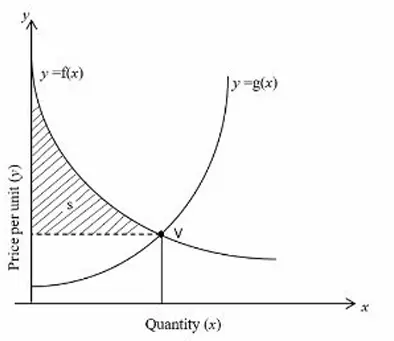 Match List-I with List-II | List-I | List-II | |---|---| | (Function/Area/point) | (Representation) | | (A) Consumers Surplus | (I) y=g(x) | | (B) Supply function | (II) v | | (C) Demand function | (III) s | | (D) Equilibrium point | (IV) y=f(x) | Choose the correct answer from the options given below:
If we reject the null hypothesis when it is true, we might be making
At what rate of interest will the present value of a perpetuity of Rs. 1000 payable at the end of every six months be Rs. 20000?
In the below mentioned demand supply curve , identify the equilibrium point 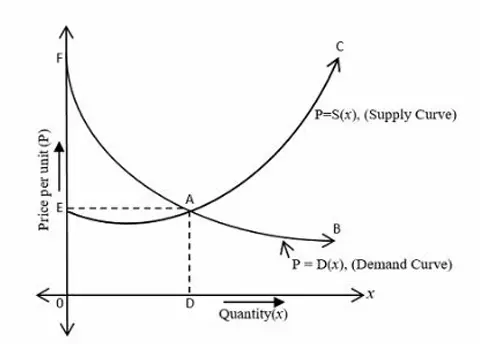
A sofa set costing ₹ 36000 has a useful life of 10 years. If the annual depreciation is ₹ 3000, then the scrap value by linear method is:
Which of the following are normal equations to fit a straight line trend y = a + bx by the method of least squares?
Ajesh purchased a printer ₹ 15,000. The printer is estimated to have a scrap value of ₹ 3,000 after a span of 6 years. Then the book value of the printer at the end of 3 years will be:-
If an investment of Rs. 12000 becomes Rs. 72000 in 4 years, then the compound annual growth rate is:
The following data shows the percentage of rural and urban Indian households who have a high speed internet connection. | Year (x) | Rural Household (y%) | Urban Household (y%) | |---|---|---| | 2020 | 2 | 6 | | 2021 | 3 | 7 | | 2022 | 3 | 9 | | 2023 | 4 | 15 | | 2024 | 5 | 20 | Based on the above data, which of the following statements are correct? (A) A straight line trend by the method of the least squares for rural Indians is $y^t$ = 3.4 + 0.7 (x - 2022) (B) A straight line trend by the method of the least squares for urban Indians is $y^t$ = 11.4 + 4.3 (x - 2022) (C) The forecast for the year 2025 for urban group using the trend equation is 22.2 %. (D) The forecast for the year 2025 for rural group using the trend equation is 5.5 %. Choose the correct answer from the options given below:
Which of the following are correct? (A) The probability curve in t-distribution is symmetric about the line t=0. (B) t-axis is an asymptote of the curve. (C) The variable t of t-distribution ranges from $-\infty$ to $\infty$ (D) As the number of degrees of freedom increases, the t-distribution curve moves closer to the binomial distribution. Choose the correct answer from the options given below:
At what rate of interest will the present value of a perpetuity of Rs. 1000 payable at the end of every six months be Rs. 40000?
The simple random sample consists of six observations: 5, 8, 10, 7, 10, 14. The point estimate of the population mean is:
If 95% confidence interval for the population mean was reported to be 140 to 150 and $\sigma = 25$, then size of the sample used in this study is: [Given: $Z_{0.025} = 1.96$]
If a moneylender charges 'interest' at the rate of 10 rupees per 100 rupees per half year, payable in advance, then the effective rate of interest per annum is
A random sample of 100 individuals provides 25 positive responses. Then the point estimate of the population proportion with "positive" responses is:
Which of the following are correct about t-test statistics? (A) The mean of t-test distribution is 0. (B) It depends on the degrees of freedom. (C) It depends on population standard deviation. (D) With more degrees of freedom, it closely resembles standard normal distribution. Choose the **correct** answer from the options given below:
In a survey for a sample of 300 individuals, 180 persons gave responses 'Yes' and 100 gave responses 'No' and 20 gave "No response". Then point estimate of proposition in the population who responded "Yes" is
A small start-up started making wafers and distributing them to the retailers. After a week, average sales per week were found to be 150 packets. So, to increase the sales, a strategy was used to change the packaging and add a chocolate worth Rs. 5 as a free gift with the pack. After this, a sample of 17 shops was taken, which showed that sales went up with mean 165 and a standard deviation of 25. Check whether the strategy was effective @5%, level of significance ? [Given $ t_{16} (0.05) =2.12$]
In a time series, the variations which occur due to general tendency of the data to increase or decrease over a long term are known as:
Which of the following is correct about the Sinking Fund?
The scrap value of a machine costing ₹ 75,000 after 4 years of use is ₹ 25000. Using straight line method the annual depreciation of the machine is:
The number of years required for a sum of money to get tripple at the effective rate of 4% is : (Given $(1.04)^{28} = 3)$
The value of a depreciable asset at the end of its useful life is called ____.
If $(t_1, y_1), (t_2, y_2), (t_3, y_3), ..., (t_n, y_n)$ denote the time series and $y_t$ are the trend values of the variable y, then $\sum(y - y_t)$, the sum of the deviations of y from their corresponding trend value is equal to:
Let $P, I$ and $n$ be the principal of the loan, the total interest on the principal and number of months in the loan period respectively, then the EMI by Flat Rate Method is:
For the following data: | | Size | Mean | Standard deviation | |---|---|---|---| | Sample 1 | 4 | 40 | 8 | | Sample 2 | 5 | 50 | 10 | The sample statistic t follows t-distribution with 'm' degrees of freedom, then m is equal to
In reference to Inferential Statistics, for 20 degrees of freedom, the least statistical t-value among the given below is:
For the given five values, 3.6, 4.3, 4.3, 3.4, 4.4, the three years moving averages are:
A T.V. panel costing Rs 18000 has a useful life of 12 years. If the annual depreciation is Rs 1000, then its scrap value by linear method is:
In an influenza epidemic, the number of cases diagnosed in a week were as follows: | Day | Monday | Tuesday | Wednesday | Thursday | Friday | Saturday | Sunday | |---|---|---|---|---|---|---|---| | Number of Cases | 10 | 12 | 8 | 16 | 9 | 14 | 4 | The 3-day moving averages are:
The values of '$a$' and '$b$' if the equation of straight line trend by least square method is given by $y = a + bx$ such that $\sum x = 0$, $\sum y = 84$, $\sum xy = 108$, $\sum x^2 = 70$ for 6 observation at are:
A person invested ₹ 10000 in a stock of a company for 6 years. The value of his investment at the end of each year is given in the following table: | 2018 | 2019 | 2020 | 2021 | 2022 | 2023 | |---|---|---|---|---|---| | ₹ 11000 | ₹ 11500 | ₹ 13000 | ₹ 11800 | ₹ 12200 | ₹ 14000 | The compound annual growth rate (CAGR) of his investment is: [Given $(1.4)^{1/6} = 1.058$]
The amount of money needed to ensure for a prize of ₹ 5000 at the begining of each year indefinitely if money is worth 5% compounded annually is:
Match List-I with List-II | List-I | List-II | |---|---| | (A) The measurable characteristic of a population is called | (i) Sample | | (B) The measurable characteristic of a sample is called | (ii) Alternative hypothesis | | (C) A smaller group of a population selected to represent a population is called | (iii) Parameter | | (D) The assumption made opposite to the null hypothesis is called | (iv) Statistic | Choose the correct answer from the options given below:
If $C$ is the original value of the asset, $S$ is the scrap value, n is the useful life of the asset and $D$ is the annual depreciation, then
A person has taken a loan of Rs. 40,000 for 3 months from a lender who has deducted Rs.2,000 as interest at the time of lending. Then the effective rate of interest charged per annum by lender is (given:$(1.0526)^4 = 1.2275):$
At what rate of interest will the present value of a perpetuity of ₹ 500 payable at the end of every 6 months be ₹ 20,000?
Match List-I with List-II | List-I | List-II | |---|---| | Time Series Component | Example | | (A) Secular Variation | (I) Pandemic | | (B) Seasonal Variation | (II) Recession in business | | (C) Cyclic Variation | (III) Monthly sale of woolen cloths | | (D) Irregular variation | (IV) Data regarding National income | Choose the correct answer from the options given below:
The number of letters posted in a certain city on each day for a week is given as follows: 40, 55, 28, 25, 31, 52, 43. Which of the following is not an entry in the three-day moving averages?
Maneesh took a loan of ₹ 9,00,800 from bank at an interest rate of 6% per annum for 10 years. If she has to pay the loan back with the help of equal monthly installments (EMI). Then, the EMI using reduced balance method is (approx): [Given: $(1.005)^{-120}=0.5496$]
Which of the following is correct about the compound annual growth rate?
Match List-I with List-II | List-I | List-II | |---|---| | **Example** | **Time-series component** | | (A) Labour strike | (I) Secular-trend | | (B) Continuous decline in death rate | (II) Seasonal | | (C) Rise in prices before Diwali | (III) Cyclical | | (D) Rise and fall of the share-market | (IV) Irregular | Choose the **correct** answer from the options given below:
What sum of money is needed to invest now, so as to get ₹5000 at the beginning of every month forever, if the money is worth 6% per annum compounded monthly?
On which of the following components, the pattern and behavior of the data in any time series is based? (A). Secular trend component (B). Seasonal component (C). Cyclical component (D). Regular component Choose the correct answer from the options given below:
Mohini purchases a house worth Rs. 50 lakhs and makes a down payment of Rs. 11.2 lakhs. She pays the remaining amount on monthly EMI using a reducing balance method. The bank charges 6% per annum compounded monthly for a tenure of 25 years. Her EMI is: [Given: $(1.005)^{-300} \approx 0.224$]
Ramesh plans to save some amount required after 10 years for higher studies of his son. He expects the cost of these studies to be Rs.1,00,000. How much should he save at the beginning of each year to accumulate this amount at the end of 10 years, if the interest rate is 12% compounded annually. (Given $(1.12)^{11}=3.477$)
Due to which of the following, the irregular variations in a time series are caused: (A) Floods (B) Rise in prices before festivals (C) A fire in a factory (D) Epidemics Choose the **correct** answer from the options given below:
A machine costing Rs.2,00,000 has a useful life of 5 years.The estimated scrap value is Rs.20,000. By using straight line method, the annual depreciation is
A money lender charges Rs10 for Rs100 per month in advance then effective rate of interest per annum charged by money lender is: [given $\left(\frac{10}{9}\right)^{12} \approx 3.541$]
For the given five values, 13, 17, 21, 22, 32; the 3-year moving averages are:
If n is the sample size of the population, then degree of freedom in t-distribution is
The following data are from a simple random sample: $6, 8, 11, 9, 15, 17$, then the point estimate of the population mean is
The sale of ice creams is higher in summer than in winter is an example of
Which one of the following statement is not correct?
Consider the following data: | Year (X) | 2004 | 2005 | 2006 | 2007 | 2008 | 2009 | 2010 | |---|---|---|---|---|---|---|---| | Profit (₹) (y) | 114 | 130 | 126 | 144 | 138 | 156 | 164 | The equation of straight line trend by using least square method is $y = 138.86 + 7.64 (x - 2007)$, then the trend values for the year 2004 is
If three year moving averages for five data items given by 16, 18, 20, 10, 21 are $x$, $y$ and $z$ respectively, then:
Anush takes a loan of ₹ 150000 @ 16% annual interest for 5 years. His EMI (Equally Monthly Installment) on monthly basis under flat rate system is:
Match List-I with List-II | List-I | List-II | |---|---| | Terms | definition | | (A) POPULATION | (I) Measurable characteristics of the population such as mean, variance, standard deviation etc. of population | | (B) SAMPLE | (II) Measurable characteristics of the sample such as mean, variance, standard deviation etc. of a sample | | (C) PARAMETER | (III) Finite set of statistical individuals drawn from a population for investigation. | | (D) STATISTIC | (IV) Collection of objects having the same characteristics | Choose the correct answer from the options given below:
Consider the following data | Year (x) | 2010 | 2011 | 2012 | 2013 | 2014 | |---|---|---|---|---|---| | Profit (Rs. in thousands) (y) | 10 | 12 | 14 | 16 | 13 | The equation of straight line trend by method of least square for the above data is given by
Mr. Jayesh plans to save amount for higher studies of his daughter, required after 10 years. How much amount should he save at the beginning of each year to accumulate Rs.1,00,000 at the end of 10 years. If rate of interest is 12% compounded annually? [Given $(1.12)^{11} = 3.5$]
Consider the following hypothesis test. $H_0: \mu \leq 12$ $H_a: \mu > 12$ If a sample of 25 is taken with sample mean 15 and a sample standard deviation of 6, then the value of t-test statistic is:
Match List-I with List-II | List-I | List-II | |---|---| | (Example) | (Components of Time Series) | | (A) Lockouts and strikes | (I) Secular trend | | (B) Rise and fall of share market | (II) Seasonal trend | | (C) Continuous decline in death rate | (III) Irregular trend | | (D) The rise in prices before Diwali | (IV) Cyclical trend | Choose the correct answer from the options given below:
For the given values 27, 35, 42, 45, 51, 34, 43; the five yearly moving averages are:-
Rakshita plans to buy a house for Rs.1,00,00,000 with down payment of 20% of the value of house paid by her mother, Rest of the amount she wishes to pay in 25 years by equal monthly installment at an interest of 9% per annum compounded monthly. Then the EMI paid by her is: (Given $(1.0075)^{300}$ = 9 )
Consider the following hypothesis test:- H₀: μ = 20 H₁: μ ≠ 20 A sample of 40 provided a sample mean of 19. The standard deviation is 3. Then the value of the t-test statistic is:
A man takes a personal loan worth Rs.3,00,000 at an interest rate of 6% per annum compounded monthly to be repaid by equal monthly installments in 3 years, then the EMI using flat rate method will be:-
If an investment value get doubled in 10 years then its compound annual growth rate (CAGR) is: (Given $2^{1/10} = 1.0729$)
If a 99% confidence interval states that the population mean is greater than 100 and less than 400. Then the sample mean and margin of error respectively are:
In reference to Inferential Statistics, if $\bar{x}$ is a sample mean of random data $\{x_i\}_{i=1}^n$ and $n$ is the sample size, then the formula $\frac{1}{n-1}\sum_{i=0}^n(x_i - \bar{x})^2$ represents
At what rate of interest will the present value of a perpetuity of ₹ 600 payable at the end of every 3 months be ₹ 18,000?
For the given 5 values, 15, 18, 21, 27,39; the three year moving averages are:
Which of the following are types of "statistical inferences"? (A) Point estimation (B) Interval estimation (C) Marginal estimation (D) Hypothesis testing Choose the correct answer from the options given below:
A machine costing ₹ 3,00,000 will have its scrap value of ₹ 50,000. The company at present plans to put ₹ 36,650 per annum at the end of each year in a sinking fund at the rate 5% per annum for the replacement of the machine after its useful life. Suppose the new machine will cost ₹ 4,00,000 at that time, then the useful life (approx.) of the machine is : [Given: $(1.4775)^{1/8} = 1.05$]
Shyam invested ₹ 2,00,000 in 2019 for 5 years. If the compound annual growth rate (CAGR) for his investment is 10 %, then the end balance of his investment is:
Components of Time Series are (A) Secular Trend Component (B) Seasonal Component (C) Moving Average Component (D) Cyclical Component Choose the **correct** answer from the options given below:
Based on the data available for the production ($y_i$ in thousand tons) of a cloth factory for 7 years ($x_i$) using the method of least squares, the straight line trend is given by $y - a + bx$ with $\sum y_i = 608, \sum x_i = 0, \sum x_iy_i = 116, \sum x_i^2 = 28$. Then, the increase in production per year is:
The marks obtained by five students in a test of Applied Mathematics carrying 100 marks are 49, 58, 67, 92, 99. Then the point estimate of the population mean is
The first m-year moving average of the data 10, 20, 30, 40, 50 is 30. The value of m is
Which of the following statements are correct? (A) The method of least squares determines the position of the trend line of the given time series. (B) The trend line is called the line of best fit. (C) The line of best fit is a line in which the sum of deviations of the actual values of the variable from their corresponding trend value is always positive. (D) The normal equations of the trend line $y = a + bx$ are $\sum y = na + b \sum x$ and $\sum xy = a \sum x + b \sum x^2$, where $n$ is the numbers of observations. Choose the *correct* answer from the options given below:
In which of the following, the time series may show the gradual shifts to relatively higher or lower values over a long period of time?
If the money is worth 8% per annum compounded semi-annually, then the present value of a sequence of payments of ₹1,000 made at the end of every 6 months and continuing forever, is:
Which of the following statements are TRUE? (A) The variable t of t-distribution ranges from $-\infty$ to $\infty$. (B) The probability curve of the t-distribution is symmetric about the line $t=0$ (C) The variance of the t-distribution is greater than one. (D) As the number of degrees of freedom decreases, the t-distribution curve moves closer to the standard normal probability curve. Choose the correct answer from the options given below:
If $(t_1, y_1)$, $(t_2, y_2)$,......,$(t_n, y_n)$ denote the time series and $y_t$ are the trend values of the variables $y$, then
Choose the correct statement about Sinking Fund?
The following data are from a random sample: 5,8,10,7,10,14, then the point estimate of the population standard deviation is
If $r_{eff}$ = effective rate of interest, $r$ = nominal rate of interest and $m$ = number of conversion periods per year, the relationship between nominal rate and effective rate of interest is:
The term of the perpetuity is
Anisha invested Rs.20000 in a mutual fund in the year 2016, which increased to Rs.36000 in the year 2024. The percentage compounded annual growth rate(CAGR) of her investment is: (Given: $(1.8)^{1/8} = 1.076$)
If CAGR stands for Compound Annual Growth Rate, F.V stands for final value of an investment, P.V stands for present value of an investment and n is the number of years then
Consider the following test: H₀: μ ≤ 12 H₁: μ > 12 A sample of 36 provided a sample mean $\bar{x} = 16$ and a sample standard deviation S=4.2. Then the value of the t- test statistic is:
Which of the following is not correct about the Central Limit Theorem?
In reference to the Inferential Statistics, which of the following is NOT correct?
Match List-I with List-II | List-I | List-II | |---|---| | (A) A fire in a factory causing production delay for some time is | (I) Secular trend | | (B) Technological progress is | (II) Seasonal trend | | (C) The rise in prices before big festival is example of | (III) Irregular trend | | (D) Rise and fall of share market is | (IV) Cyclic trend | Choose the correct answer from the options given below:
If the following data is obtained from a simple random sample: 6, 7, 9, 10, 11, 17 Then the point estimate of population standard deviation is:
The five month moving averages for the following data | Month ($r^{th}$) | 43 | 44 | 45 | 46 | 47 | 48 | 49 | 50 | 51 | |---|---|---|---|---|---|---|---|---|---| | Actual Demand | 105 | 106 | 110 | 110 | 114 | 121 | 130 | 128 | 137 | is:
Consider the following hypothesis test: $H_0: \mu \leq 3432$ $H_a: \mu > 3432$ A sample of 96 provided a sample mean $\bar{x} = 3648$ and sample standard deviation $s=802$ then the degree of freedom of t-distribution is:
Let two independent random samples of sizes $n_1$ and $n_2$ respectively have been drawn from the same normal population. Let $\overline{X_1}$ and $\overline{X_2}$ be the means and let $s_1$ and $s_2$ be their standard deviations. In order to test whether the the two sample means $\overline{X_1}$ and $\overline{X_2}$ differ significantly or not, the $t$-test statistic is given by
The amount to which ₹ 5000 will accumulate at the effective rate of 4% for 4 years and 5% for 2 years is
For the given five values $16, 25, 19, 34, 46$, the three years moving averages are
Which of the following are similarities between the sinking fund and the savings account? (A) The sinking fund and the savings account are both financial tools. (B) Both can be used in any emergency. (C) They both involve setting aside an amount of money for the future. (D) Both are long-term accounts which can be closed any time. Choose the correct answer from the options given below:
Which of the following are correct? (A) Time series analysis does not help to understand the behavior of a variable in the past. (B) Time series predict the future behavior of variable. (C) Time series helps to plan future operations. (D) The main aim of the time series analysis is to derive conclusions after arranging the time series in a systematic manner. Choose the correct answer from the options given below:
For the given 5 values 24, 18, 33, 42, 24; the 3-year moving averages are:
Consider the following hypothesis test: $H_0: \mu \leq 16$ $H_a: \mu > 16$ A sample of 25 provided a sample mean $\bar{x} = 17$ and a sample standard deviation $s = 3.5$, then the value of the test statistic in $t$-test is:
The point estimate of the population standard deviation as per the below mentioned data from a simple random sample 6,10,15,12,9,8 will be :-
Which of the following statements are correct about the "Central Limit Theorem"? (A) The sampling distribution of the sample mean approaches the normal distribution as the sample size gets larger. (B) A sample size of 30 or more is considered to be sufficient to hold the "Central Limit Theorem". (C) As the sample size becomes larger, the prediction of characteristics of the population becomes more accurate. (D) The sampling distribution of the sample mean approaches a bell shaped curve as the sample size gets larger. Choose the correct answer from the options given below:
At 6% converted quarterly, the present value of a perpetuity of ₹ 900 payable at the end of each quarter is:
Which of the following is NOT correct about the Central Limit Theorem?
Every year the price of a motorcycle depreciates by Rs. 15000. After 12 years its price has become Rs. 50000. Then its original cost was:
Which of the following statements are correct about the Compound Annual Growth Rate (CAGR)? (A) It can be used to compare historical returns on different investment portfolios. (B) It helps smooth returns when growth rates are expected to be volatile and inconsistent. (C) It is unable to track the performance of various business measures of one or multiple companies alongside one another. (D) It can be used to calculate the average growth of a single investment. Choose the correct answer from the options given below:
Match List-I with List-II | List-I | List-II | |---|---| | (A) An observed set of population selected for analysis | (I) Parameter | | (B) A specific characteristic of the population | (II) Hypothesis | | (C) A specific characteristic of the sample | (III) Statistic | | (D) A statement made about a population parameter for testing | (IV) Sample | Choose the correct answer from the options given below:
The original value of an asset minus the accumulated depreciation at a given date is known as
A specific characteristic of a sample is known as a
Which of the following are NOT correct about "Sinking Fund"? (A) It does not have any specific purpose. (B) It can be used in any emergency. (C) Any amount, any time can be deposited in it. (D) It is set up for a particular upcoming expense. Choose the **correct** answer from the options given below:
A machine costing Rs. 25000 has a useful life of 4 years. The estimated scrap value is Rs. 5000. The annual depreciation by linear method is
The present value of a sequence of payments of Rs. 2000 made at the end of every 6 months and continuing forever, if money is worth 8% per annum compounded semi-annually, is:
A man wishes to ensure that he gets Rs. 75,000/- at the end of each year indefinitely. The amount that he invest now to produce the desired cash flow, if money is worth 2.5% compounded annually is:
Mr. Mittal invested Rs. 20,000 in a mutual fund in the year 2019. The value of the mutual fund increased to Rs. 32,000 in the year 2024. The compound annual growth rate of his investment is: [Given $(1.6)^{1/5} = 1.098$]
Mr. X wishes to purchase a house for ₹ 14,51,400 from a bank and decided to repay the loan by equal monthly installments (EMI) in 10 years. If bank charges interest at 9 % per annum compounded monthly, then the EMI is: [Given that $(1.0075)^{120} = 2.4514]$
Which of the following is NOT correct about "Sinking Fund"?
What sum of money is needed to invest now, so as to get Rs. 5000 at the beginning of every month forever, if the money is worth 6 % per annum compounded monthly?
Consider the following hypothesis test: $H_0: \mu = 18$ $H_1: \mu \neq 18$ If a sample of 48 provided a sample mean $\bar{x} = 17$ and a sample standard deviation $\sigma = 4.5$, then the value of the t-test statistic is:
Which of the following is not a component of the time series?
A mobile phone costing ₹50000 has a useful life of 5 years. If the annual depreciation is ₹5000, then by using a linear method, its scrap value is
Consider the following hypothesis test, $H_0: \mu = 15$ $H_a: \mu ≠ 15$ A sample of 50 provided a sample mean of 14.15. If the sample standard deviation is 3, then the value of the test statistic t0-test is
Which of the following is correct about the compound annual growth rate(CAGR)?
A startup company invested ₹ 5,00,000 in shares for 4 years. The value of the investment was ₹ 5,50,000 at the end of first year, ₹ 5,25,000 at the end of third year, and on maturity, the final value stood ₹ 6,25,000. The CAGR on the investment will be :- [Given : $(1.25)^{\frac{1}{4}} = 1.06$]
Mr. X invested Rs. 4,00,000 in shares for 5 years. The value of this investment was Rs. 4,50,000 at the end of the second year, Rs. 490000 at the end of the third year and on maturity, the final value stood at Rs. 6,00,000. The compound annual growth rate of this investment is: [Given that: $(1.5)^{1/5} = 1.084]$
On 1st April 2024, person 'X' purchased a machinery costing ₹ 65000 and spent ₹ 10000 on its installation. The estimated effective life of the machinery is 5 years with a scrap value of ₹ 10000. The annual depreciation using the straight-line method with the accounting year ending on 31st March 2025 is:
Calculate Three Yearly moving averages for the following data | Year | 2016 | 2017 | 2018 | 2019 | 2020 | 2021 | |---|---|---|---|---|---|---| | Production (thousand tonnes) | 200 | 220 | 231 | 254 | 202 | 243 |
A trust invites a deposit of lumpsum amount from individual so that annual scholarship of Rs.5000 is paid. Rate of interest is 5% per annum. If the scholarship is to start at the end of this year then the amount needed to deposit to Trust is:
A measurable characteristic of a population is called _____.
Which of the following is not the specification of the Sinking Fund?
A motorbike costing Rs. 1,25,000 has a scrap value of Rs. 25,000. If the annual depreciation charge is Rs. 12,500, then the useful life of the bike is(by using linear method):
A 95 % confidence interval states that the population mean is greater than 152 and less than 160. If $\sigma = 15$ and $Z_{0.025} = 1.96$, then what sample size was used in the study?
A person has invested Rs.20,000 in 2020 for 5 years. If CAGR for his investment is 11.84%. The end balance of his investment is (Given $(1.1184)^5 \approx 1.7498$)
If a sample has 'n' observation $x_1$, $x_2$ ............. $x_n$ with 'm' constraints on these values then degree of freedom of sample statistic is:
The effective rate, which is equivalent to a nominal rate of 12% compounded semi-annually, is
A measure of an average yearly growth of an investment over a certain time period when returns are reinvested is
The point estimate of the population standard deviation for the random sample 5, 8, 10, 7, 10, 14 is:
Which of the following are correct? (A) A statistical hypothesis is a statement about the population parameter which may be true or false. (B) In a statistical hypothesis testing procedure, a Type I error is made when the null hypothesis is accepted when it is false. (C) In a statistical hypothesis testing procedure, a Type II error is made when the null hypothesis is rejected when it is true. (D) The number of degrees of freedom of a statistic is the number of independent variates used to compute that statistic. Choose the correct answer from the options given below:
Choose the correct statement about CAGR(compound annual growth rate)?
The annual depreciation of a car is ₹ 40,000. If the scrap value of the car after 15 years is ₹ 50,000, then the original cost of the car using linear method is
Kavya takes a personal loan of ₹ 10,00,000 at the rate of 12% per annum for 5 years, then the EMI by using flat rate method is
Which of the following statements about the Sinking Fund are correct? (A) It is a fund established by a business entity by setting aside revenue over a period of time to fund a future capital expense. (B) It is a fund established by a business entity by setting aside revenue over a period of time to fund a future repayment of a long-term debt. (C) It is set up for any purpose that it may serve. (D) It is a fund that is accumulated for the purpose of paying off a financial obligation at some future designated date. Choose the correct answer from the options given below:
The level of production where the revenue from sales is equal to the cost of production and marketing is known as
The pattern and behavior of the data in any time series are based on which of the following components: (A) Secular trend component (B) Seasonal component (C) Cyclical component (D) Irregular component Choose the correct answer from the options given below:
A person invested ₹ 20000 in a mutual fund in year 2018. The value of the mutual fund increased to ₹ 32000 in year 2023. The compound annual growth rate of his investment is: [Given that $(1.6)^{1/5} = 1.098]$
A company purchased a machine for ₹ 15,00,000 and its effective life is estimated to be 10 years. A sinking fund is created for replacing the machine at the end of its effective life when its scrap value is ₹ 2,42,000. What amount company should provide, at the end of every year out of profits for the sinking fund if it accumulates an interest of 5% per annum? [Given(1.05)¹⁰=1.629]
Which of the following are correct about equated monthly installments (EMI)? (A) The EMI depends on principal borrowed, rate of interest and tenure of the loan. (B) It is a fixed amount made by borrower to the lender every month. (C) The interest remains constant for every EMI in reducing balance method. (D) As we pay off our loan, the outstanding principal amount decreases with every EMI in reducing balance method. Choose the correct answer from the options given below:
The average cost function for a commodity is given by $AC = 0.05x^2 - 5x + 1000 + \frac{3000}{x}$ in terms of output x. The fixed cost is
Mr. X wishes to purchase a flat for Rs. 44,60,800 with a down payment of Rs 10,00,000 and balance in equal monthly installments (EMI) for 20 years. If bank charges 7.5% per annum compounded monthly, then the EMI is: [Given that $(1.00625)^{240} \approx 4.4608$]
The break-even point is the level of production where
For 95% confidence interval for a population mean reported to be 132 to 142 with standard deviation $\sigma = 17.85$ then the sample size used in this case, is: [Given that: $Z_{0.125} = 1.96$]
For the given five values 18, 25, 20, 36, 49, the three years moving averages are
A person has an initial investment of ₹ 25000 in an investment plan. After 2. years it has grown ₹ 30000, then the rate of return on his investment is
The effective rate per annum equivalent to a nominal rate of 8% compounded semi-annually is
A person has purchased a home for Rs.10,00,000 with down payment of Rs 2,00,000. He amortize the balance at 9% per annum compounded monthly for 25 years then the equal monthly installment (EMI) is: [Given that: $\frac{(1.0075)^{300} - 1}{(.0075)(1.0075)^{300}} = 119.1616]$
For the given five values, 16,25,19,34,43, the three year moving averages are
Match **List-I** with **List-II** | List-I | List-II | |---|---| | (A) Perpetuity | (I) A person deposits a fixed amount every year in his bank account to renovate his house after 10 yrs. | | (B) EMI | (II) A person depositis an amount regularly in his bank account and withdraws in case of need. | | (C) Sinking Fund | (III) A fixed amount is debited from the bank account of a person, every month, against a personal loan. | | (D) Saving Account | (IV) A person purchased a house and rents it out. | Choose the **correct** answer from the options given below:
For the given five values, 15, 24, 18, 33, 42, the three-year moving averages are
The rise and fall of share market is an example of
Mr. Vishnu has an initial investment of Rs.80,000 in an investment plan. After 3 years, it has grown to Rs.1,00,000, then his rate of return is
At what rate will the present value of a perpetuity of Rs.1000 payable at the end of each quarter be Rs.50000?
A person wishes to purchase a house for ₹ 39,65,000 with a down payment of ₹ 5,00,000 and balance in equal monthly installments (EMI) for 25 years. If bank charges 6% per annum (compounded monthly), then EMI on reducing balance payment method is: [Given $(1.005)^{300} = 4.465$]
If a 95% confidence interval for a population mean was reported to be 132 to 160 and sample standard deviation $\sigma = 50$, then the size of the sample in the study is: (Given $z_{0.025} = 1.96$)
A person has set up a sinking fund in order to have Rs. 10,00,000 after 10 years for his child education. The amount should put bi-annually into account paying 5% per annum compounded semi-annually is: [Given $(1.025)^{20} = 1.6386$]
When the two independent small samples of sizes $n_1$ and $n_2$ with means $\bar{x}_1$ and $\bar{x}_2$ respectively are drawn from populations with identical population variances, the test-statistic is computed as
An investment of ₹ 3,00,000 becomes ₹ 4,50,000 in 5 years, then the compound annual growth rate (CAGR) is equal to: [Given that: $(1.5)^{1/5} = 1.084$]
A 95% confidence interval for a population mean was reported to be 152 to 160. If standard deviation $\sigma = 15$ . Then the sample size is : ($Z_{0.025}$=1.96)
Consider a random sample of 10 students having 116 cm as mean height and standard deviation as 9.798 cm. If the suggested mean height of the students population is 110 cm then the t-test statistic of the sample is: [given $\frac{\sqrt{10}}{9.798} = 0.3227$]
A motorcycle has a scrap value of Rs. 22,500 after 15 years of its purchase. If the annual depreciation charge is Rs. 8,500, then the original cost by linear method is:
The effective rate of return equivalent to a nominal rate of 12% per annum compounded quarterly is: [Given that: $(1.03)^4 ≈ 1.1255$]
The behavior and pattern of the data in a time series is NOT based on which of the following component?
If $y = a + b(x - 2022)$ is a straight line trend using the least square method for the following data | Year ($x$) | 2020 | 2021 | 2022 | 2023 | 2024 | |---|---|---|---|---|---| | Profit (Rs. '000) ($y$) | 2 | 3 | 4 | 5 | 2 | Then the value of $\frac{a}{b}$ is:
A random sample of size 16 has 53 as mean. The sum of the squares of the deviations taken from mean is 150. If the population mean is 56 then the value of t-test statistic is:
Mrs Rathna invested Rs 2 lakh in an enterprise for 5 years. Her compound annual growth rate (CAGR) turned out to be 20.5%. The end balance would be: (given $(1.205)^5=2.54)$
Rahul invested ₹ 20000 in a mutual fund in year 2018. If the value of mutual fund increased to ₹ 32000 in year 2023. Then the compound annual growth rate of his investment is: $[given \, that(1.6)^{1/5} = 1.098]$
If $y = 38.85 + 7.64(x - 2020)$ is the equation of the straight line trend for the following data: | Year $(x)$ | 2017 | 2018 | 2019 | 2020 | 2021 | 2022 | 2023 | |---|---|---|---|---|---|---|---| | Profit (Rs. '000) $(y)$ | 14 | 30 | 26 | 44 | 38 | 56 | 64 | The trend value for the year 2021 by least square method is:
Rajesh calculated 95% confidence level. What does he mean by that? (A) He can be 95% confident that his sample will include the population parameter. (B) He can be 95% confused that his sample will include the population parameter. (C) He can be 5% confident that his sample will not include the population parameter. (D) He can be 5% confident that his sample will include the population parameter. Choose the **correct** answer from the options given below:
A machine costing Rs 50,000 has a useful life of 4 years.The estimated scrap value is Rs 10,000 . The rate of depreciation per annum is:
A piece of machinery is bought for Rs. 50,000. In the first year, it depreciates by 15%, and in each subsequent year, the depreciation rate increases by 5% from the previous year. The value of machinery after 3 years will be:
Increase in the number of patients in the hospitals due to heat stroke is:
| Year (t) | 2010 | 2011 | 2012 | 2013 | 2014 | 2015 | 2016 | |---|---|---|---|---|---|---|---| | Sales (in Rs. crores) (y) | 6 | 8 | 9 | 11 | 13 | 17 | 20 | In reference to the above data, which of the following statements are correct? (where $x = t - 2013$) (A) If the equation of the straight line trend is $y = 12 + 2.29 x$, then the trend value for the year 2017 is 21.16. (B) If the equation of the straight line trend is $y = 12 + 2.29 x$, then the trend value for the year 2013 is 11. (C) If the equation of the straight line trend is $y = 12 + 2.29 x$, then the trend value for the year 2015 is 17. (D) If $(t_1, y_2),(t_2, y_2),(t_3, y_3),......,(t_n, y_n)$ denote the time series and $y_t$ are the trend values of the variable y, then $\sum(y - y_t) = 0$. Choose the correct answer from the options given below:
A machine costing ₹ 1,00,000 has a useful life of 5 years. The estimated scrap value is ₹ 20,000. Using straight line method the annual depreciation is
Arrange the following as per statistical inferences: (A) Data Analysis (B) Population (C) Making Inferences (D) Data Collection Choose the correct answer from the options given below:
Consider the following data: | Year (x) | 2010 | 2011 | 2012 | 2013 | 2014 | |---|---|---|---|---|---| | Sale (in crore Rs.) (y) | 9 | 18 | 21 | 29 | 38 | A straight line trend by the method of least square is:
Rs. 2,50,000 cash is equivalent to a perpetuity of Rs.7500 payable at the end of each quarter. Then the rate of interest is
Vatsala buys a car for Rs.7,00,000 and pays upfront Rs.2,50,000 through her credit card. The balance is to be paid in 5 years by equal monthly installments at an interest of 7% per annum as reducing balance. The EMI to be paid by Vatsala will be :- [given (1.0058)⁻⁶⁰=0.7068]
A person invested ₹ 2,50,000 in a fund. At the end of the year, the value of the fund is ₹ 3,00,000. If the market price is the same at the end of the year, then the nominal rate of return is
The rise in prices before festivals is an example of
If for the following data: | Year (x) | 2000 | 2001 | 2002 | 2003 | 2004 | 2005 | 2006 | |---|---|---|---|---|---|---|---| | Production(in tonnes) (y) | 40 | 45 | 46 | 42 | 47 | 50 | 46 | the equation of the straight line trend is $y = 45.143 + 1.036(x - 2003)$, then the trend value for the year 2004 is
Ajesh has set up a sinking fund in order to have ₹ 10,00,000 after 10 years for his son's education. The amount should be set aside at the end of every 6 months into an account paying 5% per annum compounded half yearly is: [given $(1.025)^{20} = 1.6386$]
If an asset costs Rs. 50,000 with an estimated useful life of 6 years and a scrap value of Rs. 5000. Then by using a linear depreciation method, the annual depreciation of the asset will be:
Irregular trends in a time series are caused by (A) Epidemics (B) Strikes (C) Festival season (D) Floods Choose the correct answer from the options given below:
Consider the following hypothesis test: $H_0: \mu \leq 12$ $H_a: \mu > 12$ A sample of 25 provided a sample mean $\bar{x} = 14$ and a sample standard deviation $s = 4.32$. If $t_{0.05} = 1.711$, then which of the following is correct? (A) The test statistic is defined as $t = \frac{\bar{x} - \mu}{\frac{s}{\sqrt{n}}}$. (B) The value of the test statistic is 1.31. (C) At $\alpha = 0.05$, the null hypothesis is rejected. (D) If the value of the t-statistic is less than $t_\alpha$, then null hypothesis is accepted. Choose the correct answer from the options given below:
Which of the following statements are TRUE? (A) The sales of woolen clothes, gold, silver etc. exhibit seasonal trends. (B) The price of stocks in the share market repeats after a definite time interval. (C) The rise and fall of the share market is an example of a cyclic trend. (D) The rise in prices before festivals is an example of a irregular trend. Choose the correct answer from the options given below:
Anshu takes a personal loan of ₹10,00,000 at the rate of 12% per annum for 2 years, then the EMI by using flat rate method is
An automobile dealer wishes to buy four luxury cars of different brands given in the table below with some down payment and balance in equal monthly installments (EMI) for 10 years. The bank charges 9% interest per annum compounded monthly. $\left( {Given } \frac{0.0075 \times(1.0075)^{120}}{(1.0075)^{120}-1} = 0.01266\right)$ | Luxury Car | Price of the Car (in Rs.) | Down payment (in Rs.) | |---|---|---| | P | 25,00,000 | 5,00,000 | | Q | 35,00,000 | 12,00,000 | | R | 45,00,000 | 15,00,000 | | S | 42,00,000 | 15,00,000 | Match List-I with List-II | List-I | List-II | |---|---| | Luxury Car | EMI (in Rs.) | | (A) P | (I) 34,182 | | (B) Q | (II) 37,980 | | (C) R | (III) 29,118 | | (D) S | (IV) 25,320 | Choose the correct answer from the options given below:
Consider the following data of expenses (in lakhs) of an organization year wise | Year | 2001 | 2002 | 2003 | 2004 | 2005 | |---|---|---|---|---|---| | Expenses (Rs. lakh) | 160 | 185 | 220 | 300 | 510 | Then expected expenses trends for the year 2006 using method of least square is:
The declared rate of return compounded semi annually equivalent to the effective rate of return 10.25% per annum is:
For the given five values 15,24,18,33,42, the three years moving averages are
Mr. 'X' wishes to purchase a house for ₹ 49,65,000 with a down payment of ₹ 15,00,000 and balance amount in EMI for 25 years. If bank charges 6% per annum compounded monthly. Then the EMI is: [Given that $(1.005)^{300} = 4.4650]$
For the given values 8, 10, 12, 14, 16; the three-year moving averages are:
The annual depreciation of an asset is independent of:-
Consider the following data | Year (x) | 2014 | 2016 | 2018 | 2020 | 2022 | 2024 | |---|---|---|---|---|---|---| | Profit (in Rs. Thousand) (y) | 7 | 9 | 10 | 12 | 14 | 14 | Then for the above data the equation of straight line trend by method of least square is given by:
A 95% confidence interval for a population mean was reported to be 152 to 160. If sample standard deviation $\sigma=15$, then sample size used in this study is (Given $Z_{0.025}=1.96$)
Which one of the following statement is **incorrect** about sinking fund?
A machine has been producing steel tubes of mean inner diameter of 2 cm. A sample of 10 tubes gives an inner diameter of 2.01 cm and a standard deviation of 0.063 cm. Test the hypothesis that the machine is working in the proper order at 5 % level of significance and answer, which of the following statements are correct? [Given that : t₉(0.05) = 2.262] (A) The value of the test statistic is t = 0.476. (B) The null hypothesis is rejected at 5 % level of significance. (C) The null hypothesis is accepted at 5 % level of significance. (D) The degree of freedom is 10. Choose the correct answer from the options given below:
Which of the following statements are correct? (A) In the sinking fund a fixed amount at regular intervals is deposited. (B) Sinking fund is a long-term account which can be closed any time. (C) In a saving account, any amount, any time can be deposited. (D) Sinking fund can be used only for the purpose it was created. Choose the correct answer from the options given below:
Which of the following are the assumptions underlying the use of t-distribution? (A) The variance of population is known. (B) The samples are drawn from a normally distributed population. (C) Sample standard deviation is an unbiased estimate of the population variance. (D) It depends on a parameter known as degree of freedom. Choose the correct answer from the options given below:
Match List-I with List-II | List-I | List-II | |---|---| | (A) The chance of observing a specific outcome in an experiment | (I) Parameter | | (B) A method used to estimate the population parameters | (II) Estimation | | (C) A value that describes an entire population | (III) Statistic | | (D) A measurable characteristic of a sample | (IV) Probability distribution | Choose the correct answer from the options given below:
A man plans to take a housing loan of Rs 99,53,000 from a bank costing 18% per annum compounded monthly. The loan is to be paid back in 30 years in equal monthly installments (EMI). The EMI by reducing balance method is: [Given $(1.015)^{-360} = 0.0047$]
Which of the following is NOT correct?
Which of the following are examples of irregular trends in a time series? (A) Decrease in production due to a sudden strike. (B) The rise in prices before festivals (C) Unusual rise in income of the printing press due to the announcement of an election. (D) Fall in crop yield due to floods. Choose the correct answer from the options given below:
When data of the variable is collected at distinct time intervals for a specified period of time, it is called