CUET UG Mathematics — Algebra previous year questions with solutions.
Let $A = [a_{ij}]_{2 \times 3}$ and $B = [b_{ij}]_{3 \times 2}$, then $|5AB|$ is equal to
The relation R in $\mathbb{R}$ (set of real numbers) is defined by $R = \{(a,b): a \leq b^3\}$, then R is
As per the below-mentioned graph of shaded bounded feasible region of the LPP, the maximum value of the objective function $z = 2x + y$ is 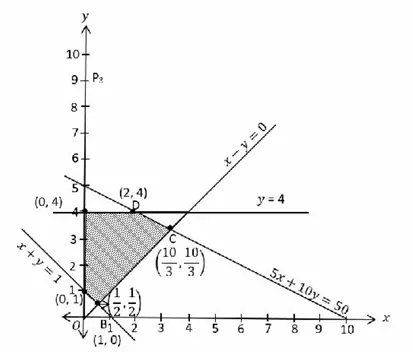
If R and S are two equivalence relations on a set A, then
Consider the following L.L.P. Minimize z = 30x - 30y + 1800; subject to x + y ≤ 30, x ≤ 15, y ≤ 20, x + y ≥ 15 and x, y ≥ 0. Then it attains its optimal value at the point
Given that $\vec{a} = -3\hat{i} - 6\hat{j} + 4\hat{k}$, $\vec{b} = 9\hat{i} - λ\hat{j} - 12\hat{k}$. If $\vec{a} \times \vec{b} = \vec{0}$, then the value of λ is
The probability distribution of a random discrete variable is given | X | -1 | 0 | 1 | 2 | 3 | |---|---|---|---|---|---| | P(X) | 0.1 | $p$ | 0.3 | $q$ | $r$ | If it is known that P(X=1) is the mean of P(X=0) and P(X=2). Then the value of r is :
Let E and F be two events such that $P(E) = \frac{1}{3}$, $P(F) = \frac{1}{4}$ and $P(E \cap F) = \frac{1}{5}$. Then the value of $P(F|E)$ is equal to
If $\vec{a}$ and $\vec{b}$ are two vectors such that $|\vec{a}| = 10, |\vec{b}| = 2$ and $\vec{a} \cdot \vec{b} = 12$, then $|\vec{a} \times \vec{b}|$ is equal to
Let $A = [a_{ij}]$ be a square matrix of order 2 with elements either 0 or 1. Then the difference between the possible number of singular and non-singular matrices is
Let X denote the number of hours a student studies on a selected day. The probability distribution of X is given by (where k is some unknown constant) $P(X = x_i) = \begin{cases} 0.5, & \text{if } x_i = 0, \\ kx_i, & \text{if } x_i = 1, \\ k(4 - x_i), & \text{if } x_i = 2 \text{ or } 3, \\ 0, & \text{otherwise}. \end{cases}$ Then the value of k is
The solution set of the inequality $\frac{2x+3}{x-1} < 0$ is:
Which one of the following inequalities is redundant for the shaded feasible region (ABCDA) shown below? 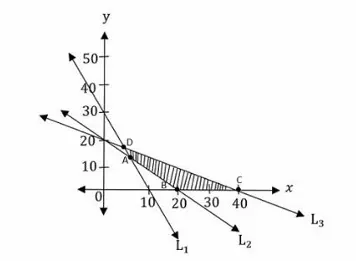
A coin is tossed and a die is thrown. The probability that the outcome will be a tail on the coin or a number greater than 3 on the die is
If the objective function $z = px + qy$ has its maximum value at the points (2, 1) and (0, 6), then the relationship between p and q is:
The number of all possible matrices of order $2 \times 3$ with each entry 0 or 1 is
If $\vec{a}$ is a unit vector perpendicular to both the vectors $\vec{b} = \hat{j} + \hat{2k}$ and $\vec{c} = \hat{i} + 2\hat{j}$, then $\hat{a}$ is equal to
A bag contains 4 red and 6 black balls. Two balls are drawn in succession without replacement. The probability that the first is red and the second is black is
The values of $\lambda$ for which the system of equation $x + 2y + z = 14, - x + y + z = 10, x + \lambda y + z = 2$ has unique solution is
The corner points of a bounded feasible region are (0, 5), (6, 1), (17, 2) and (4, 29). If the maximum value of objective function $z = px + qy$ where $p$ and $q > 0$ occurs at two points (17, 2) and (4, 29), then the relation between $p$ and $q$ is:
Let A be a 3 × 7 matrix, then each column of A contains:
If $\begin{bmatrix}3 & 1\\2 & 1\end{bmatrix}A\begin{bmatrix}2 & 1\\1 & 1\end{bmatrix} = \begin{bmatrix}1 & 1\\0 & 1\end{bmatrix}$, then matrix 'A' is
If A is a square matrix of order 3 and |A| = -5, then |3A| is equal to
If A and B are any two events such that P(B) = P(A and B), then which of the following is correct