CUET UG Mathematics — Algebra previous year questions with solutions.
The corner points of the feasible region associated with the LPP: Maximise $Z = px + qy$, $p,q > 0$ subject to $2x + y \leq 10$, $x + 3y \leq 15$, $x, y \geq 0$ are (0, 0), (5, 0), (3, 4) and (0, 5). If optimum value occurs at both (3, 4) and (0, 5), then
What is the mean of the numbers obtained on throwing a die having written 1 on three faces, 2 on two faces and 5 on 1 face?
Bag A contains 2 unbiased and 3 biased coins whereas Bag B contains 3 unbiased and 2 biased coins. A bag is selected at random and 2 coins are taken out simultaneously. The probability, that both coins are unbiased is:
Let $F(z)$ be the cumulative density function of the standard normal variate $z$, then which of the following are correct? (A) $F(z) = \frac{1}{\sqrt{2\pi}} \int_{-\infty}^z e^{-\frac{z^2}{2}} dz$, $-\infty < z < \infty$ (B) $F(-z) = 1 - F(z)$ (C) $F(0) = 0$ (D) $F(\infty) = 1$ Choose the correct answer from the options given below:
Which of the following statements are correct in reference to the linear programming problem(LPP): Maximize ${Z} = 5x + 2y$ subject to the following constraints $3x + 5y \leq 15$, $5x + 2y \leq 10$, $x \geq 0, y \geq 0$. (A) The LPP has a unique optimal solution at $(2, 0)$ only. (B) The feasible region is bounded with corner points $(0, 0)$, $(2, 0)$, $(20/19, 45/19)$ and $(0, 3)$. (C) The optimal value is unique, but there are an infinite number of optimal solutions. (D) The feasible region is unbounded. Choose the correct answer from the options given below:
Let A be a non-singular matrix of order 3 and $|A| = 15$, then $|adj A|$ is equal to
Let $\vec{a} = \hat{i} + 4\hat{j} $, $\vec{b} = 4\hat{j} + \hat{k}$ and $\vec{c} = \hat{i} - 2\hat{k}$. If $\vec{d}$ is a vector perpendicular to both $\vec{a}$ and $\vec{b}$ such that $\vec{c} \cdot \vec{d} = 16$, then $|\vec{d}|$ is equal to
Which one of the following set of constraints does the given shaded region represent? 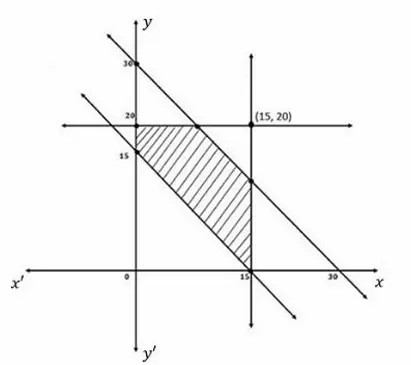
If A and B are skew-symmetric matrices, then which one of the following is NOT true?
The corner points of the feasible region of the LPP: Minimize $Z = -50x + 20y$ subject to $2x - y \geq -5$, $3x + y \geq 3$, $2x - 3y \leq 12$ and $x, y \geq 0$ are
Let $A = \begin{bmatrix} 1 & 2 & 1 \\ -1 & 3 & 2 \\ 2&4&1\end{bmatrix}$ and $M_{ij}$, $A_{ij}$ respectively denote the minor, co-factor of an element $a_{ij}$ of matrix A, then which of the following are true? (A) $M_{22} = -1$ (B) $A_{23} = 0$ (C) $A_{32} = 3$ (D) $M_{23} = 1$ (E) $M_{32} = -3$ Choose the correct answer from the options given below:
Let the random variable X represent the positive difference between the number of heads and the number of tails obtained when a coin is tossed 6 times. Then probability $P(X \leq 3)$ is equal to
Let A be a matrix such that $A = \begin{bmatrix} 1 & 2 \\ -2 & 3 \end{bmatrix}$. Then which of the following are TRUE? (A) A is non-singular matrix (B) $A^T = A$ (C) A is not invertible matrix (D) A is not skew-symmetric matrix Choose the *correct* answer from the options given below:
If $\mathbb{Z}$ and $\mathbb{R}$ denote set of integers and set of real numbers respectively, then match List I with List II. | List-I | List-II | |---|---| | (A) $5x - 3 \leq 3x + 1$, $x \in \mathbb{Z}$ | (I) $x \in (-\infty, -3]$ | | (B) $3x + 17 \leq 2(1 - x)$, $x \in \mathbb{R}$ | (II) $x \in (-\infty, -1)$ | | (C) $13x + 17 \leq 2(1 - x)$, $x \in \mathbb{R}$ | (III) $\{......, -4, -3, .......,0,1\}$ | | (D) $\frac{2x + 3}{5} - 2 > \frac{3(x - 2)}{5}$, $x \in \mathbb{Z}$ | (IV) $\{......, -4, -3, -2\}$ | Choose the correct answer from the options given below:
Which of the following are correct? (A) If A and B are symmetric matrices such that AB = BA, then AB is symmetric. (B) If A and B are symmetric matrices of the same order, then (A+B) is a symmetric matrix. (C) If A and B are symmetric matrices of the same order, then (AB-BA) is a symmetric matix. (D) If A and B are symmetric matrices of the same order, then (AB+BA) is a skew symmetric matrix Choose the correct answer from the options given below:
The maximum value of the objective function $z = 10x + 15y$ of an L.P.P. subjected to the constraints $2x + 4y \leq 8$, $3x + y \leq 6$, $-x - y \geq -4$, $x \geq 0$, $y \geq 0$ is:
Match List-I with List-II Where ℝ is set of real numbers | List-I | List-II | |---|---| | (A) f: ℝ → ℝ s.t f(x) = x⁴ is | (I) one-one, Into | | (B) f: ℝ → [0, ∞) s.t f(x) = x⁴ is | (II) many-one, into | | (C) f: [0, ∞) → ℝ s.t f(x) = x⁴ is | (III) one-one, onto | | (D) f: [0, ∞) → [0, ∞) s.t f(x) = x⁴ is | (IV) many-one, onto | Choose the correct answer from the options given below:
If $X$ is a random variable which can assume values $0, 1, 2, 3$ or $4$ such that $P(X = 1) = P(X = 2)$ and $3P(X = 3) = 4P(X = 4) = P(X = 0) = \frac{1}{8}$, then $P(X > 0)$ is:
Let A, B, C be three events. If the probability of occurring exactly one out of A and B is $\frac{3}{5}$, exactly one of B and C is $\frac{1}{5}$, exactly one of C and A is $\frac{3}{5}$ and that of occurring of three events is $\frac{4}{25}$, then the probability of occurring at least one of them is
The relation R on the set of real numbers defined by $R = \{(a, b): a \leq b^2\}$ is
If A speaks truth in 75% cases and B speaks truth in 80% cases, then the probability that they contradict each other in a statement, is:
A and B are two independent events. The probability that both events A and B occur is $\frac{1}{6}$ and the probability that neither of them occur is $\frac{1}{3}$. If P(A) = x, P(B) = y then the value of x+y is.
The corner points of the bounded feasible region determined by the system of linear constraints are $(0,8)$, $(4,4)$, $(12,12)$, $(0,20)$. Let $z = px + qy$, where $p, q > 0$. Condition on $p$ and $q$ so that the maximum of $z$ occurs at both the points $(12,12)$, $(0,20)$ is
A pair of dice is thrown until the sum of numbers appeared is a perfect square or a non-perfect square sum appeared five times in succession. If random variable $X$ denotes the number of non perfect square sums appeared, then $P(X > 0)$ is