Plant Kingdom PYQ — Page 3
NEET UG Botany — Plant Kingdom previous year questions with solutions.
All Plant Kingdom Questions (104)
Which of the following is responsible for peat formation?
An alga which can be employed as food for human beings:
Male gametophyte with the least number of cells is present in:
Which one of the following is wrong about Chara?
Read the following statements (IV) and answer the question which follows them I. In liverworts, mosses and ferns gametophytes are free living. II. Gymnosperms and some ferns are heterospores. III. Sexual reproduction in Fucus, Vofvox and Albugo is oogamous. N. The sporophyte in liverworts is more elaborate than that in mosses. How many of the above statements are correct?
The plant body is thalloid in:
Which one of the following is wrongly matched?
Syngamy can occur outside the body of the organism in:
Which of the following is not correctly matched for the organism and its cell wall degrading enzyme?
Meiosis takes place in
Isogamous condition with non-flagellated gametes is found in
What is common in all the three, Funaria, Dryopteris and Ginkgo?
Besides paddy fields, cyanobacteria are also found inside vegetative part of
Monoecious plant of Chara shows occurrence of
Which one of the following is a correct statements?
Which one of the following pairs is wrongly matched?
Read the following five statements and answer as asked next to them I. In Equisetum the female gametophyte is retained on the parent sporophyte. II. In Ginkgo male gametophyte is not independent. III. The sporophyte in Riccia is more developed than that in Polytrichum. IV. Sexual reproduction in Volvox is isogamous. V. The spores of slime molds lack cell walls How many of the above statements are correct?
Cycas and Adiantum resemble each other in having
The gametophyte is not an independent, free living generation in
Compared with the gametophytes of the bryophytes, the gametophytes of vascular plants tends to be
Archegoniophore is present in
Examine the figure below and select the right option giving all the four parts (A, B, C and (D) correctly identified. 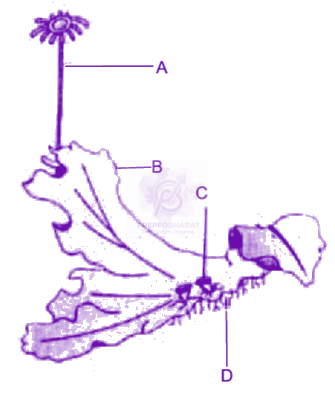 \(\begin{array}{|l|l|} \hline & \text{A} & \text{B} & \text{C} & \text{D} \\ \hline \text{(a)} & \text{Archegoniophore} & \text{Female thallus} & \text{Gemma cup} & \text{Rhizoids} \\ \hline \text{(b)} & \text{Archegoniophore} & \text{Female thallus} & \text{Bud} & \text{Foot} \\ \hline \text{(c)} & \text{Seta} & \text{Sporophyte} & \text{Protonema} & \text{Rhizoids} \\ \hline \text{(d)} & \text{Antheridiophore} & \text{Male thallus} & \text{Globule} & \text{Roots} \\ \hline \end{array}\)
Selaginella and Salvinia are considered to represent a significant step towards evolution of seed habit because
Algae have cell wall made up of