Biodiversity and its Conservation PYQ
NEET UG Botany — Biodiversity and its Conservation previous year questions with solutions.
Browse by Year
Biodiversity and its Conservation at a glance
Questions per year
87 across 22 yearsDifficulty mix
87 total- easy54 · 62%
- medium31 · 36%
- hard2 · 2%
All Biodiversity and its Conservation Questions (87)
Which one of the following is an example of ex-situ conservation?
Match List I with List II: $\begin{array}{|l|l|l|l|}\hline & \text{List - I} & & \text{List - II} \\\hline \text{A}. & \text{The Evil Quartet} & \text{(i)} & \text{Cryopreservation} \\\hline \text{B.} & \text{Ex situ conservation} & \text{(ii)} & \text{Alien species invasion} \\\hline \text{C.} & \text{Lantana camara} & \text{(iii)} & \text{Causes of biodiversity losses } \\\hline \text{D.} & \text{Dodo} & \text{(iv)} & \text{Extinction} \\\hline\end{array}$ Choose the option with all correct matches.
The regions with high level of species richness, high degree of endemism and a loss of $70 \%$ of the species and habitat are identified as:
The type of conservation in which the threatened species are taken out from their natural habitat and placed in special setting where they can be protected and given special care is called
These are regarded as major causes of biodiversity loss: A. Over exploitation B. Co-extinction C. Mutation D. Habitat loss and fragmentation E. Migration Choose the correct option:
Tropical regions show greatest level of species richness because A. Tropical latitudes have remained relatively undisturbed for millions of years, hence more time was available for species diversification. B. Tropical environments are more seasonal. C. More solar energy is available in tropics. D. Constant environments promote niche specialization. E. Tropical environments are constant and predictable. Choose the correct answer from the options given below.
List of endangered species was released by
The capacity to generate a whole plant from any cell of the plant is called:
Match List-I with List-II: $\begin{array}{|c|l|c|l|}\hline & \text{List-I} & & \text{List-II} \\ \hline A. & \text{Biodiversity hotspot} & I. & \text{Khasi and Jantia hills in Meghalaya} \\ \hline B. & \text{Sacred groves} & II. & \begin{array}{l} \text{World Summit on Sustainable} \\ \text{Development } 2002 \end{array} \\ \hline C. & \text{Johannesburg, South Africa} & III. & \text{Parthenium} \\ \hline D. & \text{Alien species invasion} & IV. & \text{Western Ghats} \\ \hline \end{array}$ Choose the correct answer from the options given below:
Which of the following are fused in somatic hybridization involving two varieties of plants?
Which one of the following is not included under in-situ conservation?
Cryopreservation technique is used for :
Match List I with List II 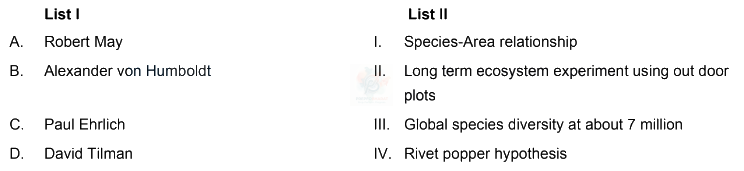 Choose the correct answer from the options given below:
The historic Convention on Biological Diversity, 'The Earth Summit' was held in Rio de Janeiro in the year:
Among 'The Evil Quartet', which one is considered the most important cause driving extinction of species?
The species of plants that plays a vital role in controlling the relative abundance of other species in a community is called
In 'rivet popper hypothesis', Paul Ehrlich compared the rivets in an airplane to
Which of the following is/are cause(s) of biodiversity losses?
Which of the following is not a method of ex situ conservation?
In situ conservation refers to:
Give the correct descending order of organisms with reference to their estimated number found in Amazon forest. (a) Plants (b) Invertebrates (c) Fishes (d) Mammals (e) Birds Choose the correct answer from the options given below :
Habitat loss and fragmentation, over exploitation, alien species invasion and co-extinction are causes for:
The World Summit on sustainable development held in 2002 in Johannesburg, South Africa pledged for:
Western Ghats have a large number of plants and animal species that are not found any where else. Which of the following term is used to notify such species?