JEE Main Physics — Electromagnetism previous year questions with solutions.
In an LCR series a.c. circuit, the voltage across each of the components, $L, C$ and $R$ is $50 \mathrm{~V}$. The voltage across the LC combination will be
Alternating current can not be measured by D.C. ammeter because
Two coils are placed close to each other. The mutual inductance of the pair of coils depends upon
In an oscillating LC circuit the maximum charge on the capacitor is Q. The charge on the capacitor when the energy is stored equally between the electric and magnetic field is
The core of any transformer is laminated so as to
A metal wire of linear mass density of $9.8 \mathrm{~g} / \mathrm{m}$ is stretched with a tension of $10 \mathrm{~kg}$-wt between two rigid supports 1 metre apart. The wire passes at its middle point between the poles of a permanent magnet, and it vibrates in resonance when carrying an alternating current of frequency $n$. The frequency $n$ of the alternating source is
The work done in placing a charge of $8 \times 10^{-18}$ coulomb on a condenser of capacity 100 micro-farad is
If the electric flux entering and leaving an enclosed surface respectively is $\phi_1$ and $\phi_2$, the electric charge inside the surface will be
An ammeter reads up to 1 ampere. Its internal resistance is $0.81 \mathrm{ohm}$. To increase the range to $10 \mathrm{~A}$ the value of the required shunt is
A particle of mass $M$ and charge Q moving with velocity $\overrightarrow{\mathrm{v}}$ describe a circular path of radius $\mathrm{R}$ when subjected to a uniform transverse magnetic field of induction $\mathrm{B}$. The work done by the field when the particle completes one full circle is
A thin rectangular magnet suspended freely has a period of oscillation equal to $T$. Now it is broken into two equal halves (each having half of the original length) and one piece is made to oscillate freely in the same field. If its period of oscillation is $T^{\prime}$, the ratio $\frac{T^{\prime}}{T}$ is
Curie temperature is the temperature above which
A 220 volt, 1000 watt bulb is connected across a 110 volt mains supply. The power consumed will be
Three charges $-q_1,+q_2$ and $-q_3$ are placed as shown in the figure. The $x$-component of the force on $-q_1$ is proportional to 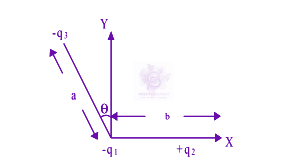
A particle of charge $-16 \times 10^{-18}$ coulomb moving with velocity $10 \mathrm{~ms}^{-1}$ along the $\mathrm{x}$-axis enters a region where a magnetic field of induction $\mathrm{B}$ is along the $\mathrm{y}$-axis, and an electric field of magnitude $10^4 \mathrm{~V} / \mathrm{m}$ is along the negative z-axis. If the charged particle continues moving along the $\mathrm{x}$-axis, the magnitude of $\mathrm{B}$ is
A thin spherical conducting shell of radius $\mathrm{R}$ has a charge $\mathrm{q}$. Another charge $\mathrm{Q}$ is placed at the centre of the shell. The electrostatic potential at a point $\mathrm{P}$ a distance $\frac{\mathrm{R}}{2}$ from the centre of the shell is
A 3 volt battery with negligible internal resistance is connected in a circuit as shown in the figure. The current $\mathrm{I}$, in the circuit will be 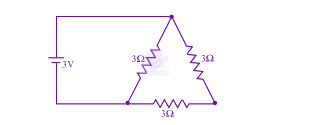
The negative $\mathrm{Zn}$ pole of a Daniell cell, sending a constant current through a circuit, decreases in mass by $0.13 \mathrm{~g}$ in 30 minutes. If the electrochemical equivalent of $\mathrm{Zn}$ and $\mathrm{Cu}$ are $32.5$ and $31.5$ respectively, the increase in the mass of the positive Cu pole in this time is
The magnetic lines of force inside a bar magnet
A sheet of aluminium foil of negligible thickness is introduced between the plates of a capacitor. The capacitance of the capacitor
A magnetic needle lying parallel to a magnetic field requires $\mathrm{W}$ units of work to turn it through $60^{\circ}$. The torque needed to maintain the needle in this position will be
A strip of copper and another of germanium are cooled from room temperature to $80 \mathrm{~K}$. The resistance of
The length of a given cylindrical wire is increased by $100 \%$. Due to the consequent decrease in diameter the change in the resistance of the wire will be
The thermo e.m.f. of a thermo-couple is $25 \mu \mathrm{V} /{ }^{\circ} \mathrm{C}$ at room temperature. A galvanometer of 40 ohm resistance, capable of detecting current as low as $10^{-5} \mathrm{~A}$, is connected with the thermo couple. The smallest temperature difference that can be detected by this sytem is