Vectors & 3D Geometry PYQ — Page 15
JEE Main Mathematics — Vectors & 3D Geometry previous year questions with solutions.
All Vectors & 3D Geometry Questions (485)
A vector $\vec{a}$ has components $3p$ and $1$ with respect to a rectangular cartesian system. This system is rotated through a certain angle about the origin in the counter clockwise sense. If, with respect to new system, $\vec{a}$ has components $p+1$ and $\sqrt{10},$ then a value of $p$ is equal to:
A line $l$ passing through origin is perpendicular to the lines ${l}_{1}:\vec{r}=(3+t)\hat{i}+(-1+2t)\hat{j}+(4+2t)\hat{k}$ ${l}_{2}:\vec{r}=(3+2s)\hat{i}+(3+2s)\hat{j}+(2+s)\hat{k}$ If the co-ordinates of the point in the first octant on ${l}_{2}$ at a distance of $\sqrt{17}$ from the point of intersection of $l$ and ${l}_{1}$ are $(a,b,c)$, then $18(a+b+c)$ is equal to ___ .
A hall has a square floor of dimension $10m\times 10m$ (see the figure) and vertical walls. If the angle $GPH$ between the diagonals $AG$ and $BH$ is ${\mathrm{cos}}^{-1}\frac{1}{5},$ then the height of the hall (in meters) is: 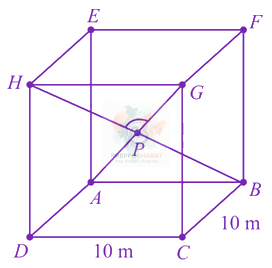
The shortest distance between the lines $\frac{x-3}{3}=\frac{y-8}{-1}=\frac{z-3}{1}$ and $\frac{x+3}{-3}=\frac{y+7}{2}=\frac{z-6}{4}$ is
The projection of the line segment joining the point $(1,-1,3)$ and $(2,-4,11)$ on the line joining the points $(-1,2,3)$ and $(3,-2,10)$ is _______
Let the vectors $\vec{a},\vec{b},\vec{c}$ be such that $|\vec{a}|=2,|\vec{b}|=4$ and $|\vec{c}|=4.$ If the projection of $\vec{b}$ on $\vec{a}$ is equal to the projection of $\vec{c}$ on $\vec{a}$ and $\vec{b}$ is perpendicular to $\vec{c},$ then the value of $|\vec{a}+\vec{b}-\vec{c}|$ is $\ldots$
Let the position vectors of points '$A$' and '$B$' be $\hat{i}+\hat{j}+\hat{k}$ and $2\hat{i}+\hat{j}+3\hat{k},$ respectively. A point $'P'$ divides the line segment $AB$ internally in the ratio $\lambda :1(\lambda >0)$. If $O$ is the origin and $\vec{\mathrm{OB}}\cdot \vec{\mathrm{OP}}-3{|\vec{\mathrm{OA}}\times \vec{\mathrm{OP}}|}^{2}=6$ then $\lambda$ is equal to
Let $a,b,c\in R$ be such that ${a}^{2}+{b}^{2}+{c}^{2}=1$. If $a\mathrm{cos}\theta =b\mathrm{cos}(\theta +\frac{2\pi }{3})=c\mathrm{cos}(\theta +\frac{4\pi }{3})$,where $\theta =\frac{\pi }{9}$, then the angle between the vectors $a\hat{i}+b\hat{j}+c\hat{k}$ and $b\hat{i}+c\hat{j}+a\hat{k}$ is:
Let $\vec{a}=\hat{i}-2\hat{j}+\hat{k}$ and $\vec{b}=\hat{i}-\hat{j}+\hat{k}$, be two vectors. If $\vec{c}$, is a vector such that $\vec{b}\times \vec{c}=\vec{b}\times \vec{a}$ and $\vec{c}\cdot \vec{a}=0,$ then $\vec{c}\cdot \vec{b}$, is equal to.
Let $\vec{a},\vec{b}$ and $\vec{c}$ be three vectors such that $|\vec{a}|=\sqrt{3},|\vec{b}|=5,\vec{b}\cdot \vec{c}=10$ and the angle between $\vec{b}$ and $\vec{c}$ is $\frac{\pi }{3}.$ If $\vec{a}$ is perpendicular to the vector $\vec{b}\times \vec{c},$ then $|\vec{a}\times (\vec{b}\times \vec{c})|$ is equal to ____________.
Let $\vec{a},\vec{b}$ and $\vec{c}$, be three unit vectors such that $\vec{a}+\vec{b}+\vec{c}=\vec{0}$. If $\lambda =\vec{a}\cdot \vec{b}+\vec{b}\cdot \vec{c}+\vec{c}\cdot \vec{a}$ and $\vec{\text{d}}=\vec{\text{a}}\times \vec{\text{b}}+\vec{\text{b}}\times \vec{\text{c}}+\vec{\text{c}}\times \vec{\text{a}}$, then the order pair, $(\lambda ,\vec{d})$, is equal to.
Let $\vec{a},\vec{b}$ and $\vec{c}$ be three unit vectors such that ${|\vec{a}-\vec{b}|}^{2}+{|\vec{a}-\vec{c}|}^{2}=8$. Then ${|\vec{a}+2\vec{b}|}^{2}+{|\vec{a}+2\vec{c}|}^{2}$ is equal to
If vectors a=2i+3j+k and b=i-j+2k then a×b is:
If $\vec{a}=2\hat{i}+\hat{j}+2\hat{k}$, then, the value of ${|\hat{i}\times (\vec{a}\times \hat{i})|}^{2}+{|\hat{j}\times (\vec{a}\times \hat{j})|}^{2}+|\hat{k}\times (\vec{a}\times \hat{k})|{}^{2}$, is equal to :
If the vectors, $\vec{p}=(a+1)\hat{i}+a\hat{j}+a\hat{k},\vec{q}=a\hat{i}+(a+1)\hat{j}+a\hat{k}$ and $\vec{r}=a\hat{i}+a\hat{j}+(a+1)\hat{k}(a\in R)$ are coplanar and $3{(\vec{p}.\vec{q})}^{2}-\lambda {|\vec{r}\times \vec{q}|}^{2}=0$ , then the value of $\lambda$ is ________
If $(a,b,c)$ is the image of the point $(1,2,-3)$ in the line, $\frac{x+1}{2}=\frac{y-3}{-2}=\frac{z}{-1},$ then $a+b+c$ is equal to:
If $\vec{x}$ and $\vec{y}$ be two non-zero vectors such that $|\vec{x}+\vec{y}|=|\vec{x}|$ and $2\vec{x}+\lambda \vec{y}$ is perpendicular to $\vec{y}$, then the value of $\lambda$ is ...... .
If $\vec{a}$ and $\vec{b}$ are unit vectors, then the greatest value of $\sqrt{3}|\vec{a}+\vec{b}|+|\vec{a}-\vec{b}|$ is
A vector $\vec{a}=\alpha \hat{i}+2\hat{j}+\beta \hat{k}(\alpha ,\beta \in R)$ lies in the plane of the vectors, $\vec{b}=\hat{i}+\hat{j}$ and $\vec{c}=\hat{i}-\hat{j}+4\hat{k}.$ If $\vec{a}$ bisects the angle between $\vec{b}$ and $\vec{c},$ then
Two lines $\frac{x-3}{1}=\frac{y+1}{3}=\frac{z-6}{-1}$ and $\frac{x+5}{7}=\frac{y-2}{-6}=\frac{z-3}{4}$ intersect at the point $R$. The reflection of $R$ in the $x y$ - plane has coordinates:
The vertices $B$ and $C$ of a $\Delta ABC$ lie on the line, $\frac{x+2}{3}=\frac{y-1}{0}=\frac{z}{4}$ such that $BC=5$ units. Then the area (in sq. units) of this triangle, given the point $A(1, -1, 2),$ is
The sum of the distinct real values of $\mu$ for which the vectors $\mu \hat{i}+\hat{j}+\hat{k}, \hat{i}+\mu \hat{j}+\hat{k}, \hat{i}+\hat{j}+\mu \hat{k}$ are co-planar, is
The magnitude of the projection of the vector $2\hat{i}+3\hat{j}+\hat{k}$ on the vector perpendicular to the plane containing the vectors $\hat{i}+\hat{j}+\hat{k}$ and $\hat{i}+2\hat{j}+3\hat{k},$ is:
The length of the perpendicular from the point $(2,-1, 4)$ on the straight line $\frac{x+3 }{10}=\frac{y-2}{-7}=\frac{z}{1}$ is