JEE Main 2021 — Trigonometry
Mathematics Trigonometry questions from JEE Main 2021.
Other Years
29 Trigonometry Questions from 2021
The value of sin30° + cos60° is
The value of cos²15° - cos²75° is:
If $n$ is the number of solutions of the equation $2\mathrm{cos}x(4\mathrm{sin}(\frac{\pi }{4}+x)\mathrm{sin}(\frac{\pi }{4}-x)-1)=1,$ $x\in [0,\pi ]$ and $S$ is the sum of all these solutions, then the ordered pair $(n,S)$ is :
If ${\mathrm{cot}}^{-1}(\alpha )={\mathrm{cot}}^{-1}2+{\mathrm{cot}}^{-1}8+{\mathrm{cot}}^{-1}18+{\mathrm{cot}}^{-1}32+\ldots .$ upto $100$ terms, then $\alpha$ is:
The value of $\mathrm{tan}(2{\mathrm{tan}}^{-1}(\frac{3}{5})+{\mathrm{sin}}^{-1}(\frac{5}{13}))$ is equal to:
$\underset{n\rightarrow \infty }{\mathrm{lim}}\mathrm{tan}{\sum _{r=1}^{n}{\mathrm{tan}}^{-1}(\frac{1}{1+r+{r}^{2}})}$ is equal to_______.
The number of distinct real roots of $|\begin{matrix}\mathrm{sin}x & \mathrm{cos}x & \mathrm{cos}x \\ \mathrm{cos}x & \mathrm{sin}x & \mathrm{cos}x \\ \mathrm{cos}x & \mathrm{cos}x & \mathrm{sin}x\end{matrix}|=0$ in the interval $-\frac{\pi }{4}\leq x\leq \frac{\pi }{4}$ is:
Let ${S}_{k}=\sum _{r=1}^{k}{\mathrm{tan}}^{-1}(\frac{{6}^{r}}{{2}^{2r+1}+{3}^{2r+1}}),$ then $\underset{k\rightarrow \infty }{\mathrm{lim}}{S}_{k}$ is equal to :
Given that the inverse trigonometric functions take principal values only. Then, the number of real values of $x$ which satisfy ${\mathrm{sin}}^{-1}(\frac{3x}{5})+{\mathrm{sin}}^{-1}(\frac{4x}{5})={\mathrm{sin}}^{-1}x$ is equal to:
If $15{\mathrm{sin}}^{4}\alpha +10{\mathrm{cos}}^{4}\alpha =6,$ for some $\alpha \in R,$ then the value of $27{\mathrm{sec}}^{6}\alpha +8{cosec}^{6}\alpha$ is equal to :
If $\sum _{r=1}^{50}{\mathrm{tan}}^{-1}\frac{1}{2{r}^{2}}=p,$ then the value of $\mathrm{tan}p$ is :
$cosec18^{\circ}$ is a root of the equation:
${\mathrm{cos}}^{-1}(\mathrm{cos}(-5))+{\mathrm{sin}}^{-1}(\mathrm{sin}(6))-{\mathrm{tan}}^{-1}(\mathrm{tan}(12))$ is equal to : (The inverse trigonometric functions take the principal values)
A possible value of $\mathrm{tan}(\frac{1}{4}{\mathrm{sin}}^{-1}\frac{\sqrt{63}}{8})$ is:
If $\frac{{\mathrm{sin}}^{-1}x}{a}=\frac{{\mathrm{cos}}^{-1}x}{b}=\frac{{\mathrm{tan}}^{-1}y}{c};0<x<1,$ then the value of $\mathrm{cos}(\frac{\pi c}{a+b})$ is:
The sum of possible values of $x$ for ${\mathrm{tan}}^{-1}(x+1)+{\mathrm{cot}}^{-1}(\frac{1}{x-1})={\mathrm{tan}}^{-1}(\frac{8}{31})$ is:
If $\sqrt{3}({\mathrm{cos}}^{2}x)=(\sqrt{3}-1)\mathrm{cos}x+1$, then number of solutions of the given equation when $x\in [0,\frac{\pi }{2}]$ is ________.
The number of integral values of $k$ for which the equation $3\mathrm{sin}x+4\mathrm{cos}x=k+1$ has a solution, $k\in R$ is _______.
$cosec[2{\mathrm{cot}}^{-1}(5)+{\mathrm{cos}}^{-1}(\frac{4}{5})]$ is equal to:
The number of roots of the equation, ${(81)}^{{\mathrm{sin}}^{2}x}+{(81)}^{{\mathrm{cos}}^{2}x}=30$ in the interval $[0,\pi ]$ is equal to :
A $10$ inches long pencil $AB$ with mid point $C$ and a small eraser $P$ are placed on the horizontal top of a table such that $PC=\sqrt{5}$ inches and $\angle PCB={\mathrm{tan}}^{-1}(2)$. The acute angle through which the pencil must be rotated about $C$ so that the perpendicular distance between eraser and pencil becomes exactly $1$ inch is : 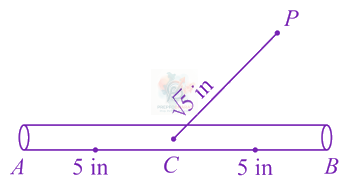
The number of real roots of the equation ${\mathrm{tan}}^{-1}\sqrt{x(x+1)}+{\mathrm{sin}}^{-1}\sqrt{{x}^{2}+x+1}=\frac{\pi }{4}$ is:
If ${({\mathrm{sin}}^{-1}x)}^{2}-{({\mathrm{cos}}^{-1}x)}^{2}=a;0<x<1,a\neq 0,$ then the value of $2{x}^{2}-1$ is
The number of solutions of the equation ${\mathrm{sin}}^{-1}[{x}^{2}+\frac{1}{3}]+{\mathrm{cos}}^{-1}[{x}^{2}-\frac{2}{3}]={x}^{2}$ for $x\in [-1,1]$, and $[x]$ denotes the greatest integer less than or equal to $x,$ is :
The sum of all values of $x$ in $[0,2\pi ]$, for which $\mathrm{sin}x+\mathrm{sin}2x+\mathrm{sin}3x+\mathrm{sin}4x=0$, is equal to :
The number of solutions of ${\mathrm{sin}}^{7}x+{\mathrm{cos}}^{7}x=1,x\in [0,4\pi ]$ is equal to
If $\mathrm{sin}\theta +\mathrm{cos}\theta =\frac{1}{2},$ then $16(\mathrm{sin}(2\theta )+\mathrm{cos}(4\theta )+\mathrm{sin}(6\theta ))$ is equal to:
The value of $2\mathrm{sin}(\frac{\pi }{8})\mathrm{sin}(\frac{2\pi }{8})\mathrm{sin}(\frac{3\pi }{8})\mathrm{sin}(\frac{5\pi }{8})\mathrm{sin}(\frac{6\pi }{8})\mathrm{sin}(\frac{7\pi }{8})$ is :
The value of $\mathrm{cot}\frac{\pi }{24}$ is: