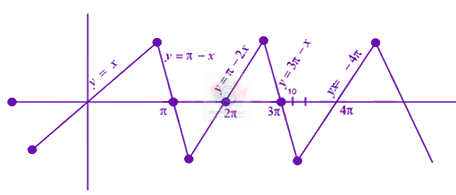
From the graph of y=sin−1(sinx), it is clear that sin−1(sin10)=3π−10
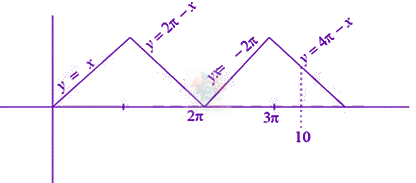
From the graph of y=cos−1(cosx)
It is clear that cos−1(cos10)=4π−10
Hence y−x=(4π−10)−(3π−10)=π
JEE Main 2019 — Mathematics Trigonometry
If x=sin−1(sin10) and y=cos−1(cos10), then y−x is equal to:
Held on 9 Jan 2019 · Verified 6 Jul 2026.
10
π
0
7π
Sign in to track your attempts and accuracy.
Sign in to keep a private note on this question. Nothing you write is ever public.
Number of solutions of $\sqrt{3} \cos 2 \theta+8 \cos \theta+3 \sqrt{3}=0, \theta \in[-3 \pi, 2 \pi]$ is:
The value of sin²30° + cos²30° is:
If $\frac{\cos ^{2} 48^{\circ}-\sin ^{2} 12^{\circ}}{\sin ^{2} 24^{\circ}-\sin ^{2} 6^{\circ}}=\frac{\alpha+\beta \sqrt{5}}{2}$, where $\alpha, \beta \in \mathbb{N}$, then $\alpha+\beta$ is equal to $\_\_\_\_\_$
Let $\alpha$ and $\beta$ respectively be the maximum and the minimum values of the function $f(\theta)=4\left(\sin ^{4}\left(\frac{7 \pi}{2}-\theta\right)+\sin ^{4}(11 \pi+\theta)\right)-2\left(\sin ^{6}\left(\frac{3 \pi}{2}-\theta\right)+\sin ^{6}(9 \pi-\theta)\right), \theta \in \mathbf{R}$. Then $\alpha+2 \beta$ is equal to :
The number of elements in the set $\left\{x \in\left[0,180^{\circ}\right]: \tan \left(x+100^{\circ}\right)=\tan \left(x+50^{\circ}\right) \tan x \tan \left(x-50^{\circ}\right)\right\}$ is $\_\_\_\_$.
Work through every JEE Main Trigonometry PYQ, year by year.