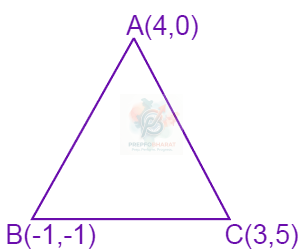
AB=(4+1)2+(0+1)2=26;BC=(3+1)2+(5+1)2=52 CA=(4−3)2+(0−5)2=26; So, in isosceles triangle AB=CA For right angled triangle BC2=AB2+AC2 So, here BC=52 or BC2=52 or (26)2+(26)2=52 So, given triangle is right angled and also isosceles
JEE Main 2002 — Mathematics Coordinate Geometry
A triangle with vertices (4, 0), (-1, -1), (3, 5) is
Held on 30 Apr 2002 · Verified 6 Jul 2026.
isosceles and right angled
isosceles but not right angled
right angled but not isosceles
neither right angled nor isoceles
Sign in to track your attempts and accuracy.
Sign in to keep a private note on this question. Nothing you write is ever public.
Let $A,B$ be points on the two half-lines $x-\sqrt{3}|y|=\alpha$, $\alpha>0$ at a distance of $\alpha$ from their point of intersection $P$. The line segment $AB$ meets the angle bisector of the given half-lines at the point $Q$. If $PQ=\dfrac{9}{2}$ and $R$ is the radius of the circumcircle of $\triangle PAB$, then $\dfrac{\alpha^2}{R}$ is equal to ______
If a straight line drawn through the point of intersection of the lines $4x+3y-1=0$ and $3x+4y-1=0$, meets the co-ordinate axes at the points P and Q, then the locus of the mid point of PQ is:
Let $C$ be a circle having centre in the first quadrant and touching the $x$-axis at a distance of $3$ units from the origin. If the circle $C$ has an intercept of length $6\sqrt{3}$ on $y$-axis, then the length of the chord of the circle $C$ on the line $x - y = 3$ is :
Let O be the origin, and P and Q be two points on the rectangular hyperbola $xy = 12$ such that the mid point of the line segment PQ is $\left(\dfrac{1}{2}, -\dfrac{1}{2}\right)$. Then the area of the triangle OPQ equals:
Let the vertex $A$ of a triangle $ABC$ be $(1, 2)$, and the mid-point of the side $AB$ be $(5, -1)$. If the centroid of this triangle is $(3, 4)$ and its circumcenter is $(\alpha, \beta)$, then $21(\alpha + \beta)$ is equal to:
Work through every JEE Main Coordinate Geometry PYQ, year by year.