Calculus PYQ — Page 19
JEE Main Mathematics — Calculus previous year questions with solutions.
All Calculus Questions (1411)
In the figure, ${\theta }_{1}+{\theta }_{2}=\frac{\pi }{2}$ and $\sqrt{3}(\mathrm{BE})=4(\mathrm{AB})$. If the area of $\Delta \mathrm{CAB}$ is $2\sqrt{3}-3{\mathrm{unit}}^{2}$, when $\frac{{\theta }_{2}}{{\theta }_{1}}$ is the largest, then the perimeter (in unit) of $\Delta \mathrm{CED}$ is equal to 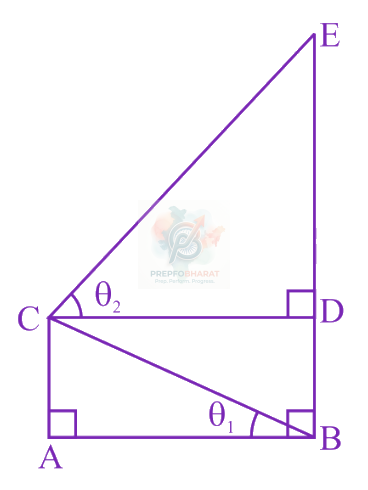
The value of $12{\int }_{0}^{3}|{x}^{2}-3x+2|\mathrm{dx}$ is ______
Let $g(x)=f(x)+f(1-x)$ and ${f}^{"}(x)>0,x\in (0,1)$. If $g$ is decreasing in the interval $(0,\alpha )$ and increasing in the interval $(\alpha ,1)$, then ${\mathrm{tan}}^{-1}2\alpha +{\mathrm{tan}}^{-1}(\frac{1}{\alpha })+{\mathrm{tan}}^{-1}(\frac{\alpha +1}{\alpha })$ is equal to
If ${a}_{\alpha }$ is the greatest term in the sequence ${a}_{n}=\frac{{n}^{3}}{{n}^{4}+147},n=1,2,3....,$ then $\alpha$ is equal to $______$
Let $f(x)=2x+{\mathrm{tan}}^{-1}x$ and $g(x)={\mathrm{log}}_{e}(\sqrt{1+{x}^{2}}+x),x\in [0,3]$. Then
Let $f(x)=|\begin{matrix}1+{\mathrm{sin}}^{2}x & {\mathrm{cos}}^{2}x & \mathrm{sin}2x \\ {\mathrm{sin}}^{2}x & 1+{\mathrm{cos}}^{2}x & \mathrm{sin}2x \\ {\mathrm{sin}}^{2}x & {\mathrm{cos}}^{2}x & 1+\mathrm{sin}2x\end{matrix}|,x\in [\frac{\pi }{6},\frac{\pi }{3}]$ . If $\alpha$ and $\beta$ respectively are the maximum and the minimum values of $f$, then
A square piece of tin of side $30\mathrm{cm}$ is to be made into a box without top by cutting a square from each corner and folding up the flaps to form a box. If the volume of the box is maximum, then its surface area (in ${\mathrm{cm}}^{2}$) is equal to
Let $[x]$ be the greatest integer $\leq x$. Then the number of points in the interval $(–2,1)$ where the function $f(x)=|[x]|+\sqrt{x-[x]}$ is discontinuous, is _____.
The integral $\int ({(\frac{x}{2})}^{x}+{(\frac{2}{x})}^{x}){\mathrm{log}}_{2}xdx$ is equal to
If ${\int }_{0}^{\pi }\frac{{5}^{\mathrm{cos}x}(1+\mathrm{cos}x\mathrm{cos}3x+{\mathrm{cos}}^{2}x+{\mathrm{cos}}^{3}x\mathrm{cos}3x)dx}{1+{5}^{\mathrm{cos}x}}=\frac{k\pi }{16}$, then $k$ is equal to _____ .
If ${\int }_{0}^{1}({x}^{21}+{x}^{14}+{x}^{7}){(2{x}^{14}+3{x}^{7}+6)}^{1/7}dx=\frac{1}{l}{(11)}^{m/n}$ where $l,m,n\in N,m$ and $n$ are co-prime then $l+m+n$ is equal to _____ .
Let a differentiable function $f$ satisfy $f(x)+{\int }_{3}^{x}\frac{f(t)}{t}dt=\sqrt{x+1},x\geq 3$. Then $12f(8)$ is equal to:
The value of $\frac{8}{\pi }{\int }_{0}^{\frac{\pi }{2}}\frac{{(\mathrm{cos}x)}^{2023}}{{(\mathrm{sin}x)}^{2023}+{(\mathrm{cos}x)}^{2023}}dx$ is ______.
Let the function $f(x)=2{x}^{3}+(2p-7){x}^{2}+3(2p-9)x-6$ have a maxima for some value of $x<0$ and a minima for some value of $x>0$. Then, the set of all values of $p$ is
The area of the region enclosed by the curve $y={x}^{3}$ and its tangent at the point $(–1,–1)$ is
The area of the region ${(x,y):{x}^{2}\leq y\leq 8-{x}^{2},y\leq 7}$ is
Let the area of the region ${(x,y):|2x-1|\leq y\leq |{x}^{2}-x|,0\leq x\leq 1}$ be $A$. Then ${(6A+11)}^{2}$ is equal to _____ .
The area of the region $A={(x,y):|\mathrm{cos}x-\mathrm{sin}x|\leq y\leq \mathrm{sin}x,0\leq x\leq \frac{\pi }{2}}$
Let $y={y}_{1}(x)$ and $y={y}_{2}(x)$ be the solution curves the differential equation $\frac{dy}{dx}=y+7$ with initial conditions ${y}_{1}(0)=0$ and ${y}_{2}(0)=1$ respectively. Then the curves $y={y}_{1}(x)$ and $y={y}_{2}(x)$ intersect at
The slope of tangent at any point $(x,y)$ on a curve $y=y(x)$ is $\frac{{x}^{2}+{y}^{2}}{2xy},x>0$. If $y(2)=0$, then a value of $y(8)$ is
Let $f$ be a differentiable function such that ${x}^{2}f(x)-x=4{\int }_{0}^{x}tf(t)dt,f(1)=\frac{2}{3}$. Then $18f(3)$ is equal to
If the solution curve of the differential equation $(y-2{\mathrm{log}}_{e}x)dx+(x{\mathrm{log}}_{e}{x}^{2})dy=0,x>1$ passes through the points $(e,\frac{4}{3})$ and $({e}^{4},\alpha )$, then $\alpha$ is equal to $_______$
If $y=y(x)$ is the solution curve of the differential equation $\frac{dy}{dx}+y\mathrm{tan}x=x\mathrm{sec}x,0\leq x\leq \frac{\pi }{3},y(0)=1$, then $y(\frac{\pi }{6})$ is equal to
Let $y=y(t)$ be a solution of the differential equation $\frac{dy}{dt}+\alpha y=\gamma {e}^{-\beta t}$ Where, $\alpha >0,\beta >0$ and $\gamma >0$. Then ${Lim}_{t\rightarrow \infty }y(t)$