JEE Main Mathematics — Calculus previous year questions with solutions.
Let $y=y(x)$ be a solution curve of the differential equation, $(1-{x}^{2}{y}^{2})dx=ydx+xdy$, If the line $x=1$ intersects the curve $y=y(x)$ at $y=2$ and the line $x=2$ intersects the curve $y=y(x)$ at $y=\alpha$, then a value of $\alpha$ is
Let the solution curve $x=x(y),0<y<\frac{\pi }{2}$, of the differential equation ${({\mathrm{log}}_{e}(\mathrm{cos}y))}^{2}\mathrm{cos}ydx-(1+3x{\mathrm{log}}_{e}(\mathrm{cos}y))\mathrm{sin}ydy=0$ satisfy $x(\frac{\pi }{3})=\frac{1}{2{\mathrm{log}}_{e}2}$. If $x(\frac{\pi }{6})=\frac{1}{{\mathrm{log}}_{e}m-{\mathrm{log}}_{e}n}$, where $m$ and $n$ are coprime, then $mn$ is equal to
If ${\int }_{-0.15}^{0.15}|100{x}^{2}-1|dx=\frac{k}{3000},$ then $k$ is equal to _____.
Let $I(x)=\int \frac{x+1}{x{(1+x{e}^{x})}^{2}}dx,x>0.$ If $\underset{x\rightarrow \infty }{\mathrm{lim}}I(x)=0$ then $I(1)$ is equal to
The area enclosed by the closed curve $C$ given by the differential equation $\frac{dy}{dx}+\frac{x+a}{y-2}=0,y(1)=0$ is $4\pi$. Let $P$ and $Q$ be the points of intersection of the curve $C$ and the $y$-axis. If normals at $P$ and $Q$ on the curve $C$ intersect $x$-axis at points $R$ and $S$ respectively, then the length of the line segment $RS$ is
The sum of the abosolute maximum and minimum values of the function $f(x)=|{x}^{2}-5x+6|-3x+2$ in the interval $[-1,3]$ is equal to :
Let $y=y(x)$ be the solution of the differential equation $x{\mathrm{log}}_{e}x\frac{dy}{dx}+y={x}^{2}{\mathrm{log}}_{e}x,(x>1)$. If $y(2)=2$, then $y(e)$ is equal to
If [ $t$ denotes the greatest integer $\leq 1$, then the value of $\frac{3(e-1)}{e}{\int }_{1}^{2}{x}^{2}{e}^{[x]+[{x}^{3}]}dx$ is :
If the area of the region bounded by the curves ${y}^{2}-2y=-x$ and $x+y=0$ is $A$, then $8A=$
The area of the region $x,y:{x}^{2}\leq y\leq |{x}^{2}-4|,y\geq 1$ is
Let $x=2$ be a root of the equation ${x}^{2}+px+q=0$ and $f(x)={\begin{matrix}\frac{1-\mathrm{cos}({x}^{2}-4px+{q}^{2}+8q+16)}{{(x-2p)}^{4}}, & x\neq 2p \\ 0, & x=2p\end{matrix}$. Then $\underset{x\rightarrow 2{p}^{+}}{\mathrm{lim}}[f(x)]$ where $[\cdot ]$ denotes greatest integer function, is
In the figure, ${\theta }_{1}+{\theta }_{2}=\frac{\pi }{2}$ and $\sqrt{3}(\mathrm{BE})=4(\mathrm{AB})$. If the area of $\Delta \mathrm{CAB}$ is $2\sqrt{3}-3{\mathrm{unit}}^{2}$, when $\frac{{\theta }_{2}}{{\theta }_{1}}$ is the largest, then the perimeter (in unit) of $\Delta \mathrm{CED}$ is equal to 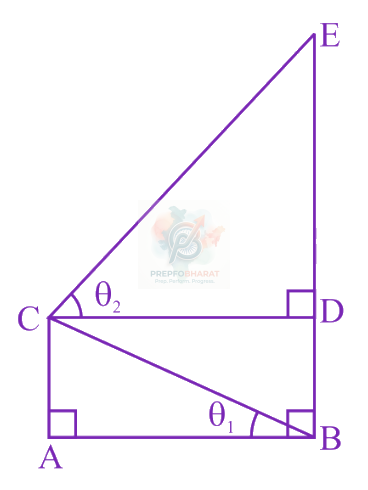
The value of $12{\int }_{0}^{3}|{x}^{2}-3x+2|\mathrm{dx}$ is ______
Let $f$ and $g$ be twice differentiable functions on $R$ such that ${f}^{"}(x)={g}^{"}(x)+6x$ ${f}^{'}(1)=4{g}^{'}(1)-3=9$ $f(2)=3g(2)=12$ Then which of the following is NOT true ?
Let $y(x)=(1+x)(1+{x}^{2})(1+{x}^{4})(1+{x}^{8})(1+{x}^{16})$. Then ${y}^{'}-{y}^{"}$ at $x=-1$ is equal to
If ${a}_{\alpha }$ is the greatest term in the sequence ${a}_{n}=\frac{{n}^{3}}{{n}^{4}+147},n=1,2,3....,$ then $\alpha$ is equal to $______$
Let $f(x)=2x+{\mathrm{tan}}^{-1}x$ and $g(x)={\mathrm{log}}_{e}(\sqrt{1+{x}^{2}}+x),x\in [0,3]$. Then
Let $f(x)=|\begin{matrix}1+{\mathrm{sin}}^{2}x & {\mathrm{cos}}^{2}x & \mathrm{sin}2x \\ {\mathrm{sin}}^{2}x & 1+{\mathrm{cos}}^{2}x & \mathrm{sin}2x \\ {\mathrm{sin}}^{2}x & {\mathrm{cos}}^{2}x & 1+\mathrm{sin}2x\end{matrix}|,x\in [\frac{\pi }{6},\frac{\pi }{3}]$ . If $\alpha$ and $\beta$ respectively are the maximum and the minimum values of $f$, then
If $y(x)={x}^{x},x>0$, then ${y}^{"}(2)-2{y}^{'}(2)$ is equal to :
The integral $\int ({(\frac{x}{2})}^{x}+{(\frac{2}{x})}^{x}){\mathrm{log}}_{2}xdx$ is equal to
For $m,n>0$, let $\alpha (m,n)={\int }_{0}^{2}{t}^{m}{(1+3t)}^{n}dt$. If ,$11\alpha (10,6)+18\alpha (11,5)=p{(14)}^{6}$, then $p$ is equal to
If ${\int }_{0}^{1}({x}^{21}+{x}^{14}+{x}^{7}){(2{x}^{14}+3{x}^{7}+6)}^{1/7}dx=\frac{1}{l}{(11)}^{m/n}$ where $l,m,n\in N,m$ and $n$ are co-prime then $l+m+n$ is equal to _____ .
If ${\int }_{0}^{\pi }\frac{{5}^{\mathrm{cos}x}(1+\mathrm{cos}x\mathrm{cos}3x+{\mathrm{cos}}^{2}x+{\mathrm{cos}}^{3}x\mathrm{cos}3x)dx}{1+{5}^{\mathrm{cos}x}}=\frac{k\pi }{16}$, then $k$ is equal to _____ .
Let a differentiable function $f$ satisfy $f(x)+{\int }_{3}^{x}\frac{f(t)}{t}dt=\sqrt{x+1},x\geq 3$. Then $12f(8)$ is equal to: