Physical Chemistry PYQ — Page 72
JEE Main Chemistry — Physical Chemistry previous year questions with solutions.
All Physical Chemistry Questions (1826)
According to Bohr's theory, the angular momentum of an electron in $5^{\text {th }}$ orbit is
The "spin-only" magnetic moment [in units of Bohr magneton, $\left.\left(\mu_{\mathrm{B}}\right)\right]$ of $\mathrm{Ni}^{2+}$ in aqueous solution would be (Atomic number of $\mathrm{Ni}=28$ )
$18 \mathrm{~g}$ of glucose $\left(\mathrm{C}_6 \mathrm{H}_{12} \mathrm{O}_6\right)$ is added to $178.2 \mathrm{~g}$ of water. The vapour pressure of water for this aqueous solution at $100^{\circ} \mathrm{C}$ is
An ideal gas is allowed to expand both reversibly and irreversibly in an isolated system. If $T_i$ is the initial temperature and $T_f$ is the final temperature, which of the following statements is correct?
The following mechanism has been proposed for the reaction of $\mathrm{NO}$ with $\mathrm{Br}_2$ to form $\mathrm{NOBr}$ : $\mathrm{NO}(\mathrm{g})+\mathrm{Br}_2(\mathrm{~g}) \rightleftharpoons \mathrm{NOBr}_2(\mathrm{~g})$ $$ \mathrm{NOBr}_2(\mathrm{~g})+\mathrm{NO}(\mathrm{g}) \longrightarrow 2 \mathrm{NOBr}(\mathrm{g}) $$ If the second step is the rate determining step, the order of the reaction with respect to $N O(g)$ is
Rate of a reaction can be expressed by Arrhenius equation as: $$ \mathrm{k}=\mathrm{Ae}^{-\mathrm{E} / \mathrm{RT}} $$ In this equation, E represents
The standard enthalpy of formation $\left(\Delta_{\mathrm{f}} \mathrm{H}^{\circ}\right)$ at $298 \mathrm{~K}$ for methane, $\mathrm{CH}_4(\mathrm{~g})$, is $-74.8 \mathrm{~kJ} \mathrm{~mol}^{-1}$. The additional information required to determine the average energy for $\mathrm{C}-\mathrm{H}$ bond formation would be
Uncertainty in the position of an electron (mass $=9.1 \times 10^{-31} \mathrm{~kg}$ ) moving with a velocity $300 \mathrm{~ms}^{-1}$, accurate upto $0.001 \%$, will be
In the transformation of ${ }_{92}^{238} \mathrm{U}$ to ${ }_{92}^{234} \mathrm{U}$, if one emission is an $\alpha$-particle, what should be the other emission(s)?
Resistance of a conductivity cell filled with a solution of an electrolyte of concentration $0.1 \mathrm{M}$ is $100 \Omega$. The conductivity of this solution is $1.29 \mathrm{~S} \mathrm{~m}^{-1}$. Resistance of the same cell when filled with $0.2 \mathrm{M}$ of the same solution is $520 \Omega$. The molar conductivity of $0.02 \mathrm{M}$ solution of the electrolyte will be
Density of a $2.05 \mathrm{M}$ solution of acetic acid in water is $1.02 \mathrm{~g} / \mathrm{mL}$. The molality of the solution is
If we consider that $\frac{1}{6}$, in place of $\frac{1}{12}$; mass of carbon atom is taken to be the relative atomic mass unit, the mass of one mole of a substance will
Hydrogen ion concentration in mol / L in a solution of pH = 5.4 will be
Aluminium oxide may be electrolysed at $1000^{\circ} \mathrm{C}$ to furnish aluminium metal (Atomic mass $=27$ amu; 1 Faraday $=96,500$ Coulombs). The cathode reaction is $\mathrm{Al}^{3+}+3 \mathrm{e}^{-} \longrightarrow \mathrm{Al}^{\circ}$ To prepare $5.12 \mathrm{~kg}$ of aluminium metal by this method would require
A schematic plot of ln $\mathrm{K}_{\text {eq }}$ versus inverse of temperature for a reaction is shown below 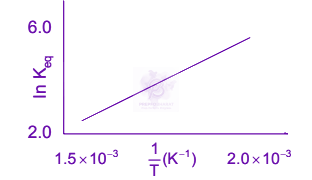 The reaction must be
For a spontaneous reaction the $\Delta \mathrm{G}$, equilibrium constant $(\mathrm{K})$ and $\mathrm{E}_{\mathrm{cell}}^{\circ}$ will be respectively
Of the following sets which one does NOT contain isoelectronic species?
If the bond dissociation energies of $X Y, X_2$ and $Y_2$ (all diatomic molecules) are in the ratio of 1:1:0.5 and $\Delta_t \mathrm{H}$ for the formation of $X Y$ is $-200 \mathrm{~kJ} \mathrm{~mole}^{-1}$. The bond dissociation energy of $\mathrm{X}_2$ will be
An organic compound having molecular mass 60 is found to contain $\mathrm{C}=20 \%, \mathrm{H}=$ $6.67 \%$ and $\mathrm{N}=46.67 \%$ while rest is oxygen. On heating it gives $\mathrm{NH}_3$ alongwith a solid residue. The solid residue give violet colour with alkaline copper sulphate solution. The compound is
$\mathrm{t}_{1 / 4}$ can be taken as the time taken for the concentration of a reactant to drop to $\frac{3}{4}$ of its initial value. If the rate constant for a first order reaction is $\mathrm{K}$, the $\mathrm{t}_{1 / 4}$ can be written as
The exothermic formation of $\mathrm{ClF}_3$ is represented by the equation: $$ \mathrm{Cl}_{2(g)}+3 \mathrm{~F}_{2(g)} \rightleftharpoons 2 \mathrm{ClF}_{3(g)} ; \Delta \mathrm{r} \mathrm{H}=-329 \mathrm{~kJ} $$ Which of the following will increase the quantity of $\mathrm{ClF}_3$ in an equilibrium mixture of $\mathrm{Cl}_2, \mathrm{~F}_2$ and $\mathrm{ClF}_3$ ?
A reaction involving two different reactants can never be
The solubility product of a salt having general formula $M X_2$, in water is: $4 \times 10^{-12}$. The concentration of $\mathrm{M}^{2+}$ ions in the aqueous solution of the salt is
Two solutions of a substance (non electrolyte) are mixed in the following manner. 480 ml of 1.5 M first solution + 520 mL of 1.2 M second solution. What is the molarity of the final mixture?