Physical Chemistry PYQ — Page 67
JEE Main Chemistry — Physical Chemistry previous year questions with solutions.
All Physical Chemistry Questions (1826)
$12 \mathrm{~g}$ of a nonvolatile solute dissolved in $108 \mathrm{~g}$ of water produces the relative lowering of vapour pressure of $0.1$. The molecular mass of the solute is :
Given: $\mathrm{(I)}$ $\begin{aligned} & \mathrm{H}_2(\mathrm{g})+\frac{1}{2} \mathrm{O}_2(\mathrm{g}) \rightarrow \mathrm{H}_2 \mathrm{O}(l) ; \\ & \Delta \mathrm{H}^{\circ}{ }_{298 \mathrm{~K}}=-285.9 \mathrm{~kJ} \mathrm{~mol}^{-1} \end{aligned}$ $\mathrm{(II)}$ $\begin{aligned} & \mathrm{H}_2(\mathrm{g})+\frac{1}{2} \mathrm{O}_2(\mathrm{g}) \rightarrow \mathrm{H}_2 \mathrm{O}(\mathrm{g}); \\ & \Delta \mathrm{H}^{\circ}{ }_{298 \mathrm{~K}}=-241.8 \mathrm{~kJ} \mathrm{~mol}^{-1} \end{aligned}$ The molar enthalpy of vapourisation of water will be :
The ratio $\frac{K_p}{K_c}$ for the reaction $\mathrm{CO}(g)+\frac{1}{2} O_2(g) \rightleftharpoons C O_2(g)$ is:
The Gibbs energy for the decomposition of $\mathrm{Al}_2 \mathrm{O}_3$ at $500 \mathrm{~C}$ is as follows : $\frac{2}{3} \mathrm{Al}_2 \mathrm{O}_3 \rightarrow \frac{4}{3} \mathrm{Al}+\mathrm{O}_2, \Delta_r G=+940 \mathrm{~kJ} \mathrm{~mol}^{-1}$ The potential difference needed for the electrolytic reduction of aluminium oxide at $500^{\circ} \mathrm{C}$ should be at least :
How many litres of water must be added to $1$ litre of aqueous solution of $\mathrm{HCl}$ with a pH of $1$ to create an aqueous solution with pH of $2$?
In an atom how many orbital(s) will have the quantum numbers; $n=3, l=2$ and $m_l=+2$ ?
The incorrect expression among the following is :
An aqueous solution of oxalic acid dihydrate contains its $6.3 \mathrm{~g}$ in $250 \mathrm{ml}$. The volume of $0.1 \mathrm{~N}$ $\mathrm{NaOH}$ required to completely neutralize $10 \mathrm{ml}$ of this solution
Which of the following paramagnetic ions would exhibit a magnetic moment (spin only) of the order of $5 \mathrm{BM}$ ? (At. Nos. $\mathrm{Mn}=25, \mathrm{Cr}=24, \mathrm{~V}=23, \mathrm{Ti}=22$ )
A solution containing $0.85 \mathrm{~g}$ of $\mathrm{ZnCl}_2$ in $125.0 \mathrm{~g}$ of water freezes at $-0.23^{\circ} \mathrm{C}$. The apparent degree of dissociation of the salt is $\left(K_f\right.$ for water $=1.86 \mathrm{~K} \mathrm{~kg} \mathrm{~mol}^{-1}$, atomic mass: $\mathrm{Zn}=65.3$ and $\mathrm{Cl}=35.5)$
A transition metal $M$ forms a volatile chloride which has a vapour density of $94.8$. If it contains $74.75 \%$ of chlorine the formula of the metal chloride will be
If the kinetic energy of an electron is increased four times, the wavelength of the de-Broglie wave associated with it would become
One mole of $\mathrm{O}_{2(\mathrm{~g})}$ and two moles of $\mathrm{SO}_{2(\mathrm{~g})}$ were heated in a closed vessel of one-litre capacity at $1098 \mathrm{~K}$. At equilibrium $1.6$ moles of $\mathrm{SO}_{3(\mathrm{~g})}$ were found. The equilibrium constant $K_c$ of the reaction would be
The solubility (in mol $\mathrm{L}^{-1}$ ) of $\mathrm{AgCl}$ $\left(K_{\mathrm{sp}}=1.0 \times 10^{-10}\right)$ in a $0.1 \mathrm{M} \mathrm{KCl}$ solution will be
The limiting line in Balmer series will have a frequency of (Rydberg constant, $R_{\infty}=3.29 \times 10^{15}$ cycles $/ \mathrm{s}$ )
For a reaction $A \rightarrow$ Products, a plot of $\log t_{1 / 2}$ versus $\log a_0$ is shown in the figure. If the initial concentration of $A$ is represented by $a_0$, the order of the reaction is 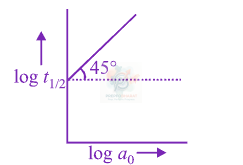
$8 \mathrm{~mol}$ of $A B_3(\mathrm{~g})$ are introduced into a $1.0 \mathrm{dm}^3$ vessel. If it dissociates as $2 \mathrm{AB}_3(g) \rightleftharpoons A_2(g)+3 B_2(g)$. At equilibrium, $2 \mathrm{~mol}$ of $A_2$ are found to be present. The equilibrium constant of this reaction is
The entropy of a sample of a certain substance increases by $0.836 \mathrm{~J} \mathrm{~K}^{-1}$ on adding reversibly $0.3344 \mathrm{~J}$ of heat at constant temperature. The temperature of the sample is:
In the following balanced reaction, 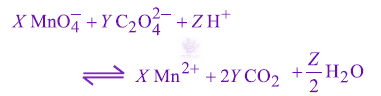 values of $X, Y$ and $Z$ respectively are
Reaction rate between two substance $A$ and $B$ is expressed as following: rate $=k[A]^n[B]^m$ If the concentration of $\mathrm{A}$ is doubled and concentration of $\mathrm{B}$ is made half of initial concentration, the ratio of the new rate to the earlier rate will be:
The electrons identified by quantum numbers $\mathrm{n}$ and $\mathrm{I}$ : (a) $n=4, I=1$ (b) $n=4, l=0$ (c) $n=3, I=2$ (d) $n=3, I=1$ Can be placed in order of increasing energy as:
The pH of a $0.1$ molar solution of the acid $\mathrm{HQ}$ is $3$ . The value of the ionization constant, Ka of this acid is :
The increasing order of the ionic radii of the given isoelectronic species is :
The electron affinity of chlorine is $3.7 \mathrm{eV} .1$ gram of chlorine is completely converted to $\mathrm{Cl}^{-}$ion in a gaseous state. $\left(1 \mathrm{eV}=23.06 \mathrm{kcal} \mathrm{mol}^{-1}\right)$. Energy released in the process is