JEE Main Chemistry — Physical Chemistry previous year questions with solutions.
$50\mathrm{mL}$ of $0.1M{\mathrm{CH}}_{3}\mathrm{COOH}$ is being titrated against $0.1M\mathrm{NaOH}$. When $25\mathrm{mL}$ of $\mathrm{NaOH}$ has been added, the $\mathrm{pH}$ of the solution will be____$\times {10}^{-2}$. (Nearest integer) (Given : ${\mathrm{pK}}_{a}({\mathrm{CH}}_{3}\mathrm{COOH})=4.76$) $\mathrm{log}2=0.30$ $\mathrm{log}3=0.48$ $\mathrm{log}5=0.69$ $\mathrm{log}7=0.84$ $\mathrm{log}11=1.04$
The neutralization occurs when $10\mathrm{mL}$ of $0.1M$ acid '$A$' is allowed to react with $30\mathrm{mL}$ of $0.05M$ base $M{(\mathrm{OH})}_{2}$. The basicity of the acid '$A$' is [$M$ is a metal]
$20\mathrm{mL}$ of $0.1M{\mathrm{NH}}_{4}\mathrm{OH}$ is mixed with $40\mathrm{mL}$ of $0.05M\mathrm{HCl}$. The $\mathrm{pH}$ of the mixture is nearest to: (Given: ${K}_{b}({\mathrm{NH}}_{4}\mathrm{OH})=1\times {10}^{-5},\mathrm{log}2=0.30$, $\mathrm{log}3=0.48,\mathrm{log}5=0.69,\mathrm{log}7=0.84$, $\mathrm{log}11=1.04$)
$20\mathrm{mL}$ of $0.02M$ hypo solution is used for the titration of $10\mathrm{mL}$ of copper sulphate solution, in the presence of excess of $\mathrm{KI}$ using starch as an indicator. The molarity of ${\mathrm{Cu}}^{2+}$ is found to be $_____\times {10}^{-2}M$ (nearest integer) Given : $2{\mathrm{Cu}}^{2+}+4{I}^{-}\rightarrow {\mathrm{Cu}}_{2}{I}_{2}+{I}_{2} {I}_{2}+2{S}_{2}{O}_{3}^{-2}\rightarrow 2{I}^{—}+{S}_{4}{O}_{6}^{-2}$
A compound '$X$' is a weak acid and it exhibits colour change at $\mathrm{pH}$ close to the equivalence point during neutralization of $\mathrm{NaOH}$ with ${\mathrm{CH}}_{3}\mathrm{COOH}$. Compound '$X$' exists in ionized form in basic medium. The compound '$X$' is
For a given chemical reaction ${\gamma }_{1}A+{\gamma }_{2}B\rightarrow {\gamma }_{3}C+{\gamma }_{4}D$. Concentration of $C$ changes from $10\mathrm{mmol}{\mathrm{dm}}^{-3}$ to $20\mathrm{mmol}{\mathrm{dm}}^{-3}$ in $10s.$ Rate of appearance of $D$ is $1.5$ times the rate of disappearance of $B$ which is twice the rate of disappearance $A$. The rate of appearance of $D$ has been experimentally determined to be $9\mathrm{mmol}{\mathrm{dm}}^{-3}{s}^{-1}.$ Therefore the rate of reaction is____$\mathrm{mmol}{\mathrm{dm}}^{-3}{s}^{-1}.$ (Nearest Integer)
Which of the following is the correct plot for the probability density ${\psi }^{2}(r)$ as a function of distance $'r'$ of the electron form the nucleus for $2s$ orbital?
The correct decreasing order of energy, for the orbitals having, following set of quantum numbers: (A) $n=3,1=0,m=0$ (B) $n=4,l=0,m=0$ (C) $n=3,l=1,m=0$ (D) $n=3,1=2,m=1$
The moles of methane required to produce $81g$ of water after complete combustion is____$\times {10}^{-2}\mathrm{mol}$. [nearest integer]
$C(s)+{O}_{2}(g)\rightarrow {\mathrm{CO}}_{2}(g)+400\mathrm{kJ}$ $C(s)+\frac{1}{2}{O}_{2}(g)\rightarrow \mathrm{CO}(g)+100\mathrm{kJ}$ When coal of purity $60%$ is allowed to burn in presence of insufficient oxygen, $60%$ of carbon is converted into ' $\mathrm{CO}$' and the remaining is converted into '${\mathrm{CO}}_{2}$'. The heat generated when $0.6\mathrm{kg}$ of coal is burnt is
A gaseous mixture of two substances $A$ and $B$, under a total pressure of $0.8\mathrm{atm}$ is in equilibrium with an ideal liquid solution. The mole fraction of substance $A$ is $0.5$ in the vapour phase and $0.2$ in the liquid phase. The vapour pressure of pure liquid $A$ is____atm.(Nearest integer)
Assertion: The amphoteric behaviour of water is explained by Lewis acid base theory Reason: water acts as acid with ${\mathrm{NH}}_{3}$ and base with ${H}_{2}S$
$150g$ of acetic acid was contaminated with $10.2g$ ascorbic acid $({C}_{6}{H}_{8}{O}_{6})$ to lower down its freezing point by $(x\times {10}^{-1})^{\circ}C$. The value of $x$ is____ (Nearest integer). [Given ${K}_{f}=3.9K\mathrm{kg}{\mathrm{mol}}^{-1}$; Molar mass of ascorbic acid $=176g{\mathrm{mol}}^{-1}$]
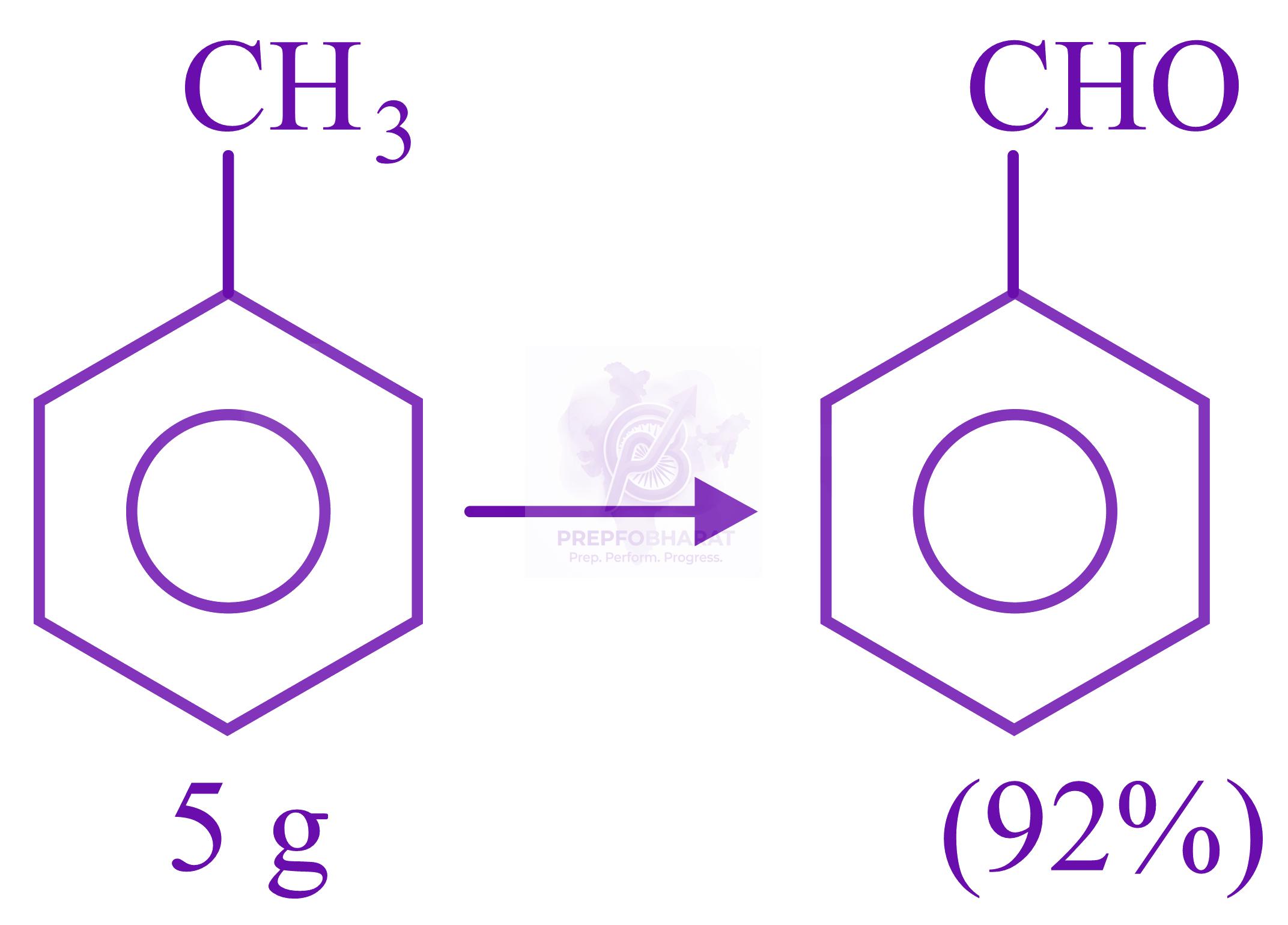 In the above reaction, $5g$ of toluene is converted into benzaldehyde with $92%$ yield. The amount of benzaldehyde produced is____ $\times {10}^{-2}g$
Consider the cell at $25^{\circ}C$ $\mathrm{Zn}|{\mathrm{Zn}}^{2+}(\mathrm{aq}),(1M)\|{\mathrm{Fe}}^{3+}(\mathrm{aq}),{\mathrm{Fe}}^{2+}(\mathrm{aq})|\mathrm{Pt}(s)$ The fraction of total iron present as ${\mathrm{Fe}}^{3+}$ ion at the cell potential of $1.500V$ is $x\times {10}^{-2}$. The value of $x$ is ______. (Nearest integer) $\mathrm{Given}:{{E}^{\circ }}_{{\mathrm{Fe}}^{3+}|{\mathrm{Fe}}^{2+}}=0.77V,{{E}^{\circ }}_{{\mathrm{Zn}}^{2+}|\mathrm{Zn}}=-0.76V$
${\mathrm{CO}}_{2}$ gas is bubbled through water during a soft drink manufacturing process at $298K$. If ${\mathrm{CO}}_{2}$ exerts a partial pressure of $0.835\mathrm{bar}$ then $xm\mathrm{mol}$ of ${\mathrm{CO}}_{2}$ would dissolve in $0.9L$ of water. The value of $x$ is _______. (Nearest integer) (Henry's law constant for ${\mathrm{CO}}_{2}$ at $298K$ is $1.67\times {10}^{3}\mathrm{bar}$)
Gaseous cyclobutene isomerizes to butadiene in a first order process which has a '$K$' value of $3.3\times {10}^{-4}{s}^{-1}$ at $153^{\circ}C.$ The time in minutes it takes for the isomerization to proceed $40%$ to completion at this temperature is_____. (Rounded off to the nearest integer)
Given below are two statements : Statement I : According to Bohr's model of an atom, qualitatively the magnitude of velocity of electron increases with decrease in positive charges on the nucleus as there is no strong hold on the electron by the nucleus. Statement II : According to Bohr's model of an atom, qualitatively the magnitude of velocity of electron increases with decrease in principle quantum number. In the light of the above statements, choose the most appropriate answer from the options given below:
The average $S-F$ bond energy in $\mathrm{kJ}{\mathrm{mol}}^{-1}$ of ${\mathrm{SF}}_{6}$ is _. (Rounded off to the nearest integer) [Given : The values of standard enthalpy of formation of ${\mathrm{SF}}_{6}(g),S(g)$ and $F(g)$ are $-1100,275$ and $80\mathrm{kJ}{\mathrm{mol}}^{-1}$ respectively.]
At $298K$, the enthalpy of fusion of a solid $(X)$ is $2.8\mathrm{kJ}{\mathrm{mol}}^{-1}$ and the enthalpy of vaporisation of the liquid $(X)$ is $98.2\mathrm{kJ}{\mathrm{mol}}^{-1}$. The enthalpy of sublimation of the substance $(X)$ in $\mathrm{kJ}{\mathrm{mol}}^{-1}$ is ______. (in nearest integer)
In which one of the following sets all species show disproportionation reaction?
When light of wavelength $248\mathrm{nm}$ falls on a metal of threshold energy $3.0\mathrm{eV}$, the de-Broglie wavelength of emitted electrons is ________ $\overset{o}{A}$. (Round off to the Nearest Integer). [Use : $\sqrt{3}=1.73,h=6.63\times {10}^{-34}\mathrm{Js};{m}_{e}=9.1\times {10}^{-31}\mathrm{kg};c=3.0\times {10}^{8}{\mathrm{ms}}^{-1};1\mathrm{eV}=1.6\times {10}^{-19}J]$
$1\mathrm{kg}$ of $0.75$ molal aqueous solution of sucrose can be cooled up to $-4^{\circ}C$ before freezing. The amount of ice (in $g$) that will be separated out is ___________. (Nearest integer) [Given : ${K}_{f}({H}_{2}O)=1.86K\mathrm{kg}{\mathrm{mol}}^{-1}$]
Electromagnetic radiation of wavelength $663\mathrm{nm}$ is just sufficient to ionise the atom of metal $A$. The ionization energy of metal $A$ in $\mathrm{kJ}{\mathrm{mol}}^{-1}$ is ___. (Rounded-off to the nearest integer) $[h=6.63\times {10}^{-34}\mathrm{Js},c=3.00\times {10}^{8}{\mathrm{ms}}^{-1},{N}_{A}=6.02\times {10}^{23}{\mathrm{mol}}^{-1}]$