Organic Chemistry PYQ — Page 45
JEE Main Chemistry — Organic Chemistry previous year questions with solutions.
All Organic Chemistry Questions (1783)
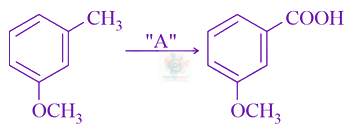 In the above reaction, the reagent "$A$" is :
The major product formed in the following reaction is: 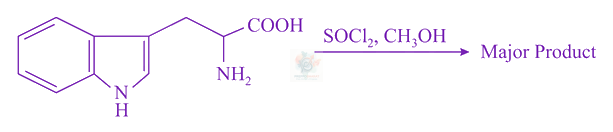
In the following sequence of reactions a compound $A,$ (molecular formula ${C}_{6}{H}_{12}{O}_{2}$ ) with a straight chain structure gives a ${C}_{4}$ carboxylic acid. $A$ is : $A\frac{{\mathrm{LiAlH}}_{4}}{{H}_{3}{O}^{+}}B\overset{\text{ Oxidation }}{\longrightarrow }{C}_{4}-$ carboxylic acid
The major product of the following reaction is :${\mathrm{CH}}_{3}{\mathrm{CH}}_{2}\mathrm{CH}={\mathrm{CH}}_{2}\rightarrow _{\mathrm{Rh}\mathrm{catalyst}}^{{H}_{2}/\mathrm{CO}}$
Which one of the following carbonyl compounds cannot be prepared by addition of water on an alkyne in the presence of ${\mathrm{HgSO}}_{4}$ and ${H}_{2}{\mathrm{SO}}_{4}?$
Identify $A$ in the following chemical reaction. 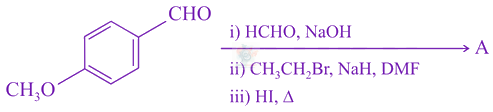
The major product (P) in the following reaction is: 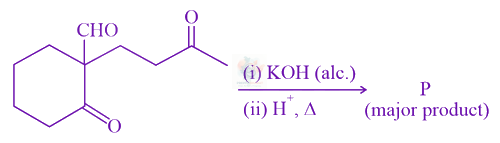
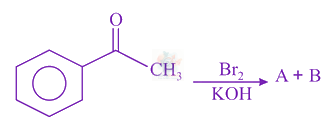
Identify the major products $A$ and $B$ respectively in the following reactions of phenol 
Identify $A$ in the given reaction. 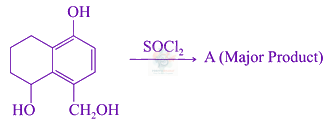
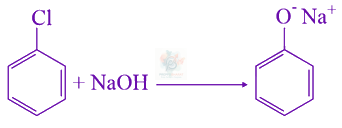 The above reaction requires which of the following reaction conditions?
To synthesise $1$ mole of $2-$methylpropan$-2-$ol from Ethylethanoate equivalents of ${\mathrm{CH}}_{3}\mathrm{MgBr}$ reagent will be required. (Integer value)
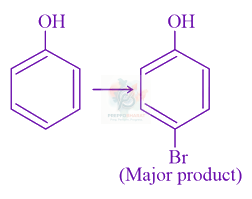 The given reaction can occur in the presence of : (a) Bromine water (b) ${\mathrm{Br}}_{2}$ in ${\mathrm{CS}}_{2},273K$ (c) ${\mathrm{Br}}_{2}/{\mathrm{FeBr}}_{3}$ (d) ${\mathrm{Br}}_{2}$ in ${\mathrm{CHCl}}_{3},273K$ Choose the correct answer from the options given below:
Given below are two statements : Statement I : The process of producing syn-gas is called gasification of coal. Statement II : The composition of syn-gas is $\mathrm{CO}+{\mathrm{CO}}_{2}+{H}_{2}(1:1:1).$ In the light of the above statements, choose the most appropriate answer from the options given below :
A reaction of benzonitrile with one equivalent ${\mathrm{CH}}_{3}\mathrm{MgBr}$ followed by hydrolysis produces a yellow liquid "P". The compound "P" will give positive ________
The major product of the following reaction is : 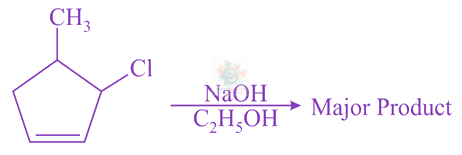
Which of the following compounds will show optical isomerism?
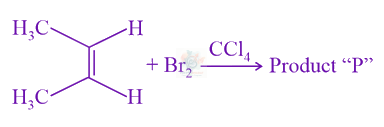 Consider the above chemical reaction. The total number of stereoisomers possible for Product "P" is _________
An organic compound '$A$' ${C}_{4}{H}_{8}$on treatment with ${\mathrm{KMnO}}_{4}/{H}^{+}$ yields compound '$B$' ${C}_{3}{H}_{6}O$. Compound '$A$' also yields compound '$B$' an ozonolysis. Compound '$A$' is :
The total number of negative charge in the tetrapeptide, Gly-Glu-Asp-Tyr, at $\mathrm{pH}12.5$ will be_______ (Integer answer)
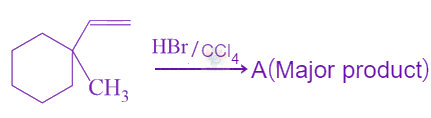
Match List$-I$ with List$-\mathrm{II}:$ <table class="pyq-table"><tbody><tr><td></td><td>List$-I$ (Chemicals)</td><td></td><td>List$-\mathrm{II}$ (Use / Preparation / Constituent)</td></tr><tr><td>(a)</td><td>Alcoholic potassium hydroxide</td><td>(i)</td><td>Electrodes in batteries</td></tr><tr><td>(b)</td><td>$\mathrm{Pd}/{\mathrm{BaSO}}_{4}$</td><td>(ii)</td><td>Obtained by addition reaction</td></tr><tr><td>(c)</td><td>$\mathrm{BHC}$ (Benzene hexachloride)</td><td>(iii)</td><td>Used for $\beta -$elimination reaction</td></tr><tr><td>(d)</td><td>Polyacetylene</td><td>(iv)</td><td>Lindlar's catalyst</td></tr></tbody></table>Choose the most appropriate match
Consider the following chemical reaction. $\mathrm{CH}\equiv \mathrm{CH}\frac{1)\mathrm{Red}\mathrm{hot}\mathrm{Fe}\mathrm{tube},873K}{2)\mathrm{CO},\mathrm{HCl},{\mathrm{AlCl}}_{3}}>\mathrm{Product}$ The number of ${\mathrm{sp}}^{2}$ hybridized carbon atom(s) present in the product is
Assertion A : Enol form of acetone $[{\mathrm{CH}}_{3}{\mathrm{COCH}}_{3}]$ exists in $<0.1%$ quantity. However, the enol form of acetyl acetone $[{\mathrm{CH}}_{3}{\mathrm{COCH}}_{2}{\mathrm{OCCH}}_{3}]$ exists in approximately $15%$quantity. Reason R : enol form of acetyl acetone is stabilized by intramolecular hydrogen bonding, which is not possible in enol form of acetone. Choose the correct statement:
The major products formed in the following reaction sequence $A$ and $B$ are: