Organic Chemistry PYQ — Page 38
JEE Main Chemistry — Organic Chemistry previous year questions with solutions.
All Organic Chemistry Questions (1783)
The structure of $A$ in the given reaction is 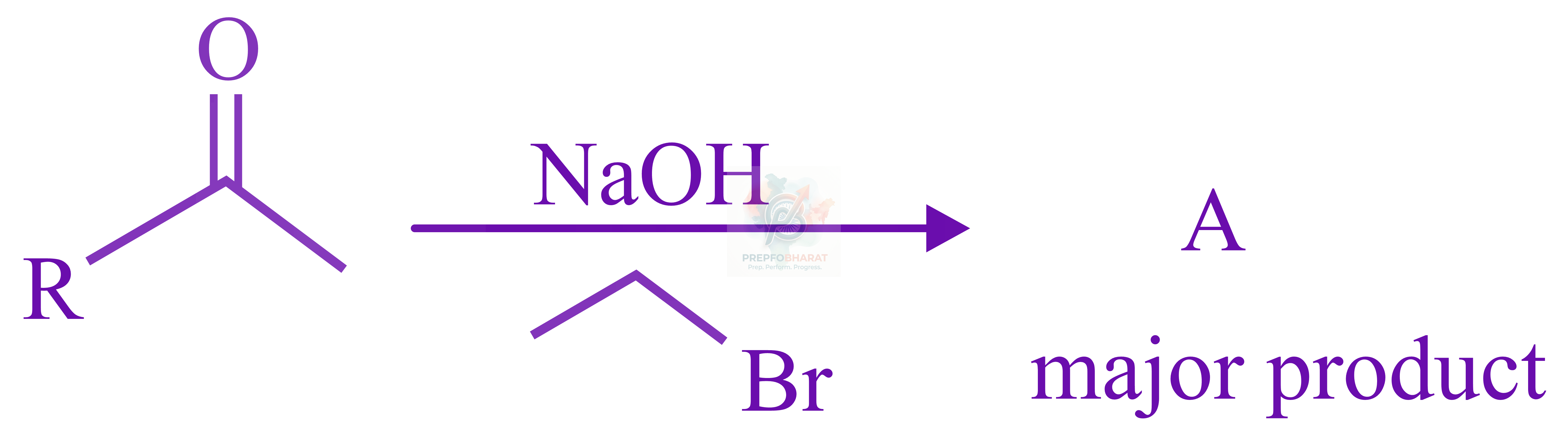
$L$-isomer of a compound $A''({C}_{4}{H}_{8}{O}_{4})$gives a positive test with ${[\mathrm{Ag}{({\mathrm{NH}}_{3})}_{2}]}^{+}$. Treatment of '$A$' with acetic anhydride yields triacetate derivative. Compound '$A$' produces an optically active compound $(B)$ and an optically inactive compound $(C)$ on treatment with bromine water and ${\mathrm{HNO}}_{3}$ respectively. Compound $(A)$ is :
Consider the following reaction sequence 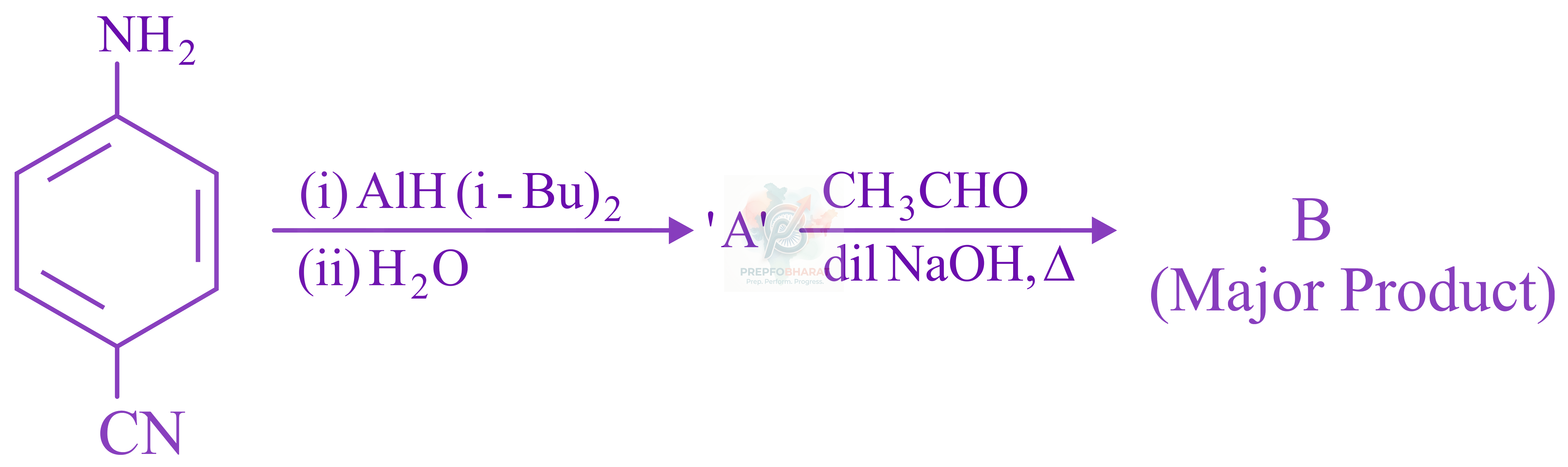 The product '$B$' is
Hydrolysis of which compound will give carbolic acid?
Toluene can be easily converted into benzaldehyde by which of the following reagents?
Arrange the following in decreasing acidic strength. 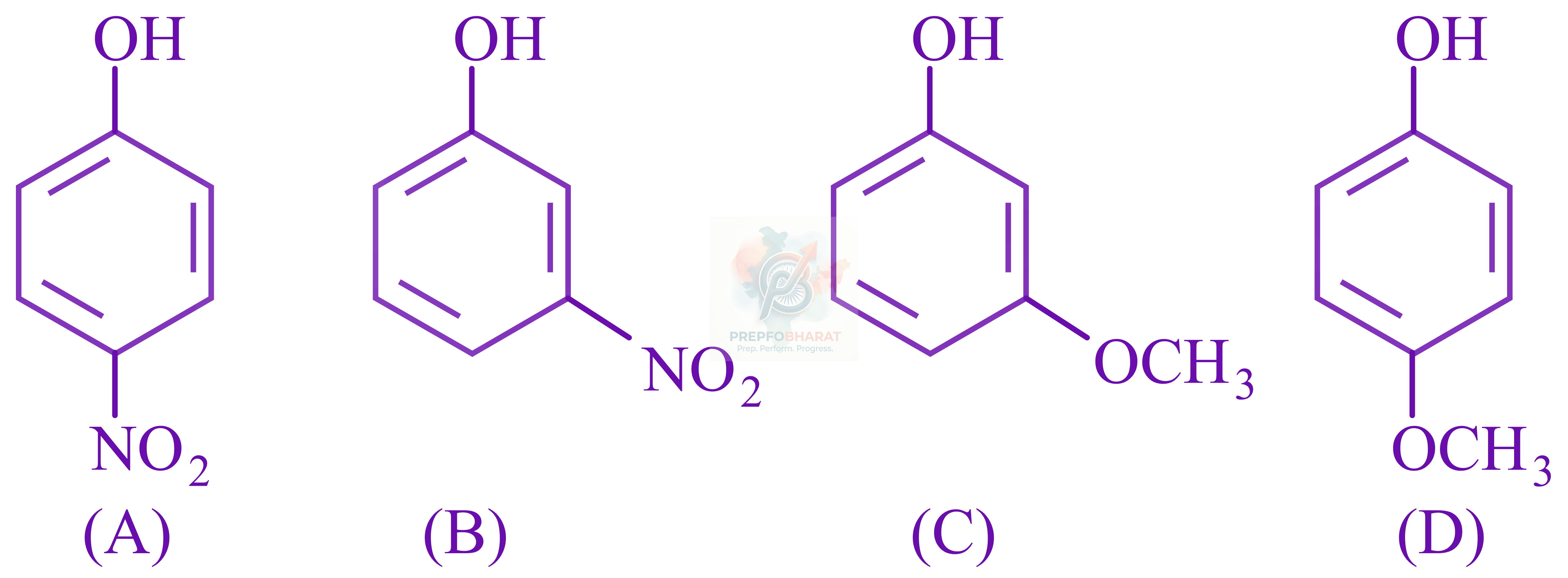
Which of the following is reducing sugar?
What will be the major product of following sequence of reactions? 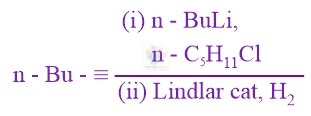
Observe structures of the following compounds  The total number of structures/compounds which possess asymmetric carbon atoms is
The major product '$A$' of the following given reaction has ${\mathrm{sp}}^{2}$ hybridized carbon atoms. $2,7$-Dimethyl-$2,6$-octadiene $\overset{{H}^{+}}{\longrightarrow }\underset{\mathrm{Major}\mathrm{Product}}{A}$
Identify the major product formed in the following sequence of reactions : 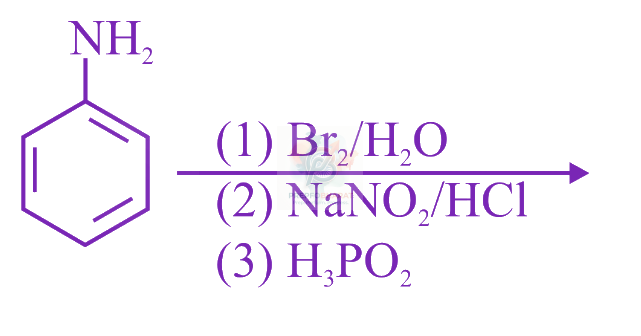
When sugar '$X$' is boiled with dilute ${H}_{2}{\mathrm{SO}}_{4}$ in alcoholic solution, two isomers '$A$' and '$B$' are formed. '$A$' on oxidation with ${\mathrm{HNO}}_{3}$ yields saccharic acid where as '$B$' is laevorotatory. The compound '$X$' is
The correct structure of product '$A$' formed in the following reaction, 
Among the following marked proton of which compound shows lowest ${\mathrm{pK}}_{a}$ value?
Given below are two statements : Statement I : In 'Lassaigne's Test', when both nitrogen and sulphur are present in an organic compound, sodium thiocyanate is formed. Statement II : If both nitrogen and sulphur are present in an organic compound, then the excess of sodium used in sodium fusion will decompose the sodium thiocyanate formed to give $\mathrm{NaCN}$ and ${\mathrm{Na}}_{2}S$. In the light of the above statements, choose the most appropriate answer from the options a: given below
Most stable product of the following reaction is 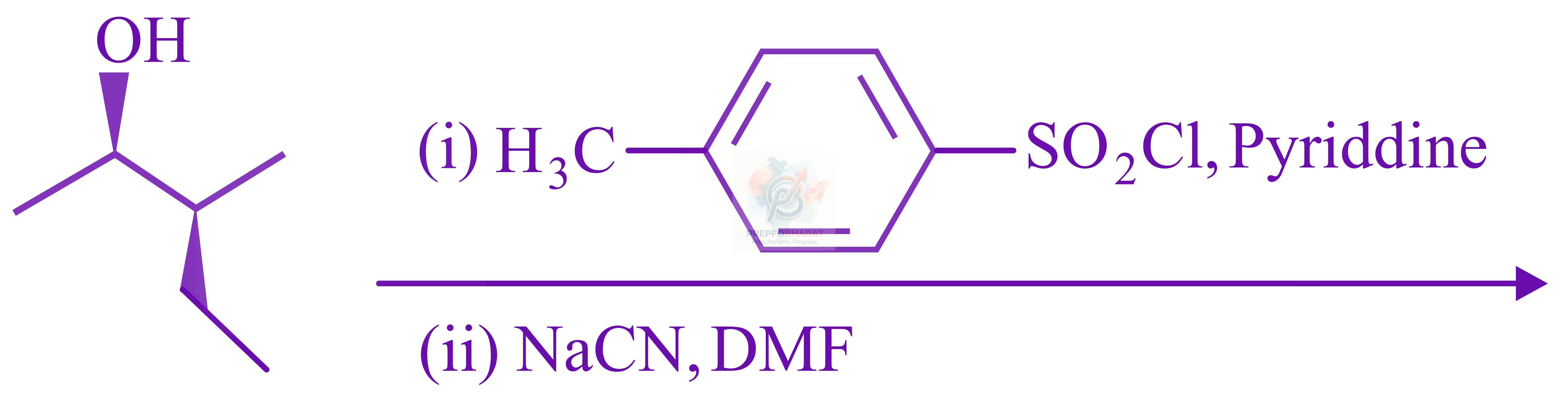
In alanylglycylleucylalanylvaline the number of peptide linkages is:
The major product formed in the given reaction is: 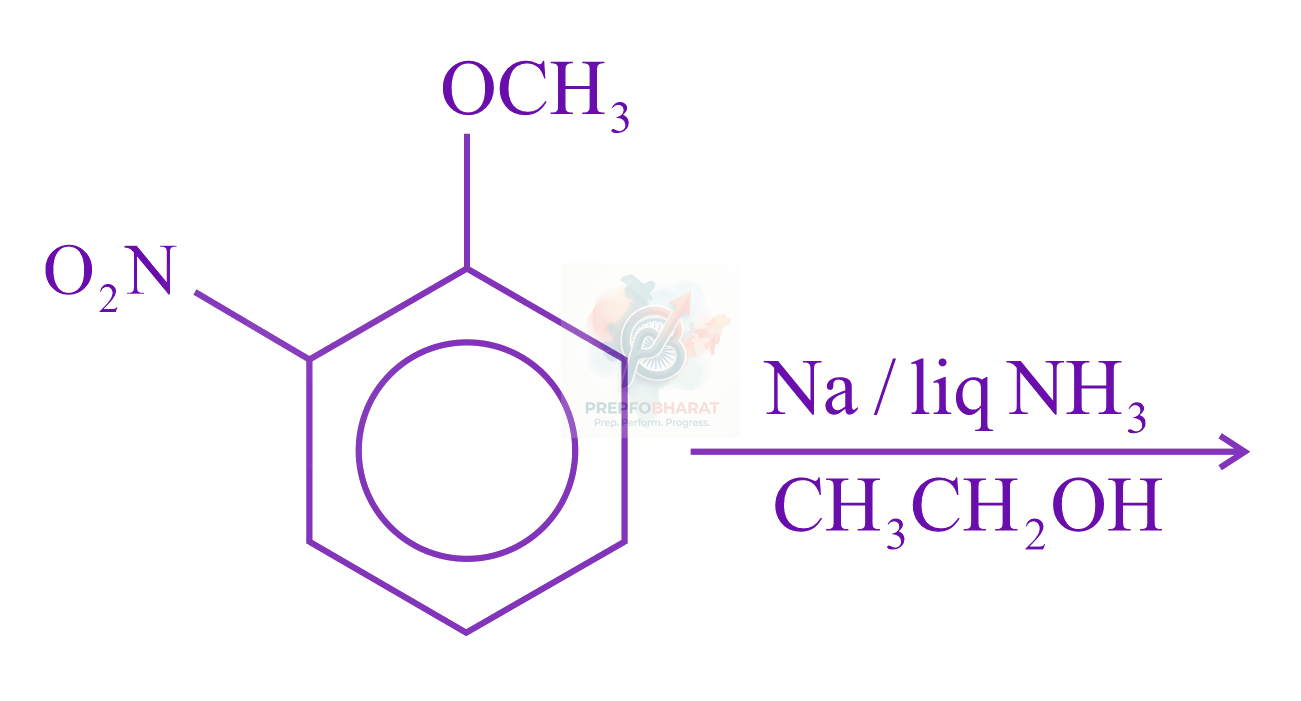
A sample of $4.5\mathrm{mg}$ of an unknown monohydric alcohol, $R-\mathrm{OH}$ was added to methylmagnesium iodide. A gas is evolved and is collected and its volume measured to be $3.1\mathrm{mL}$. The molecular weight of the unknown alcohol is $g/\mathrm{mol}$.
A $100\mathrm{mL}$ solution of ${\mathrm{CH}}_{3}{\mathrm{CH}}_{2}\mathrm{MgBr}$ on treatment with methanol produces $2.24\mathrm{mL}$ of a gas at STP. The weight of gas produced is____mg (nearest integer)
Which of the following compounds is not aromatic?
Wurtz reaction is used to prepare
Which of the following ketone will NOT give enamine on treatment with secondary amines? [where $t-\mathrm{Bu}$ is $-C{({\mathrm{CH}}_{3})}_{3}$]
Optical activity of an enantiomeric mixture is $+12.6^{\circ}$ and the specific rotation of $(+)$ isomer is $+30^{\circ}$. The optical purity is____$%$