Organic Chemistry PYQ — Page 24
JEE Main Chemistry — Organic Chemistry previous year questions with solutions.
All Organic Chemistry Questions (1783)
The correct order of reactivity in electrophilic substitution reaction of the following compounds is: 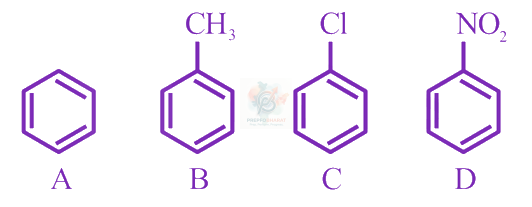
The final product A formed in the following multistep reaction sequence is 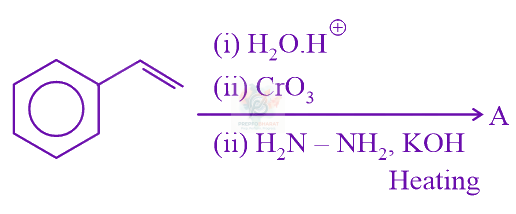
Which among the following has highest boiling point?
Which of the following gives a positive test with ninhydrin?
Match List I with List I <table class="pyq-table"><tbody><tr><td></td><td>List I (Substances)</td><td></td><td>List II (Element Present)</td></tr><tr><td>A.</td><td>Ziegler catalyst</td><td>I.</td><td>Rhodium</td></tr><tr><td>B.</td><td>Blood Pigment</td><td>II.</td><td>Cobalt</td></tr><tr><td>C.</td><td>Wilkinson catalyst</td><td>III.</td><td>Iron</td></tr><tr><td>D.</td><td>Vitamin B12</td><td>IV.</td><td>Titanium</td></tr></tbody></table>Choose the correct answer from the options given below:
Major product formed in the following reaction is a mixture of: 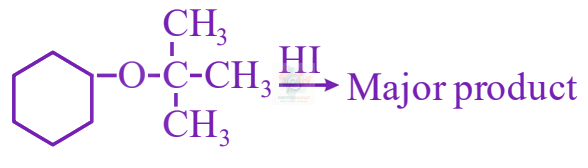
Which one the following compounds will readily react with dilute \(\mathrm{NaOH}\) ?
Match List I with List II \(\begin{array}{|l|l|l|l|} \hline & \text{ List - I (Test) } & & \text{List - II (Observation)} \\ \hline \text { A. } & \mathrm{Br}_2 \text { water test } & \text { I. } & \text { Yellow orange or orange red precipitate formed } \\ \hline \text { B. } & \text { Ceric ammonium nitrate test } & \text { II. } & \text { Reddish orange colour disappears } \\ \hline \text { C. } & \text { Ferric chloride test } & \text { III. } & \text { Red colour appears } \\ \hline \text { D. } & 2,4 \text { - DNP test } & \text { IV. } & \text { Blue, Green, Violet or Red colour appear } \\ \hline \end{array}\) Choose the correct answer from the options given below:
Consider the given chemical reaction sequence : 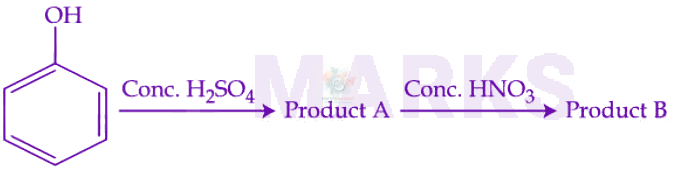 Total sum of oxygen atoms in Product A and Product B are _______
Sugar which does not give reddish brown precipitate with Fehling's reagent is:
The final product A, formed in the following reaction sequence is: 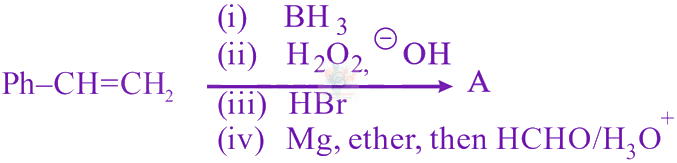
A species having carbon with sextet of electrons and can act as electrophile is called
Correct order of stability of carbanion is - 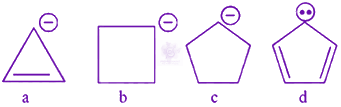
In the given reactions identify the reagent $A$ and reagent $B$ 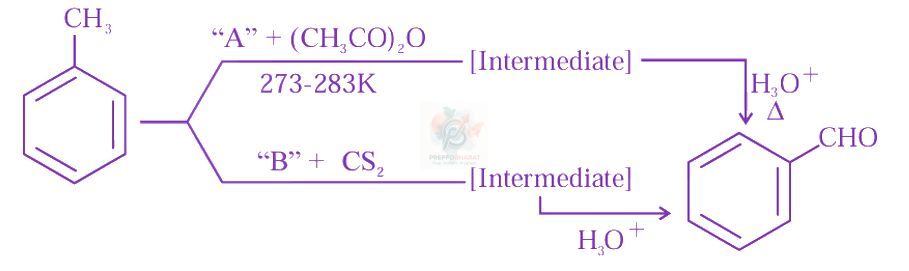
If one strand of a $\mathrm{DNA}$ has the sequence ATGCTTCA, sequence of the bases in complementary strand is:
The product $A$ formed in the following reaction is: 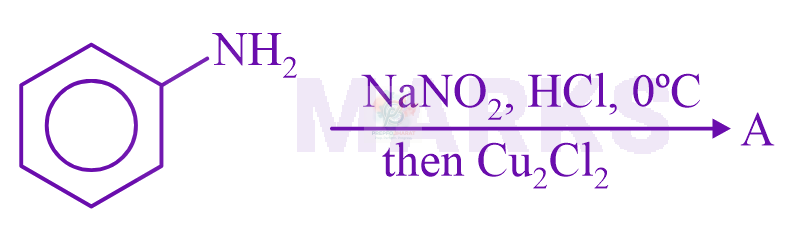
For the given compounds, the correct order of increasing \(\mathrm{pK}_{\mathrm{a}}\) value : 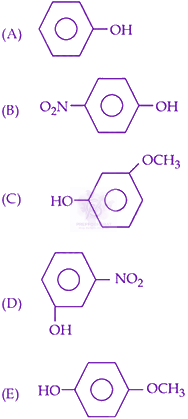 Choose the correct answer from the options given below :
Given below are two statements: Statement (I) : Aminobenzene and aniline are same organic compounds. Statement (II) : Aminobenzene and aniline are different organic compounds. In the light of the above statements, choose the most appropriate answer from the options given below:
Compound $A,{C}_{5}{H}_{10}{O}_{5}$, given a tetraacetate with ${\mathrm{AC}}_{2}O$ and oxidation of $A$ with ${\mathrm{Br}}_{2}-{H}_{2}O$ gives an acid, ${C}_{5}{H}_{10}{O}_{6}$. Reduction of $A$ with $\mathrm{HI}$ gives isopentane. The possible structure of $A$ is :
In the reaction given below 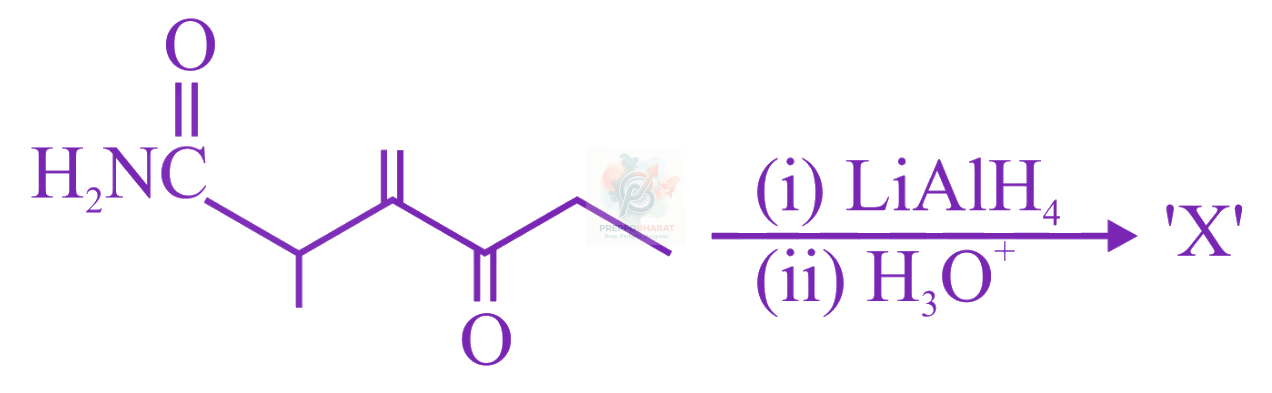 The product ‘$X$’ is :
Number of compounds giving (i) red colouration with ceric ammonium nitrate and also (ii) positive iodoform test from the following is _________ 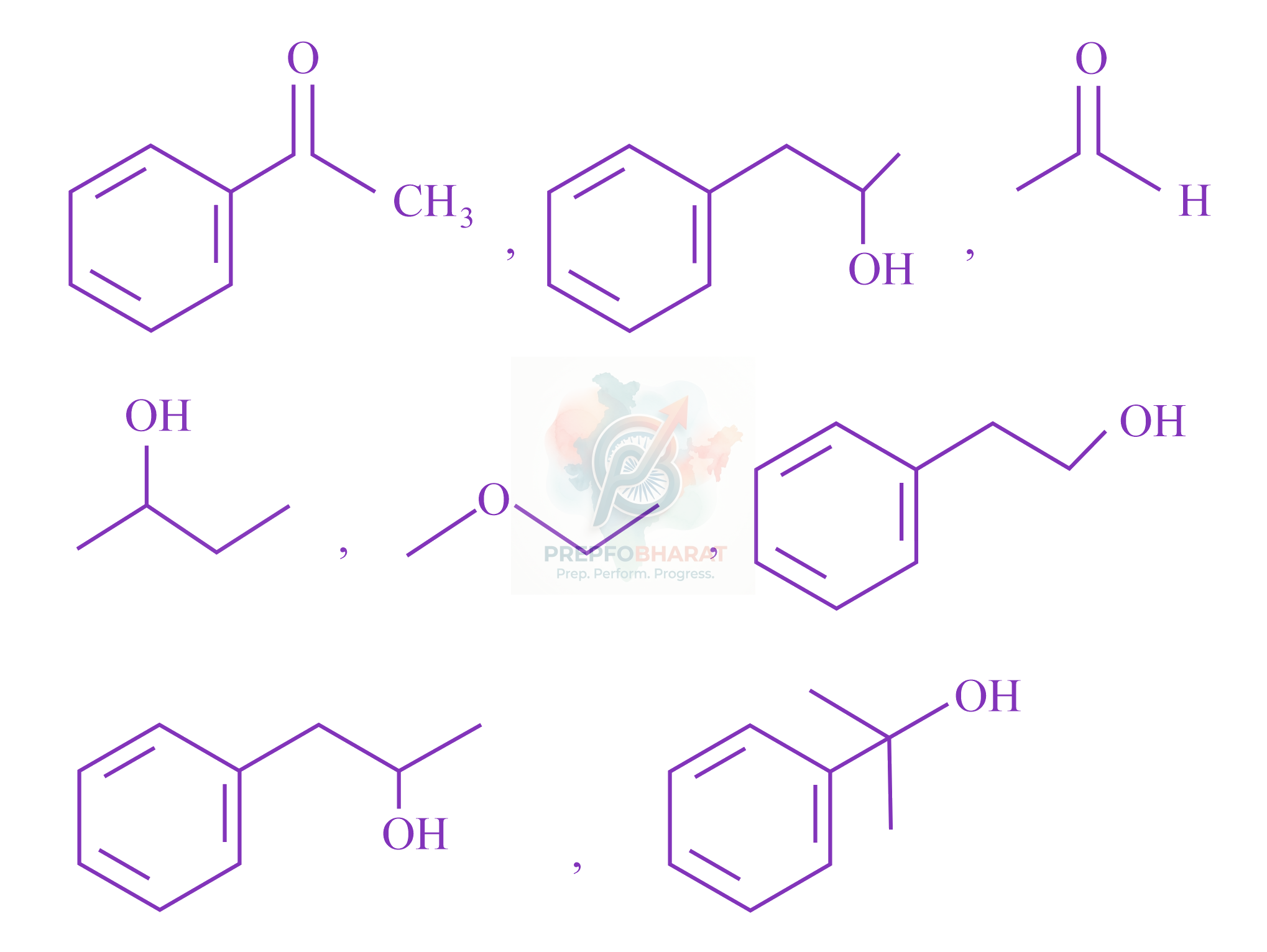
  Where Nu = Nucleophile Find out the correct statement from the options given below for the above two reactions.
Choose the correct set of reagents for the following conversion trans$(\mathrm{Ph}-\mathrm{CH}=\mathrm{CH}-{\mathrm{CH}}_{3})\rightarrow \text{ cis }(\mathrm{Ph}-\mathrm{CH}=\mathrm{CH}-{\mathrm{CH}}_{3})$
Given below are two statements : Statement I : 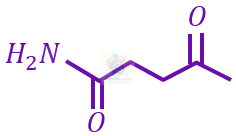 under Clemmensen reduction conditions will give 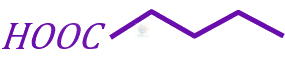 Statement II : 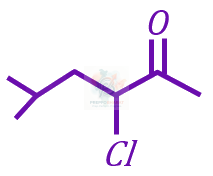 under Wolff-Kishner reduction condition will give 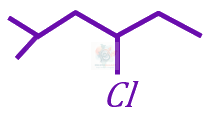 In the light of the above statements, choose the correct answer from the options given below :