Organic Chemistry PYQ — Page 18
JEE Main Chemistry — Organic Chemistry previous year questions with solutions.
All Organic Chemistry Questions (1783)
Major product of the following reaction is: 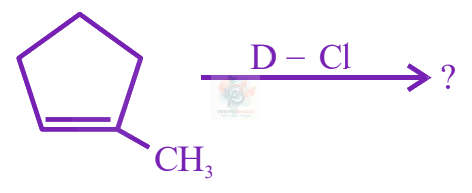
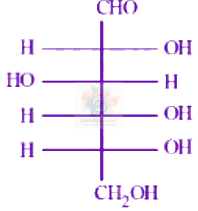 The incorrect statement regarding the given structure is
Identify the reagents used for the following conversion 
Phenol treated with chloroform in presence of sodium hydroxide, which further hydrolysed in presence of an acid results
The total number of correct statements, regarding the nucleic acids is _________. A. RNA is regarded as the reserve of genetic information. B. DNA molecule self-duplicates during cell division C. DNA synthesizes proteins in the cell. D. The message for the synthesis of particular proteins is present in DNA E. Identical DNA strands are transferred to daughter cells.
The number of the correct reaction(s) among the following is ______ 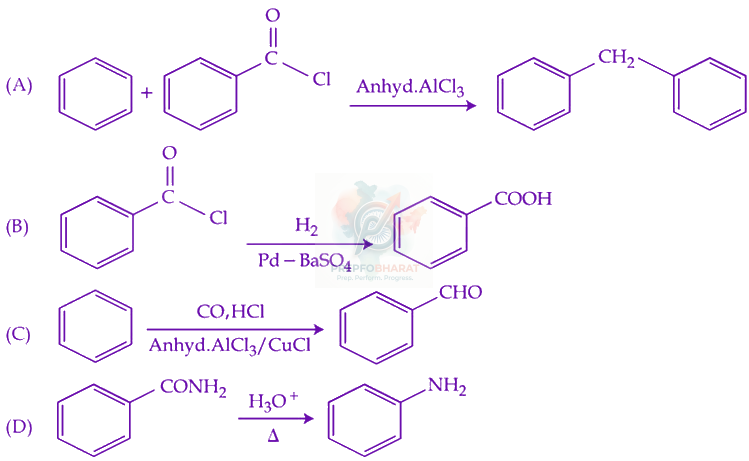
The total number of 'sigma' and 'Pi' bonds in 2-oxohex-4-ynoic acid is ______
If \(279 \mathrm{~g}\) of aniline is reacted with one equivalent of benzenediazonium chloride, the maximum amount of aniline yellow formed will be _______ g. (nearest integer) (consider complete conversion).
The correct sequence of acidic strength of the following aliphatic acids in their decreasing order is: \(\mathrm{CH}_3 \mathrm{CH}_2 \mathrm{COOH}, \mathrm{CH}_3 \mathrm{COOH}, \mathrm{CH}_3 \mathrm{CH}_2 \mathrm{CH}_2 \mathrm{COOH}, \mathrm{HCOOH}\)
Given below are two statements : one is labelled as Assertion (A) and the other is labelled as Reason (R). Assertion (A) : Cis form of alkene is found to be more polar than the trans form. Reason (R): Dipole moment of trans isomer of 2-butene is zero. In the light of the above statements, choose the correct answer from the options given below :
Match List I with List II : 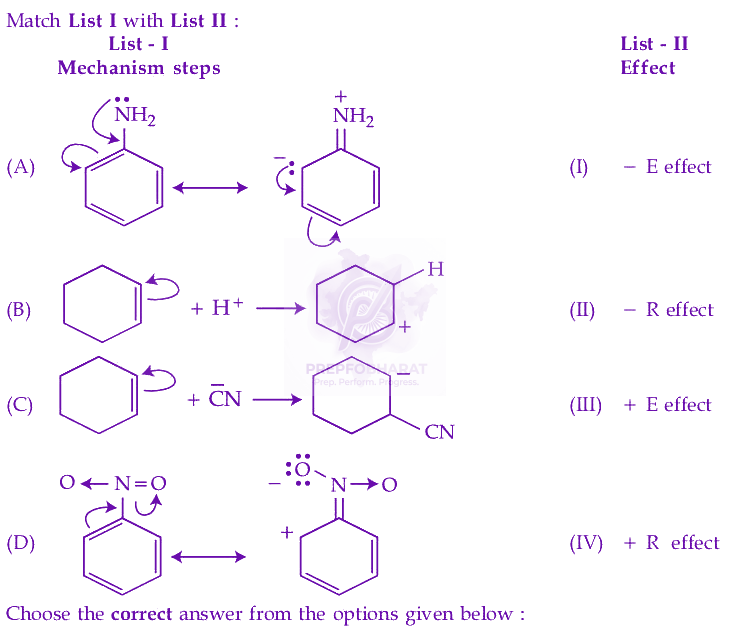 Choose the correct answer from the options given below :
Match List I with List II \(\begin{array}{llll} \text{List - I} & \text{List - II} \\ \text{(Pair of compounds)} & \text{(Isomerism)} \\ \text{(A) n-propanol and Isopropanol} & \text{(I) Metamerism} \\ \text{(B) Methoxypropane and ethoxyethane} & \text{(II) Chain Isomerism} \\ \text{(C) Propanone and propanal} & \text{(III) Position Isomerism} \\ \text{(D) Neopentane and Isopentane} & \text{(IV) Functional Isomerism} \\ \end{array}\) Choose the correct answer from the options given below :
\(9.3 \mathrm{~g}\) of pure aniline upon diazotisation followed by coupling with phenol gives an orange dye. The mass of orange dye produced (assume 100\% yield/conversion) is _______ g. (nearest integer)
Which of the following compound will most easily be attacked by an electrophile?
The major products formed : 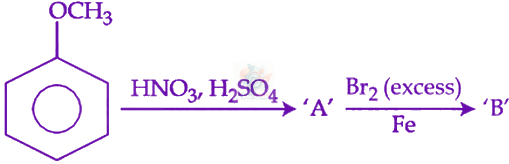 \(\mathrm{A}\) and \(\mathrm{B}\) respectively are:
Given below are two statements : one is labelled as Assertion $(A)$ and the other is labelled as Reason $(R).$ Assertion $(A):$ Haloalkanes react with $\mathrm{KCN}$ to form alkyl cyanides as a main product while with $\mathrm{AgCN}$ form isocyanide as the main product. Reason $(R):$ $\mathrm{KCN}$ and $\mathrm{AgCN}$ both are highly ionic compounds. In the light of the above statement, choose the most appropriate answer from the options given below.
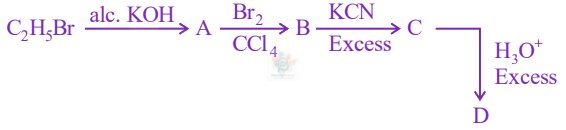 Acid $D$ formed in above reaction is:
Given below are two statements: Statement - I: High concentration of strong nucleophilic reagent with secondary alkyl halides which do not have bulky substituents will follow ${S}_{N}2$ mechanism. Statement - II: A secondary alkyl halide when treated with a large excess of ethanol follows ${S}_{N}1$ mechanism. In the the light of the above statements, choose the most appropriate from the questions given below:
Match List - I with List - II. <table class="pyq-table"><tbody><tr><td colspan="2" rowspan="1">List-I (Reactants)</td><td colspan="2" rowspan="1">List-II Products</td></tr><tr><td>(A)</td><td>Phenol, $\mathrm{Zn}/\Delta$</td><td>(I)</td><td>Salicylaldehyde</td></tr><tr><td>(B)</td><td>Phenol, ${\mathrm{CHCl}}_{3},\mathrm{NaOH},\mathrm{HCl}$</td><td>(II)</td><td>Salicylic acid</td></tr><tr><td>(C)</td><td>Phenol, ${\mathrm{CO}}_{2},\mathrm{NaOH},\mathrm{HCl}$</td><td>(III)</td><td>Benzene</td></tr><tr><td>(D)</td><td>Phenol, $\text{ Conc. }{\mathrm{HNO}}_{3}$</td><td>(IV)</td><td>Picric acid</td></tr></tbody></table>Choose the correct answer from the options given below.
Relative stability of the contributing structures is : 
Match List I with List II \(\begin{array}{|l|l|c|l|} \hline & \text{List - I} & & \text{List - II} \\ \hline \text { A. } & \alpha \text { - Glucose and } \alpha \text { - Galactose } & \text { I. } & \text { Functional isomers } \\ \hline \text { B. } & \alpha \text { - Glucose and } \beta \text { - Glucose } & \text { II. } & \text { Homologous } \\ \hline \text { C. } & \alpha \text { - Glucose and } \alpha \text { - Fructose } & \text { III. } & \text { Anomers } \\ \hline \text { D. } & \alpha \text { - Glucose and } \alpha \text { - Ribose } & \text { IV. } & \text { Epimers } \\ \hline \end{array}\) Choose the correct answer from the options given below:
Identify the product (A) in the following reaction. 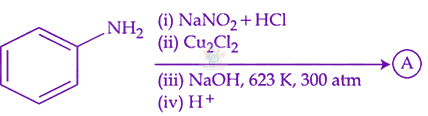
DNA molecule contains 4 bases whose structure are shown below. One of the structures is not correct, identify the incorrect base structure.
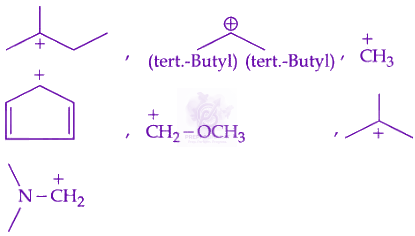
Number of carbocations from the following that are not stabilized by hyperconjugation is _______