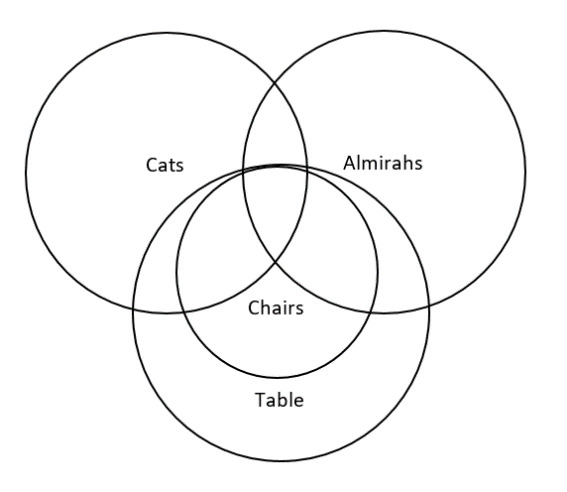
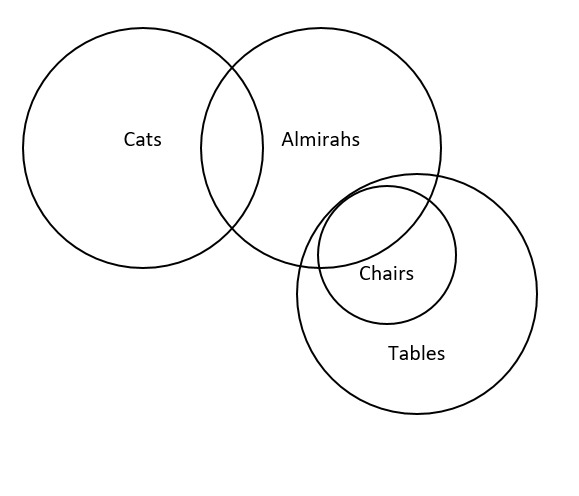
Correct Option (3)
Both Conclusion-I and Conclusion-II logically follow from the given statements.
Explanation for Conclusion-I:
- The statement "Some almirahs are chairs" establishes that there is at least one entity that is both an almirah and a chair.
- The statement "All chairs are tables" implies that every entity classified as a chair is also classified as a table.
- Combining these, if some almirahs are chairs, and all chairs are tables, then it necessarily follows that those specific almirahs which are chairs must also be tables. Therefore, "Certainly some almirahs are tables" is a definite conclusion.
Explanation for Conclusion-II:
- The statement "Some cats are almirahs" indicates an overlap between the set of cats and the set of almirahs. It does not imply that all cats are almirahs, nor does it define a universal relationship between cats and chairs.
- The statement "Some almirahs are chairs" indicates an overlap between almirahs and chairs.
- There is no information provided in the statements that mandates all cats to be chairs, or even that all cats must have some direct relationship with chairs. It is entirely consistent with the given premises that some cats exist which are not chairs. For example, cats that are not almirahs, or cats that are almirahs but not among the almirahs that are chairs, would not be chairs.
- Since the possibility that "Some cats may not be chairs" does not contradict any of the given statements, it is considered to logically follow as a consistent scenario.
Incorrect Options:
Options 1, 2, and 4 are incorrect because, as demonstrated, both Conclusion-I and Conclusion-II are logically derivable from the provided statements. Therefore, asserting that only one conclusion follows or that neither follows is inaccurate.