Correct Option
Neither Conclusion-I nor Conclusion-II logically follows from the given statements.
Let's analyze the statements and conclusions:
Statements:
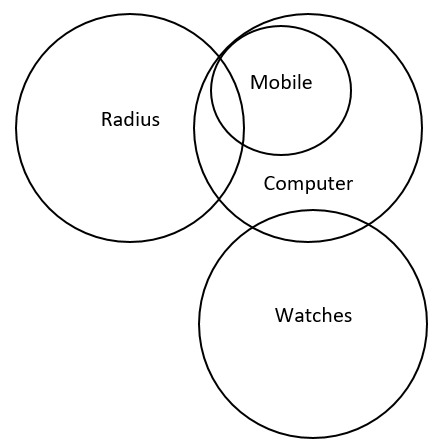
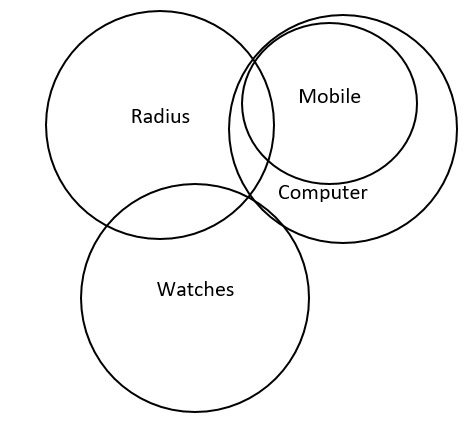
- Some radios are mobiles. (R ∩ M ≠ Ø)
- All mobiles are computers. (M ⊆ C)
- Some computers are watches. (C ∩ W ≠ Ø)
Analysis of Conclusion-I: Certainly some radios are watches.
- From statement (1) and (2), it can be deduced that "Some radios are computers" (R ∩ C ≠ Ø), because any radio that is a mobile must also be a computer.
- However, the fact that "Some radios are computers" and "Some computers are watches" (statement 3) does not guarantee an overlap between radios and watches. The subset of computers that are radios could be entirely distinct from the subset of computers that are watches.
- Therefore, it is possible to construct a scenario where no radios are watches. Conclusion-I does not necessarily follow.
Analysis of Conclusion-II: Certainly some mobiles are watches.
- We know that "All mobiles are computers" (statement 2) and "Some computers are watches" (statement 3).
- However, the 'some computers' that are watches might be precisely those computers that are not mobiles. There is no information to suggest that the intersection of computers and watches must include mobiles.
- It is possible to construct a scenario where the computers that are watches do not include any mobiles. Conclusion-II does not necessarily follow.
Since neither Conclusion-I nor Conclusion-II can be definitively established as true based on the given statements, the correct option is that neither conclusion follows.
Incorrect Options
Options 1, 2, and 3 are incorrect because they assert that at least one of the conclusions (Conclusion-I or Conclusion-II, or both) logically follows from the statements. As demonstrated above, both conclusions are not necessarily true. The relationships between radios and watches, and mobiles and watches, are not established with certainty by the given premises, as counter-examples can be drawn where these intersections are empty.