Correct Option (2)
Let's deduce the family structure based on the given information:
- There are six members (P, Q, R, S, T, U) with three males and three females across two generations.
- Known genders: U is P's daughter (U is female). Q is R's mother-in-law (Q is female). T is an unmarried male. S is a male.
- Initial gender count: U (F), Q (F), T (M), S (M). This accounts for two females and two males.
- The remaining two members (P and R) must consist of one male and one female to satisfy the 3M/3F condition.
- If P were female, we would have P, Q, U as females. This would mean R must be male. However, if P and Q are both female, they cannot be married to each other, which complicates the "two married couples" condition, especially if they are parents to U.
- Let's assume P is male. Then R must be female.
- Confirmed Genders: P (Male), Q (Female), R (Female), S (Male), T (Male), U (Female). This satisfies the 3 males and 3 females condition.
Now, let's establish relationships and generations:
- U is P's daughter: P (Male) is in Generation 1, U (Female) is in Generation 2.
- Q is R's mother-in-law: Q (Female) is in Generation 1, R (Female) is in Generation 2. This means Q's child is married to R. Since R is female, her spouse must be male. Let this male spouse be Q's son.
- We have two males in Generation 2: S and T. T is unmarried. Therefore, S must be Q's son who is married to R.
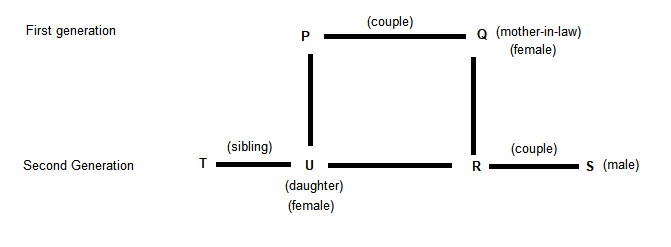
- So, S (Male) is married to R (Female). This forms the first married couple (S - R).
- Since P (Male) is U's father and Q (Female) is S's mother, and U and S are in the same generation, P and Q must be married to each other and are the parents of U and S. This forms the second married couple (P - Q).
- This implies U and S are siblings.
- We are told there are two unmarried siblings. T is an unmarried male. U is P's daughter and is not married to R (as R is female and married to S). Therefore, U (Female) is also unmarried.
- Thus, U and T are the two unmarried siblings. This means T is also a child of P and Q.
The family structure is:
- Generation 1: P (Male) is married to Q (Female).
- Generation 2: Their children are U (Female), S (Male), and T (Male).
- S (Male) is married to R (Female).
- U (Female) and T (Male) are unmarried siblings.
Let's verify all conditions:
- Six members: P, Q, R, S, T, U (Yes).
- Two generations: Gen 1 (P, Q), Gen 2 (R, S, T, U) (Yes).
- Three males (P, S, T) and three females (Q, R, U) (Yes).
- Two married couples: (P - Q) and (S - R) (Yes).
- Two unmarried siblings: U and T (Yes).
- U is P's daughter (Yes).
- Q is R's mother-in-law (Q is S's mother, S is married to R, so Q is R's mother-in-law) (Yes).
- T is an unmarried male (Yes).
- S is a male (Yes).
Based on this structure, R is S's wife. Therefore, Option 2 is correct.
Incorrect Options:
-
R is U's husband: In the established family structure, R is female and U is female. They cannot be husband and wife. R is S's wife, and U is S's sister, making R U's sister-in-law.
-
S is unmarried: The derived family structure clearly shows S (Male) is married to R (Female). T and U are the unmarried siblings.
-
None of the above: Since Option 2 is correct, this option is incorrect.