Correct Option
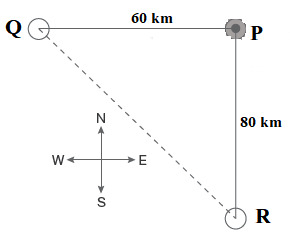
The problem describes the relative positions of three towns: P, Q, and R. Q is located to the West of P, and R is situated to the South of P. This spatial arrangement indicates that the lines connecting P to Q (PQ) and P to R (PR) are perpendicular to each other. Consequently, towns P, Q, and R form a right-angled triangle, with the right angle at P.
The given distances are:
- Distance between P and Q (PQ) = 60 km
- Distance between P and R (PR) = 80 km
To determine the distance between Q and R (QR), which is the hypotenuse of the right-angled triangle PQR, the Pythagorean theorem is applied:
QR² = PQ² + PR²
QR² = 60² + 80²
QR² = 3600 + 6400
QR² = 10000
QR = √10000
QR = 100 km
Incorrect Options:
-
140 km: This value is the arithmetic sum of the individual distances (60 km + 80 km). This calculation would be relevant only if Q, P, and R were collinear and P was positioned between Q and R, which contradicts the given directional information (West and South).
-
130 km: This value does not align with the geometric configuration established by the problem statement. It does not result from the application of the Pythagorean theorem or any other pertinent geometric principle for perpendicular directions.
-
10 km: This value represents the absolute difference between the two given distances (|80 km - 60 km|). This would be applicable if Q, P, and R were collinear, with Q or R lying between the other two, which is inconsistent with the perpendicular directional relationship.