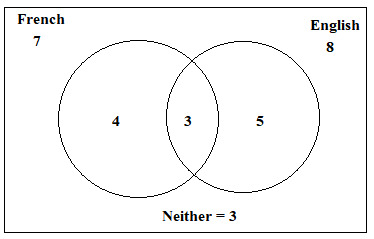
Correct Option (B)
To determine the number of people who can read exactly one language, the following steps are undertaken:
- Total number of individuals in the group = 15.
- Number of individuals who read neither French nor English = 3.
- The number of individuals who read at least one language is calculated as: Total individuals - Individuals reading neither = 15 - 3 = 12.
- Let F denote the set of individuals who read French, and E denote the set of individuals who read English.
- Given: |F| = 7 and |E| = 8.
- Applying the Principle of Inclusion-Exclusion for two sets: |F ∪ E| = |F| + |E| - |F ∩ E|.
- Substituting the known values: 12 = 7 + 8 - |F ∩ E|.
- This simplifies to: 12 = 15 - |F ∩ E|.
- Therefore, the number of individuals who read both languages, |F ∩ E|, is 15 - 12 = 3.
- The number of individuals who read only French = |F| - |F ∩ E| = 7 - 3 = 4.
- The number of individuals who read only English = |E| - |F ∩ E| = 8 - 3 = 5.
- The number of individuals who can read exactly one language is the sum of those who read only French and those who read only English: 4 + 5 = 9.
Incorrect Options:
- Option 1 (10): This value does not correspond to any specific calculated subset based on the problem's conditions.
- Option 3 (5): This represents the number of individuals who can read only English.
- Option 4 (4): This represents the number of individuals who can read only French.