Correct Option (3)
Conclusion III: Some cats are rats.
This conclusion is an immediate inference derived directly from Statement 1, "Some rats are cats." In syllogistic reasoning, if a statement of the form "Some A are B" is true, then its converse, "Some B are A," is also necessarily true. Therefore, "Some cats are rats" is a valid deduction.
Incorrect Options:
Conclusion I: No cow is a cat.
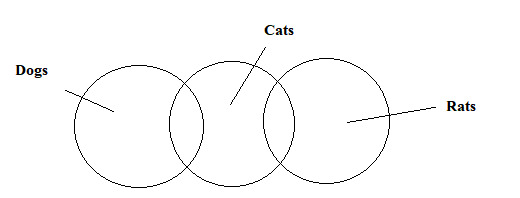
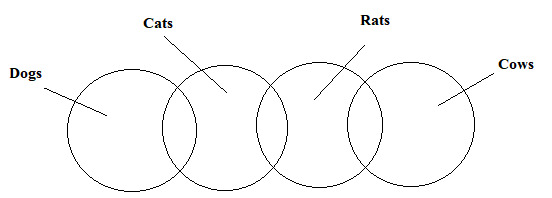
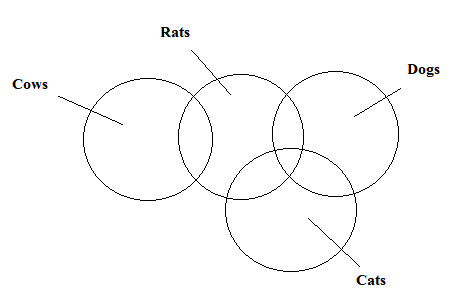
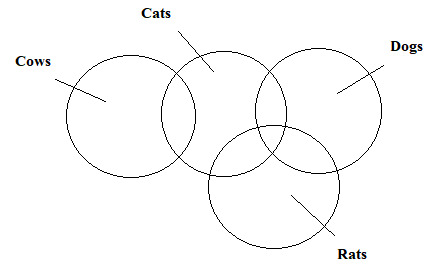
Statements 2 ("Some cats are dogs") and 3 ("No dog is a cow") establish that dogs and cows are mutually exclusive sets, and that some cats belong to the set of dogs. However, these statements do not provide sufficient information to establish a definite negative relationship between all cats and all cows. It is possible that some cats are not dogs, and these specific cats could potentially be cows without contradicting the given statements. Therefore, this conclusion does not necessarily follow.
Conclusion II: No dog is a rat.
Statements 1 ("Some rats are cats") and 2 ("Some cats are dogs") indicate partial overlaps. "Some rats are cats" implies an intersection between the sets of rats and cats. "Some cats are dogs" implies an intersection between the sets of cats and dogs. These partial relationships do not establish a definite connection or a universal negative relationship between rats and dogs. The statements allow for scenarios where some rats are dogs, or no rats are dogs, without contradiction. Thus, a definitive conclusion of "No dog is a rat" cannot be drawn.