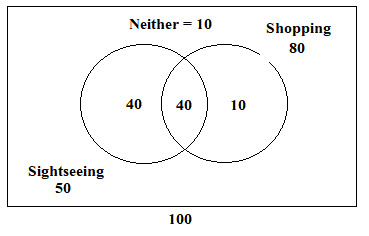
Correct Option (1)
Let the total club members be represented as 100%.
- Percentage of members who went for shopping (S) = 80%.
- Percentage of members who went for sightseeing (G) = 50%.
- Percentage of members who took rest in the hotel (R) = 10%.
Assuming that taking rest in the hotel is an activity mutually exclusive from shopping or sightseeing, the total percentage of members engaged in at least one activity (shopping or sightseeing) can be determined:
- Total members = (Members who went for shopping or sightseeing) + (Members who took rest)
- 100% = P(S U G) + P(R)
- 100% = P(S U G) + 10%
- P(S U G) = 100% - 10% = 90%.
Using the principle of inclusion-exclusion for two sets:
- P(S U G) = P(S) + P(G) - P(S ∩ G)
- 90% = 80% + 50% - P(S ∩ G)
- 90% = 130% - P(S ∩ G)
- P(S ∩ G) = 130% - 90% = 40%.
Therefore, 40% of the members went for shopping as well as sightseeing. Conclusion 1 is correct.
Incorrect Options:
Conclusion 2 states that 20% members went for only shopping.
- The percentage of members who went for only shopping is calculated by subtracting the percentage of members who went for both shopping and sightseeing from the total percentage of members who went for shopping.
- Percentage of members who went for only shopping = P(S) - P(S ∩ G) = 80% - 40% = 40%.
Since the calculated percentage of members who went for only shopping is 40% and not 20%, conclusion 2 is incorrect.