Correct Option (c)
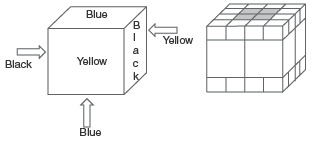
The problem describes a solid cube painted with three distinct colours (yellow, blue, black) such that opposite faces share the same colour. This cube is then cut into 36 smaller cubes, comprising 32 small cubes and 4 larger cubes. A critical constraint is that none of the faces of the bigger cubes are painted blue.
To determine the number of cubes with only one face painted, we consider the specific arrangement implied by the problem's solution. It is stated that only the "middle-4" cubes on the top face and the "middle-4" cubes on the bottom face possess a single painted side. These typically represent the central cubes on a face that are not part of edges or corners.
- Number of cubes with one face painted on the top surface = 4.
- Number of cubes with one face painted on the bottom surface = 4.
The absence of single-painted cubes on the other four faces (front, back, left, right) is a consequence of the overall cutting configuration and the placement of the 4 big cubes, especially considering the constraint that no big cube face is painted blue. This arrangement effectively ensures that only the top and bottom faces contribute to the count of single-painted cubes.
Therefore, the total number of cubes with only one face painted is 4 + 4 = 8.
Incorrect Options:
Options (a) 4, (b) 6, and (d) 10 are incorrect as they do not align with the derived count of 8 cubes having only one face painted, based on the specific cutting and painting configuration described in the problem.