Correct Option (4)
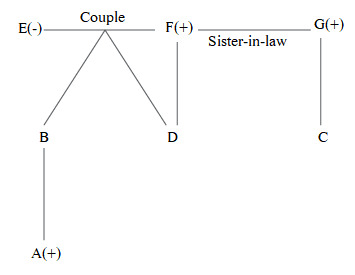
The problem describes a joint family of seven members (A, B, C, D, E, F, G) with three females. The relationships are established as follows:
- "G is a widow and sister-in-law of D's father F." This indicates F is male. For G to be F's sister-in-law, her deceased husband must have been F's brother. G is female.
- "B and D are siblings."
- "A is daughter of B." A is female.
- "C is cousin of B." Since B and D are children of F, and C is B's cousin, C must be the child of G and F's deceased brother.
From these deductions, the identified members and their relationships are:
- F (male) is the father of B and D.
- G (female) is the widow of F's brother and mother of C.
- A (female) is the daughter of B.
The family members identified are F, G, B, D, A, C (6 members). The seventh member is E. Given that there are three females in total, and G and A are confirmed females, E must be the third female. To complete the immediate family structure, E is the wife of F.
Now, let's evaluate the given statements about E:
- Wife of F: As deduced, E is the wife of F. This statement is correct.
- Grandmother of A: A is the daughter of B. B is the child of F and E. Therefore, E is the paternal grandmother of A. This statement is correct.
- Aunt of C: C is the child of F's brother and G. E is F's wife. Thus, E is the paternal aunt of C. This statement is correct.
Since all three statements (1, 2, and 3) are correct, the option including all of them is the correct answer.
Incorrect Options:
Options 1, 2, and 3 are incorrect because they do not include all the relationships correctly identified for E. All three statements (1, 2, and 3) are factually accurate based on the provided family information.