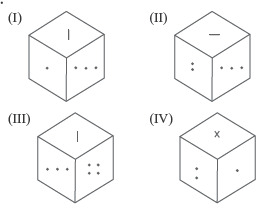
Correct Option (c)
: Four dots
Analysis of figures (I), (II), and (III) indicates that the faces marked with a single dot (.), two dots (..), three dots (...), and four dots (::) are all adjacent to the face marked with a line (–). Consequently, the cross (×) must be positioned on the face opposite to the line (–).
Further examination of figures (I), (II), and (IV) reveals that the line (–), single dot (.), three dots (...), and the cross (×) are all adjacent to the face displaying two dots (..). Given these adjacencies, the only remaining symbol, four dots (::), must therefore be opposite the face with two dots (..).
Incorrect Options:
Based on the established oppositions:
- Single dot: Considering figures (II) and (IV), the line (–), two dots (..), and cross (×) are observed to be adjacent to the single dot (.). With the established opposition of two dots (..) to four dots (::), the remaining symbol, three dots (...), is consequently opposite the single dot (.). Therefore, a single dot is not opposite two dots.
- Three dots: As determined, three dots (...) are opposite the single dot (.). Thus, three dots are not opposite two dots.
- Line: As established, the line (–) is opposite the cross (×). Therefore, the line is not opposite two dots.