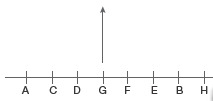
Correct Option (3)
The final arrangement of the eight individuals, A, B, C, D, E, F, G, and H, in a row facing North, is determined by systematically applying the given conditions:
- "A is sixth to the left of E" implies a sequence of seven positions with A at the leftmost and E at the sixth position to its right (A _ _ _ _ _ E).
- "H is sixth to the right of C" implies a sequence of seven positions with C at the leftmost and H at the sixth position to its right (C _ _ _ _ _ H).
- "F is to the immediate right of G and is a neighbour of E" establishes the contiguous block GFE.
- "G is not at the extreme end," meaning there is at least one person to G's left.
- "B is not a neighbour of G."
Considering a row of 8 positions (P1 to P8):
- From "A is sixth to the left of E," A can be at P1 and E at P7, or A at P2 and E at P8.
- From "H is sixth to the right of C," C can be at P1 and H at P7, or C at P2 and H at P8.
- If A is at P1 and E is at P7, the arrangement starts as A _ _ _ _ _ E _.
- The block GFE must align with E at P7. This places G at P5 and F at P6. The arrangement becomes A _ _ _ G F E _.
- The remaining positions are P2, P3, P4, P8. The remaining individuals are B, C, D, H.
- To satisfy "H is sixth to the right of C" with C and H among the remaining, C must be at P2 and H at P8. This forms A C _ _ G F E H.
- The remaining individuals B and D must occupy P3 and P4.
- If D is at P3 and B at P4 (A C D B G F E H), B would be a neighbour of G, violating the condition "B is not a neighbour of G."
- Therefore, B must be at P3 and D at P4. This yields the unique arrangement: A C B D G F E H.
In this arrangement, D is at the fourth position from the left (P4) and G is at the fifth position from the left (P5). Thus, G is to the immediate right of D, making option (3) correct.
Incorrect Options:
-
Option (1): C is to the immediate left of A.
In the derived arrangement (A C B D G F E H), A is at P1 and C is at P2. This indicates that C is to the immediate right of A, not to its immediate left.
-
Option (2): D is the immediate neighbour of B and F.
In the derived arrangement (A C B D G F E H), D is at P4. Its immediate neighbours are B (at P3) and G (at P5). D is not a neighbour of F (which is at P6).
-
Option (4): A and E are at the extreme ends.
In the derived arrangement (A C B D G F E H), A is at P1, which is an extreme end. However, E is at P7, and H is at P8. Therefore, E is not at an extreme end.