Correct Option
To determine the correct statement, we first establish the complete arrangement and attributes of the boxes based on the given clues:
- The box A, containing a tennis ball, is orange and at the extreme right. This places Box A at Position 6 (rightmost) with the attributes: A - Orange - Tennis.
- Box C is fifth from the right and next to Box B. This places Box C at Position 2 and Box B at Position 1 (leftmost).
- Box C contains a cricket ball and is painted green. So, C - Green - Cricket.
- Box B contains a volleyball. So, B - Volleyball.
Current arrangement from left to right (Positions 1-6):
- Position 1: B (Volleyball)
- Position 2: C (Green, Cricket)
- Position 3: (Unknown)
- Position 4: (Unknown)
- Position 5: (Unknown)
- Position 6: A (Orange, Tennis)
The remaining boxes for Positions 3, 4, 5 are D, E, F. The remaining games are Golf, Hockey, Football. The remaining colours are Violet, Indigo, Blue, Yellow.
Further deductions:
- "The golf ball is in violet box and is not in the box D." This implies Golf is Violet, and D does not contain Golf.
- "The hockey ball is neither in box D nor in box E." This means Box F must contain the Hockey ball.
- Since F has Hockey and D does not have Golf, Box E must contain the Golf ball. Consequently, Box E is painted Violet (from clue 5).
- The last remaining game, Football, must be in Box D.
Summary of attributes for D, E, F:
- D: Football
- E: Golf, Violet
- F: Hockey
Now, we place D, E, F into Positions 3, 4, 5:
- "The box containing the hockey ball is between the boxes containing golf ball and volleyball." This implies that the position of the Hockey box (F) is numerically between the position of the Golf box (E) and the Volleyball box (B).
- Volleyball box (B) is at Position 1.
- Hockey box is F. Golf box is E.
- If E is at Position 4, then F can be at Position 3 (since 1 < 3 < 4). This arrangement fits the condition.
- This leaves Box D for Position 5.
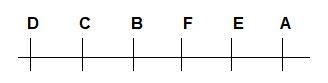
The complete arrangement of boxes and their games is:
- Position 1: B (Volleyball)
- Position 2: C (Cricket)
- Position 3: F (Hockey)
- Position 4: E (Golf)
- Position 5: D (Football)
- Position 6: A (Tennis)
Finally, we determine the remaining colours:
- Known colours: A (Orange), C (Green), E (Violet).
- Remaining colours for B, D, F are Indigo, Blue, Yellow.
- "The hockey ball is neither in the box painted blue nor in the box painted yellow." Since F contains Hockey, F cannot be Blue or Yellow. Therefore, F must be painted Indigo.
The complete arrangement with determined colours:
- Position 1: B (Volleyball)
- Position 2: C (Green, Cricket)
- Position 3: F (Indigo, Hockey)
- Position 4: E (Violet, Golf)
- Position 5: D (Football)
- Position 6: A (Orange, Tennis)
The colours for Box B and Box D are Blue and Yellow, but the specific assignment to each cannot be determined from the given information.
Evaluating the options:
- Option 2 states "F is painted indigo". This is consistent with our deductions.
Incorrect Options:
- Option 1: "D is painted yellow". The colour of Box D could be either Yellow or Blue, as the information provided is insufficient to make a definitive assignment.
- Option 3: "B is painted blue". The colour of Box B could be either Blue or Yellow, as the information provided is insufficient to make a definitive assignment.
- Option 4: "All of the above". Since options 1 and 3 cannot be definitively confirmed, this option is incorrect.