Correct Option
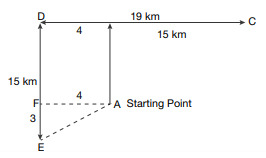
The problem requires determining the net displacement, which is the shortest straight-line distance from the starting point to the final position. This can be calculated by resolving the movements into perpendicular components (North-South and East-West).
- First, consider the North-South movements:
- Movement North: 12 km
- Movement South: 15 km
- Net displacement in the North-South direction = 15 km (South) - 12 km (North) = 3 km (South).
- Next, consider the East-West movements:
- Movement East: 15 km
- Movement West: 19 km
- Net displacement in the East-West direction = 19 km (West) - 15 km (East) = 4 km (West).
- The final position is 3 km South and 4 km West from the starting point. Since these two net displacements are perpendicular, the total displacement can be found using the Pythagorean theorem.
- Let 'D' be the required distance from the starting point:
- D² = (Net Southward displacement)² + (Net Westward displacement)²
- D² = 3² + 4²
- D² = 9 + 16
- D² = 25
- D = √(25)
- D = 5 km
Incorrect Options
Options 2 (9 km), 3 (37 km), and 4 (61 km) are incorrect. These values do not represent the correct net displacement from the starting point. The total distance traveled by the person is the sum of all individual path lengths (12 + 15 + 19 + 15 = 61 km), which is distinct from the displacement. Displacement is a vector quantity representing the shortest distance between the initial and final positions, calculated by considering the direction of movement for each segment.