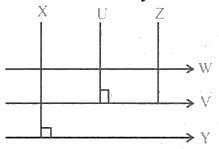
Correct Option (4)
The given conditions establish the following relationships:
- Line X is perpendicular to Line Y (X ⊥ Y).
- Line X is parallel to Line Z (X || Z).
- Line U is perpendicular to Line V (U ⊥ V).
- Line U is perpendicular to Line W (U ⊥ W).
- Line X is perpendicular to Line V (X ⊥ V).
From X ⊥ Y and X ⊥ V, it can be inferred that Line Y and Line V are both perpendicular to Line X. In a plane, if two lines are perpendicular to the same line, they are parallel to each other. Therefore, Y || V.
From U ⊥ V and U ⊥ W, it can be inferred that Line V and Line W are both perpendicular to Line U. Thus, V || W.
Since Y || V and V || W, by transitivity, Y || W. Consequently, Y, V, and W are all parallel to each other.
Incorrect Options:
Let's analyze the other options based on the derived relationships:
- Option (1) Z, U and W are parallel: We know X || Z. We also know U ⊥ W. If U and W are perpendicular, they cannot be parallel. Therefore, Z, U, and W cannot all be parallel.
- Option (2) X, V and Y are parallel: We are given X ⊥ Y and X ⊥ V. If two lines are perpendicular, they cannot be parallel. Thus, X cannot be parallel to Y or V.
- Option (3) Z, V and U are all perpendicular to W: We know U ⊥ W (given). We deduced V || W. If V is parallel to W, it cannot be perpendicular to W. We also deduced X ⊥ W (since X ⊥ V and V || W), and since X || Z, it implies Z ⊥ W. While Z ⊥ W and U ⊥ W are true, V ⊥ W is false. Therefore, this statement is incorrect.