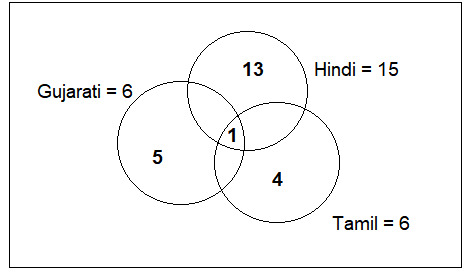
Correct Option (C)
To determine the total number of persons in the group, we can apply principles of set theory, specifically by categorizing individuals based on the number of languages they speak.
- Let N(T), N(H), and N(G) represent the number of persons speaking Tamil, Hindi, and Gujarati, respectively.
- Given: N(T) = 6, N(H) = 15, and N(G) = 6.
We define three distinct groups of speakers:
- P₁: Persons speaking exactly one language.
- P₂: Persons speaking exactly two languages.
- P₃: Persons speaking exactly three languages.
From the problem statement:
- P₂ = 2 (two persons can speak two languages only).
- P₃ = 1 (one person can speak all three languages).
The sum of the individual language counts, N(T) + N(H) + N(G), accounts for each person differently based on how many languages they speak:
- A person speaking exactly one language (P₁) is counted once.
- A person speaking exactly two languages (P₂) is counted twice (once for each language they speak).
- A person speaking exactly three languages (P₃) is counted thrice (once for each language they speak).
Therefore, the relationship can be expressed as:
N(T) + N(H) + N(G) = P₁ + 2P₂ + 3P₃
Substitute the given values into the equation:
6 + 15 + 6 = P₁ + 2(2) + 3(1)
27 = P₁ + 4 + 3
27 = P₁ + 7
P₁ = 27 - 7
P₁ = 20
The total number of persons in the group is the sum of all individuals across these categories:
Total Persons = P₁ + P₂ + P₃
Total Persons = 20 + 2 + 1
Total Persons = 23
Incorrect Options:
The other options are incorrect as they do not correspond to the precise calculation derived from the problem's conditions using set theory principles. Any deviation from the calculated total of 23 would indicate an error in accounting for individuals speaking one, two, or three languages.
- (A) 21: This value would arise if the sum of persons speaking exactly one language (P₁) was 18 instead of 20, assuming P₂ and P₃ remain constant.
- (B) 22: This value would result from an arithmetic error during the summation of the different categories of speakers (P₁ + P₂ + P₃).
- (D) 24: This value would occur if the sum of persons speaking exactly one language (P₁) was 21 instead of 20, or if there was an overestimation in other categories.