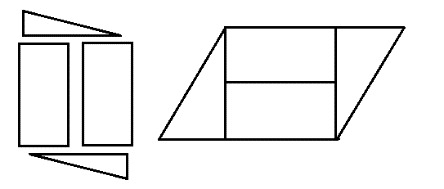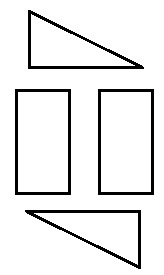
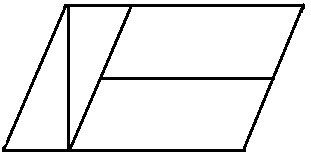
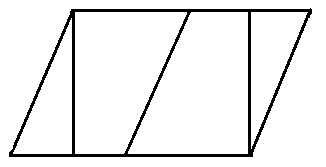
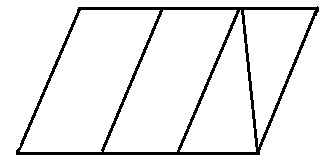
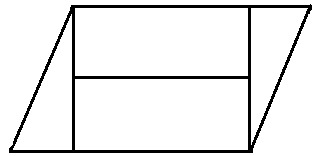
Correct Option (D)
Option (D) represents the figure that can be formed by precisely joining the four given cardboard pieces without any overlap or gaps.
To determine the correct option, first, calculate the total area of the four individual pieces:
- Piece 1 (Large L-shape, appearing as a 3x2 rectangle with one 1x1 square removed): 5 square units.
- Piece 2 (Small square): 1 square unit.
- Piece 3 (Rectangle): 2 square units.
- Piece 4 (Small L-shape, appearing as a 2x2 square with one 1x1 square removed): 3 square units.
The total combined area of these four pieces is 5 + 1 + 2 + 3 = 11 square units.
Now, evaluate the area of each option:
- Option (A) appears to be a 2x4 rectangle, with an area of 8 square units.
- Option (B) appears to be a 3x3 square, with an area of 9 square units.
- Option (C) appears to be a 2x5 rectangle, with an area of 10 square units.
- Option (D) appears to be an L-shaped figure, which can be visualized as a 3x4 rectangle with one 1x1 square removed from a corner. Its area is (3 × 4) - 1 = 11 square units.
Only Option (D) has a total area that matches the combined area of the four given pieces. The pieces can be arranged and rotated to fit together perfectly to form the specific L-shaped structure depicted in Option (D).
Incorrect Options:
Options (A), (B), and (C) are incorrect because their total areas do not match the combined area of the four given pieces:
- Option (A) has an area of 8 square units, which is less than the required 11 square units.
- Option (B) has an area of 9 square units, which is less than the required 11 square units.
- Option (C) has an area of 10 square units, which is less than the required 11 square units.
A fundamental principle in such puzzles is that the total area of the composite figure must be equal to the sum of the areas of its constituent parts. Since the areas of options (A), (B), and (C) are not 11 square units, they cannot be formed by the given set of pieces. Furthermore, the specific geometric configurations of these options would not allow for a seamless arrangement of the given pieces without leaving gaps or causing overlaps, even if area discrepancies were overlooked.