Correct Option (2)
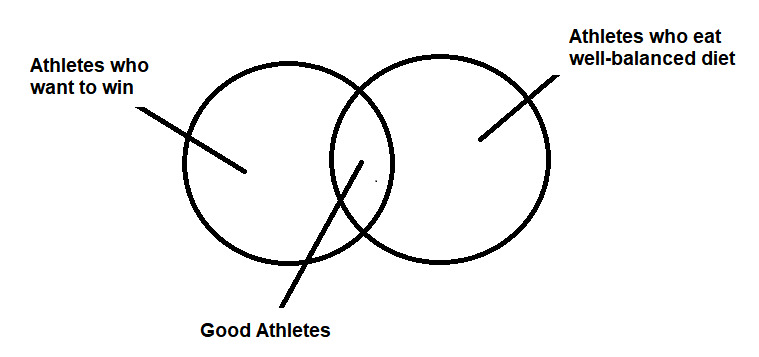
The given statements establish a logical sequence:
- All good athletes want to win. (Good Athlete → Wants to Win)
- All athletes who want to win eat a well-balanced diet. (Wants to Win → Eats Well-Balanced Diet)
From these two premises, it can be logically deduced that all good athletes eat a well-balanced diet (Good Athlete → Eats Well-Balanced Diet).
The contrapositive of this deduction is: If an athlete does not eat a well-balanced diet, then they are not a good athlete (¬Eats Well-Balanced Diet → ¬Good Athlete).
Option 2, "no athletes who does not eat a well-balanced diet is a good athlete," is a direct restatement of this contrapositive. Therefore, this statement is a valid inference from the given premises.
Incorrect Options:
Option 1: "no bad athlete wants to win."
The premises indicate that all good athletes want to win. However, they provide no information regarding the aspirations of athletes who are not considered good. It is plausible for an athlete classified as 'bad' to still possess a desire to win. Thus, this statement cannot be definitively concluded from the provided information.
Option 3: "every athlete who eats a well-balanced diet is a good athlete."
The premises imply that eating a well-balanced diet is a necessary condition for being a good athlete (Good Athlete → Eats Well-Balanced Diet). This option, however, asserts it as a sufficient condition (Eats Well-Balanced Diet → Good Athlete), which is the converse. The truth of a statement does not guarantee the truth of its converse. An athlete may consume a well-balanced diet but lack other attributes necessary to be classified as a good athlete.
Option 4: "all athletes who want to win are good athletes."
The premises state that all good athletes want to win (Good Athlete → Wants to Win). This option presents the converse (Wants to Win → Good Athlete). Similar to Option 3, the converse of a true statement is not necessarily true. An athlete's desire to win does not automatically qualify them as a good athlete; other factors contribute to athletic proficiency.