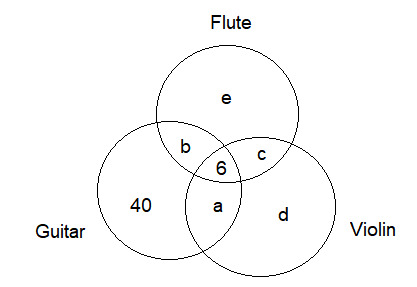
Correct Option (2)
The problem provides the following data:
- Total number of musicians = 120.
- Number of musicians who can play all three instruments (guitar, violin, and flute) = 5% of 120 = (5/100) * 120 = 6.
- Number of musicians who can play exactly two instruments (any two of guitar, violin, flute) = 30.
- Number of musicians who can play guitar alone = 40.
Let 'V' represent the number of musicians who can play violin alone, and 'F' represent the number of musicians who can play flute alone. The objective is to find the sum V + F.
The total number of musicians can be expressed as the sum of musicians in mutually exclusive categories:
Total Musicians = (Guitar alone) + (Violin alone) + (Flute alone) + (Exactly two instruments) + (All three instruments)
Substituting the given values into this equation:
120 = 40 + V + F + 30 + 6
Combine the known numerical values:
120 = 76 + V + F
To find the sum of musicians who can play violin alone or flute alone (V + F), rearrange the equation:
V + F = 120 - 76
V + F = 44
Thus, the total number of those who can play violin alone or flute alone is 44.
Incorrect Options:
Options 1 (45), 3 (38), and 4 (30) are incorrect. These values do not align with the logical deduction derived from the given data. The structured calculation, accounting for all distinct categories of musicians, uniquely determines that the sum of musicians playing violin alone or flute alone is 44.