Correct Option (2)
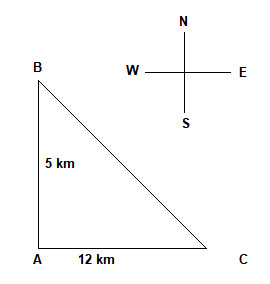
The problem describes the relative positions of three locations, A, B, and C. Location B is situated North of A, and location C is situated East of A. This geometric arrangement implies that the lines connecting A to B (AB) and A to C (AC) are perpendicular to each other, forming a right angle at A. Therefore, the locations A, B, and C form a right-angled triangle, with the shortest distance between B and C being the hypotenuse of this triangle.
Given distances:
- AB = 5 km
- AC = 12 km
Applying the Pythagorean theorem (BC² = AB² + AC²):
- BC² = 5² + 12²
- BC² = 25 + 144
- BC² = 169
- BC = √169
- BC = 13 km
Thus, the shortest distance between locations B and C is 13 km.
Incorrect Options:
The other options do not represent the correct calculation for the hypotenuse of a right-angled triangle with sides 5 km and 12 km.
-
Option 1 (60): This value is the product of the two given distances (5 × 12), which is not relevant for calculating the shortest distance between B and C.
-
Option 3 (17): This value represents the sum of the two given distances (5 + 12). This would only be the distance if B, A, and C were collinear, which they are not in this scenario.
-
Option 4 (7): This value represents the difference between the two given distances (12 - 5), which is not applicable for determining the hypotenuse of a right-angled triangle.