Correct Option (2)
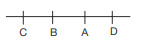
Let the four children be arranged in a row. The first condition states that A is occupying the seat next to B but not next to C. This implies that A and B are adjacent, forming a block (AB or BA), and C cannot be immediately beside A. Considering four seats, this leads to two potential arrangements:
- If A and B are in the sequence B-A, and C is not next to A, the only way to place C is at the extreme end opposite to A, resulting in the sequence C B A D (where D occupies the remaining seat).
- If A and B are in the sequence A-B, and C is not next to A, the only way to place C is at the extreme end opposite to A, resulting in the sequence D A B C (where D occupies the remaining seat).
Thus, the two possible arrangements based on the first condition are C B A D and D A B C.
The second condition states that C is not sitting next to D.
- In the arrangement C B A D, C is adjacent to D. This violates the second condition.
- In the arrangement D A B C, C is not adjacent to D (B is between them). This arrangement satisfies both conditions.
Therefore, the only valid arrangement is D A B C. In this arrangement, the child occupying the seat adjacent to D is A.
Incorrect Options:
The unique valid arrangement derived from the given conditions is D A B C.
- Option 1 (B): B is not adjacent to D in the arrangement D A B C; A is between D and B. Therefore, this option is incorrect.
- Option 3 (B and A): While A is adjacent to D, B is not. Only one child, A, is adjacent to D. Therefore, this option is incorrect.
- Option 4 (Impossible to tell): A unique and definitive arrangement can be determined from the provided information, allowing the identification of the child adjacent to D. Therefore, this option is incorrect.