Correct Option (B)
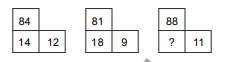
The figures follow a specific numerical pattern. Let the top number be 'A', the left number be 'B', and the right number be 'C'.
Upon examining the first two figures, a consistent relationship between 'B' and 'C' is observed:
- In Figure 1: A=4, B=28, C=56. Here, C is twice B (56 = 2 × 28).
- In Figure 2: A=5, B=45, C=90. Here, C is twice B (90 = 2 × 45).
This establishes the pattern that the rightmost number (C) is consistently double the leftmost number (B).
Applying this pattern to Figure 3:
- A=8, B=?, C=32.
- According to the established pattern, C = 2 × B.
- Substituting the known value for C: 32 = 2 × B.
- Solving for B: B = 32 / 2 = 16.
Therefore, the missing number in the third figure is 16.
Incorrect Options:
- Options A (7), C (21), and D (28) are inconsistent with the derived pattern (C = 2 × B). If the missing number (B) were 7, 21, or 28, the relationship with C=32 would not hold true (i.e., 32 ≠ 2 × 7, 32 ≠ 2 × 21, and 32 ≠ 2 × 28).
