Correct Option
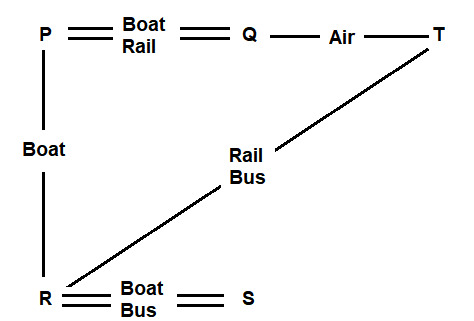
To reach R from Q without changing the mode of transport, a continuous path using a single mode must be identified. The connections are as follows:
- Q and P are connected by Boat and Rail.
- P and R are connected by Boat only.
If one commences the journey from Q to P by Boat, the same mode of transport (Boat) can then be utilized to travel from P to R. This establishes a continuous journey from Q to R via P using only the Boat mode.
Incorrect Options
-
Rail: While Q and P are connected by Rail, P and R are connected by Boat only. Therefore, a journey from Q to P by Rail would necessitate a change of mode to Boat to proceed from P to R, which violates the condition. Furthermore, Q and T are connected by Air only, and T and R are connected by Rail. This path (Q-T-R) would require a change from Air to Rail.
-
Bus: There is no direct Bus connection from Q to R. To reach R from Q, one could consider paths via T or P. Q and T are connected by Air only, and T and R are connected by Rail and Bus. This path (Q-T-R) would involve changing from Air to Bus. The path via P (Q-P, P-R) does not involve Bus as a continuous mode to R.
-
Air: Q and T are connected by Air only. However, T and R are connected by Rail and Bus, with no Air connection available. Consequently, a journey from Q to T by Air would require a change of mode (to Rail or Bus) to proceed from T to R, which violates the specified condition.