Correct Option (3)
The houses of C and D are less than 20 km apart.
To determine the relative positions of C and D:
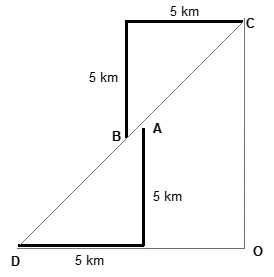
- A's house is on the western side of a north-south road. A comes out (facing East), turns left (North), travels 5 km, then turns right (East), and travels 5 km to D's house. Therefore, D's house is 5 km North and 5 km East of A's house.
- B's house is on the eastern side, facing A's. B comes out (facing West), turns left (South), travels 5 km, then turns right (West), and travels 5 km to C's house. Therefore, C's house is 5 km South and 5 km West of B's house.
For calculating the distance between C and D, the width of the road separating A's and B's houses is considered negligible, a common assumption in such problems. Thus, if A's house is set at the origin (0,0), then D's house is at (5, 5). Similarly, C's house is at (-5, -5) relative to the same origin.
The distance between C(-5, -5) and D(5, 5) is calculated using the Pythagorean theorem:
${= \sqrt{(5 - (-5))^{2} + (5 - (-5))^{2}} }$
${= \sqrt{(10)^{2} + (10)^{2}} }$
${= \sqrt{(100 + 100)} }$
${= \sqrt{200} }$
${= 14.14 \text{ km} }$
Since 14.14 km is less than 20 km, the statement is correct.
Incorrect Options:
-
Option 1: C and D live on the same street. D's house is at (5, 5) and C's house is at (-5, -5). These coordinates indicate that they are located diagonally opposite to each other relative to the origin, not on the same linear street.
-
Option 2: C's house faces south. B reaches C's house after traveling 5 km West. This implies that B was facing West upon arrival at C's house. Therefore, C's house faces West, not South.
-
Option 4: None of the above. As Option 3 is a correct statement, this option is incorrect.