Correct Option (B)
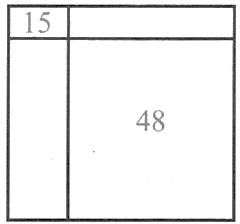
Let the side length of the square be denoted by S. When a square is divided into four rectangles by one horizontal and one vertical line, let the segments of one side be x and y, and the segments of the adjacent side be a and b. Consequently, S = x + y and S = a + b.
The areas of the four resulting rectangles are xa, xb, ya, and yb. For this problem, it is implied that the given areas (15 and 48) correspond to two diagonally opposite rectangles. Therefore:
- xa = 15
- yb = 48
All dimensions (x, a, y, b) must be natural numbers as per the problem statement.
We need to identify natural number factors for 15 and 48 such that the condition x + y = a + b is satisfied.
- Possible factor pairs for 15 are (1, 15) and (3, 5).
- Possible factor pairs for 48 are (1, 48), (2, 24), (3, 16), (4, 12), (6, 8).
Let's test combinations:
- If we set x = 3 and a = 5 (from xa = 15):
- The condition x + y = a + b becomes 3 + y = 5 + b, which simplifies to y - b = 2.
- From the factor pairs of 48, the pair (8, 6) for (y, b) satisfies this condition, as 8 - 6 = 2.
- Thus, x = 3, y = 8, a = 5, b = 6.
- The side length of the square S = x + y = 3 + 8 = 11.
- Alternatively, S = a + b = 5 + 6 = 11.
- If we set x = 5 and a = 3 (from xa = 15):
- The condition x + y = a + b becomes 5 + y = 3 + b, which simplifies to y - b = -2.
- From the factor pairs of 48, the pair (6, 8) for (y, b) satisfies this condition, as 6 - 8 = -2.
- Thus, x = 5, y = 6, a = 3, b = 8.
- The side length of the square S = x + y = 5 + 6 = 11.
- Alternatively, S = a + b = 3 + 8 = 11.
Both consistent derivations confirm that the length of each side of the square is 11 units.
Incorrect Options:
Options 10, 15, and "Cannot be determined as the given data are insufficient" are incorrect.
- A unique side length of 11 units can be determined through systematic analysis of the factors of the given areas (15 and 48) and the geometric constraints of a square divided into four rectangles with natural number side lengths.
- If the side length of the square were 10 or 15, it would not be possible to find natural number dimensions for the four constituent rectangles that simultaneously satisfy the given area conditions and the requirement that the sum of the segments along each side equals the total side length of the square. For instance, if S=10, and xa=15, yb=48, then x+y=10 and a+b=10. No combination of factors for 15 and 48 would allow for this consistency.