Correct Option (3)
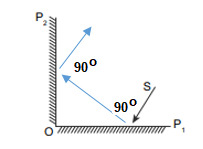
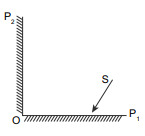
When a beam of light undergoes two successive reflections from two plane mirrors placed perpendicular to each other, the final reflected ray is always anti-parallel (i.e., opposite in direction but parallel) to the initial incident ray. This phenomenon occurs irrespective of the angle of incidence on the first mirror. Therefore, the direction of the reflected beam from mirror OP₂ will be opposite and parallel to the original direction S.
Incorrect Options:
The characteristic outcome of reflection from two plane mirrors oriented perpendicularly is that the final ray is anti-parallel to the incident ray. Options suggesting other angles are inconsistent with this principle.
-
Option 1 (Perpendicular to the direction S): This is incorrect. The final reflected ray is parallel, not perpendicular, to the initial incident ray.
-
Option 2 (At 45° to the direction S): This is incorrect. The angle between the initial incident ray and the final reflected ray from two perpendicular mirrors is 180°, meaning they are anti-parallel.
-
Option 4 (At 60° to the direction S): This is incorrect. Similar to option 2, this angle does not represent the outcome of reflection from two mirrors placed at 90 degrees to each other.