Correct Option (3)
The given equation is  , where p, q, and r are natural numbers (positive integers). We need to determine the number of distinct possible values for the sum (p + q + r).
To systematically find all solutions, we assume p ≤ q ≤ r without loss of generality. This approach covers all unique sets of {p, q, r} and their corresponding sums.
1. Determine the range for p:
- Since p, q, r are natural numbers, 1/p, 1/q, and 1/r are all positive.
- From the equation 1/p + 1/q + 1/r = 1, it must be that 1/p < 1, which implies p > 1.
- Given p ≤ q ≤ r, it follows that 1/p ≥ 1/q ≥ 1/r.
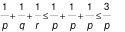
- Therefore, 1 = 1/p + 1/q + 1/r ≤ 1/p + 1/p + 1/p = 3/p.
- This inequality implies p ≤ 3.
- Combining p > 1 and p ≤ 3, the possible integer values for p are 2 and 3.
2. Case 1: p = 2
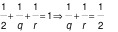
- Substitute p = 2 into the equation: 1/2 + 1/q + 1/r = 1, which simplifies to 1/q + 1/r = 1/2.
- Since q ≥ p, we have q ≥ 2.
- Also, 1/2 = 1/q + 1/r ≤ 1/q + 1/q = 2/q. This implies q ≤ 4.
- Considering q ≥ 2 and q ≤ 4, possible values for q are 2, 3, 4.
- If q = 2: 1/2 + 1/r = 1/2, which means 1/r = 0. This is not possible for a natural number r.
- If q = 3: 1/3 + 1/r = 1/2. Solving for 1/r gives 1/r = 1/2 - 1/3 = 1/6. Thus, r = 6. This solution (p, q, r) = (2, 3, 6) satisfies p ≤ q ≤ r. The sum p + q + r = 2 + 3 + 6 = 11.
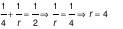
- If q = 4: 1/4 + 1/r = 1/2. Solving for 1/r gives 1/r = 1/2 - 1/4 = 1/4. Thus, r = 4. This solution (p, q, r) = (2, 4, 4) satisfies p ≤ q ≤ r. The sum p + q + r = 2 + 4 + 4 = 10.
- For any q > 4, 1/q < 1/4. Then 1/r = 1/2 - 1/q > 1/2 - 1/4 = 1/4, implying r < 4. This contradicts the condition q ≤ r (since q > 4). Therefore, no solutions exist for q > 4 when p = 2.
3. Case 2: p = 3
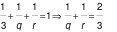
- Substitute p = 3 into the equation: 1/3 + 1/q + 1/r = 1, which simplifies to 1/q + 1/r = 2/3.
- Since q ≥ p, we have q ≥ 3.
- Also, 2/3 = 1/q + 1/r ≤ 1/q + 1/q = 2/q. This implies q ≤ 3.
- Combining q ≥ 3 and q ≤ 3, the only possible value for q is 3.
- If q = 3: 1/3 + 1/r = 2/3. Solving for 1/r gives 1/r = 2/3 - 1/3 = 1/3. Thus, r = 3. This solution (p, q, r) = (3, 3, 3) satisfies p ≤ q ≤ r. The sum p + q + r = 3 + 3 + 3 = 9.
4. Summary of valid (p, q, r) triplets (with p ≤ q ≤ r) and their sums:
- (2, 3, 6) → p + q + r = 11
- (2, 4, 4) → p + q + r = 10
- (3, 3, 3) → p + q + r = 9
The distinct possible values for (p + q + r) are 9, 10, and 11. There are 3 such distinct values.
Incorrect Options:
Options 1 (None), 2 (One), and 4 (More than three) are incorrect because the comprehensive analysis reveals exactly three distinct values for (p + q + r), namely 9, 10, and 11.