Correct Option (C)
Let the speed of the tram be V km/hr and its length be L meters. The speeds of persons X and Y are 3 km/hr and 4 km/hr, respectively, both walking in the same direction as the tram.
When a tram overtakes a person moving in the same direction, the relative speed is the difference between their speeds. The distance covered during the overtaking process is equal to the length of the tram. To ensure unit consistency, speeds in km/hr must be converted to m/s by multiplying by 5/18.
- For Person X:
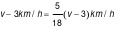
- Relative speed = (V - 3) km/hr = (V - 3) × 5/18 m/s
- Time taken = 8 seconds
- Length of tram (L) = (V - 3) × 5/18 × 8 --- (Equation 1)
- For Person Y:
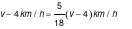
- Relative speed = (V - 4) km/hr = (V - 4) × 5/18 m/s
- Time taken = 9 seconds
- Length of tram (L) = (V - 4) × 5/18 × 9 --- (Equation 2)
Since the length of the tram is constant, we can equate Equation 1 and Equation 2:
(V - 3) × 5/18 × 8 = (V - 4) × 5/18 × 9
Dividing both sides by 5/18:
(V - 3) × 8 = (V - 4) × 9
8V - 24 = 9V - 36
Rearranging the terms to solve for V:
9V - 8V = 36 - 24
V = 12 km/hr
Now, substitute the calculated speed of the tram (V = 12 km/hr) into Equation 1 to determine the length L:
L = (12 - 3) × 5/18 × 8
L = 9 × 5/18 × 8
L = (45/18) × 8
L = 2.5 × 8
L = 20 meters
Incorrect Options:
Options A (15m), B (18m), and D (24m) are incorrect. These values do not align with the conditions provided in the problem statement. The unique length of the tram is derived from the consistent application of relative speed principles and the given time durations for overtaking both individuals. Any other length would lead to an inconsistency in the calculated speed of the tram or the time taken for overtaking.